
Cell Banking Services in Israel: A Comprehensive Guide for Biotech and Pharma R&D Teams
Expert Insight from 25+ Years in Biotech R&D: Every biological research or drug development project depends on one fundamental asset — reliable, well-characterized cells. Without a structured approach to preserving and managing that asset, years of work can be compromised by genetic drift, contamination, or simple loss of material. Cell banking provides the framework that ensures your cells remain consistent, traceable, and ready for use — from early proof-of-concept through regulatory submission.
What Are Cell Banking Services in Israel and Who Needs Them?
Cell banking services encompass the establishment, testing, documentation, and cryogenic storage of cells or cell lines. The goal is to ensure consistency, safety, and availability for R&D, preclinical, and clinical projects. In Israel, these services support a growing ecosystem of biotech startups, pharmaceutical companies, academic institutions, medical centers, and government research bodies.
The typical scope includes creation of Master Cell Banks (MCB) and Working Cell Banks (WCB), quality control tests such as identity verification, sterility, and mycoplasma screening, storage in liquid nitrogen (LN2) — usually in vapor phase — and full documentation for traceability. Whether you are developing a cell therapy, producing a recombinant protein, or running a long-term in vitro study, cell banking is the operational backbone that keeps your biological materials standardized and accessible.
What Is Cell Banking (and What Does It Mean for Your Lab)?
At its core, cell banking is the process of generating a uniform batch of cells, dividing them into cryovials, performing controlled-rate freezing, and placing them in long-term cryogenic storage. This allows you to return to the exact same cell source — at the same passage, with the same characteristics — at any stage of your project.
Why does this matter? Because cells change. Prolonged culture introduces genetic drift, phenotypic shifts, and contamination risk. A properly established cell bank mitigates all of these. It also establishes a regulatory and industrial foundation for biological production, which becomes essential as a project advances toward clinical trials or commercial manufacturing. For teams working in tissue culture, having a defined cell bank means reproducibility is built into the workflow from day one.
What Is a Master Cell Bank (MCB)?
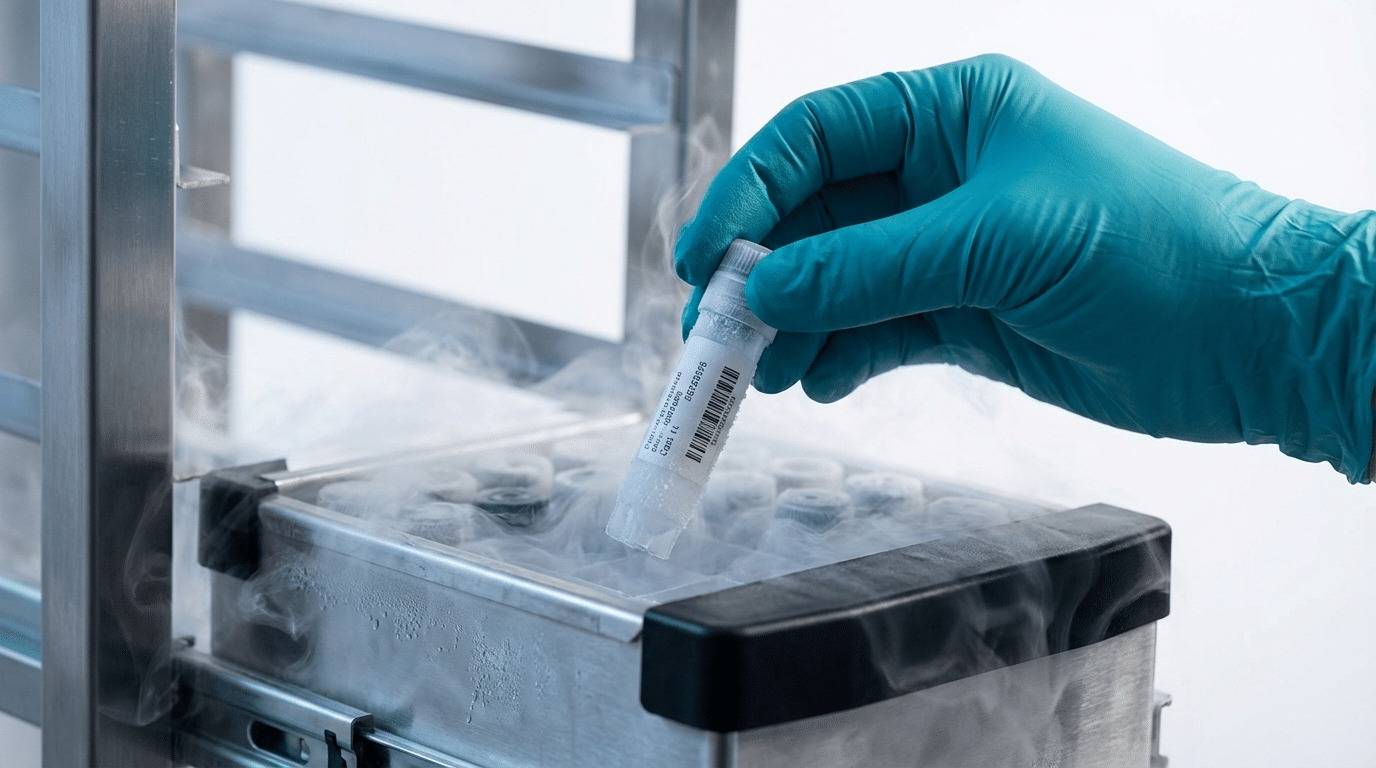
An MCB is the primary cell repository — the “true source” for the identity and quality of a cell line. All subsequent derivative banks are produced from the MCB, making it the reference point for your entire program. Establishing an MCB typically involves a more extensive set of characterization tests, meticulous documentation (including passage history and culture conditions), and generation of a sufficient number of vials to support years of use without excessive re-expansion.
When Is an MCB Mandatory, and When Can a Research Bank Suffice?
The answer depends on your project phase. For early R&D — where clones are still being screened or protocols are evolving — a Research Cell Bank (RCB) may be adequate. However, if you are preparing for an IND or IMPD submission, regulatory bodies expect an MCB/WCB system aligned with guidelines such as ICH Q5D. Establishing an MCB earlier than strictly required can save significant time and cost later, because it prevents the need to re-characterize or re-qualify your cell line when regulatory pressure increases.
✓ Pro Tip: Establishing an MCB earlier than strictly required can save significant time and cost later — it prevents the need to re-characterize or re-qualify your cell line when regulatory pressure increases.
What Is a Working Cell Bank (WCB)?
A WCB is derived from the MCB and serves as the day-to-day source of cells for routine operations — experiments, production runs, or assay development. Using a WCB protects the MCB from frequent access, which reduces the risk of depleting or contaminating the primary stock. Each WCB lot should be tested to confirm consistency with the MCB, ensuring that your results remain comparable across batches and across time. In practice, the MCB-WCB tiered system is the standard architecture for any program with regulatory ambitions.
MCB vs. WCB: Key Differences
- MCB: Primary reference source, extensive characterization, limited access
- WCB: Derived from MCB, routine operations, expendable supply
- Protection Strategy: WCB shields MCB from depletion and contamination risk
A Research Cell Bank Might Be Enough — Here Is How to Decide
An RCB is a cell bank intended for research use. It does not necessarily meet GMP standards and is suitable for early stages where protocols, clones, or formulations are still being modified. The key advantage is speed and lower cost: you freeze your cells under reasonable conditions with basic documentation, and you have a safety net to fall back on.
That said, even an RCB should not skip fundamental quality steps. Identity verification (e.g., STR profiling) and mycoplasma testing are essential regardless of the bank tier. Skipping them risks “freezing a problem” — storing contaminated or misidentified cells that will invalidate future work. Da-Ta Biotech provides cell-based assay and cell banking services that integrate these quality checks into every banking workflow, even at the research level.
⚠ Warning: Skipping identity verification and mycoplasma testing risks “freezing a problem” — storing contaminated or misidentified cells that will invalidate future work and waste significant resources.
Which Cell Types Can Be Banked — and Does It Change the Process?
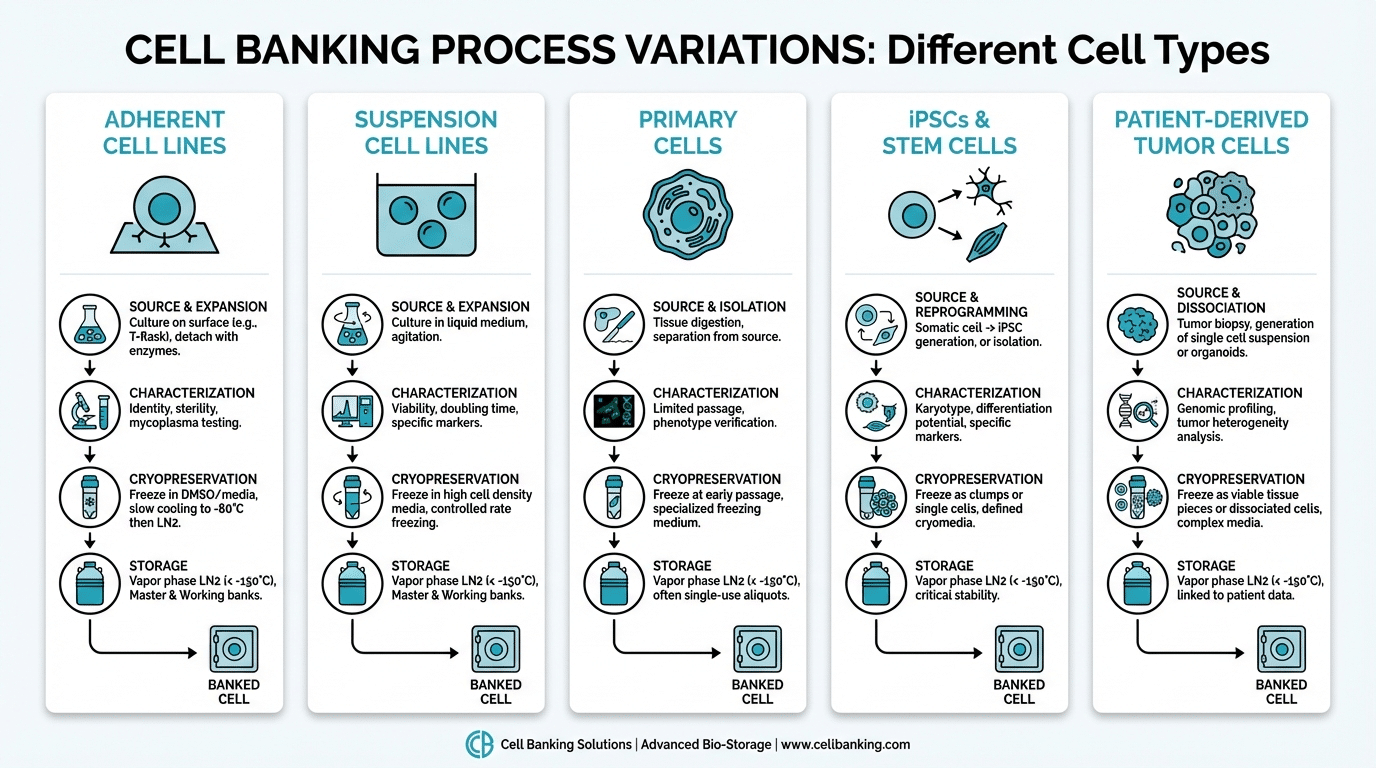
A wide range of cell types can be stored: adherent cell lines, suspension cell lines, primary cells, stem cells (including iPSCs), and even patient-derived samples. However, each type demands specific freezing and thawing conditions. The variables include cell density at harvest, cryoprotectant concentration (typically DMSO at 5–10%), freezing medium composition, cooling rate (usually −1°C/min), and viability criteria post-thaw.
Da-Ta Biotech maintains a frozen bank of dozens of both cancer and non-cancer cell lines, enabling rapid access to validated tissue culture models. Learn more about these capabilities at in vitro, ex vivo and behavioral models.
How Long Can Cells Be Stored in Liquid Nitrogen?
With proper LN2 storage — especially in vapor phase — cells can be preserved for decades. The primary risks are not time itself but temperature fluctuations, poor inventory management, inadequate documentation, or cross-contamination events. Continuous monitoring (24/7 temperature logging), automated alarms, backup nitrogen supply, and restricted physical access are what truly protect long-term cell storage integrity.
Vapor Phase vs. Liquid Phase Storage — Which Is Better?
Liquid phase storage (cells submerged in LN2 at approximately −196°C) offers slightly colder temperatures, but it introduces a significant cross-contamination risk: pathogens can survive in liquid nitrogen and transfer between vials. Vapor phase storage (−150°C to −190°C) eliminates this risk while still maintaining temperatures well below the glass transition point of water. For most cell banking applications, vapor phase is the recommended standard.
“Vapor phase storage eliminates cross-contamination risk while maintaining temperatures well below the glass transition point of water — making it the recommended standard for most cell banking applications.”
— Industry Best Practice
What Tests Are Required for Cell Bank Release?
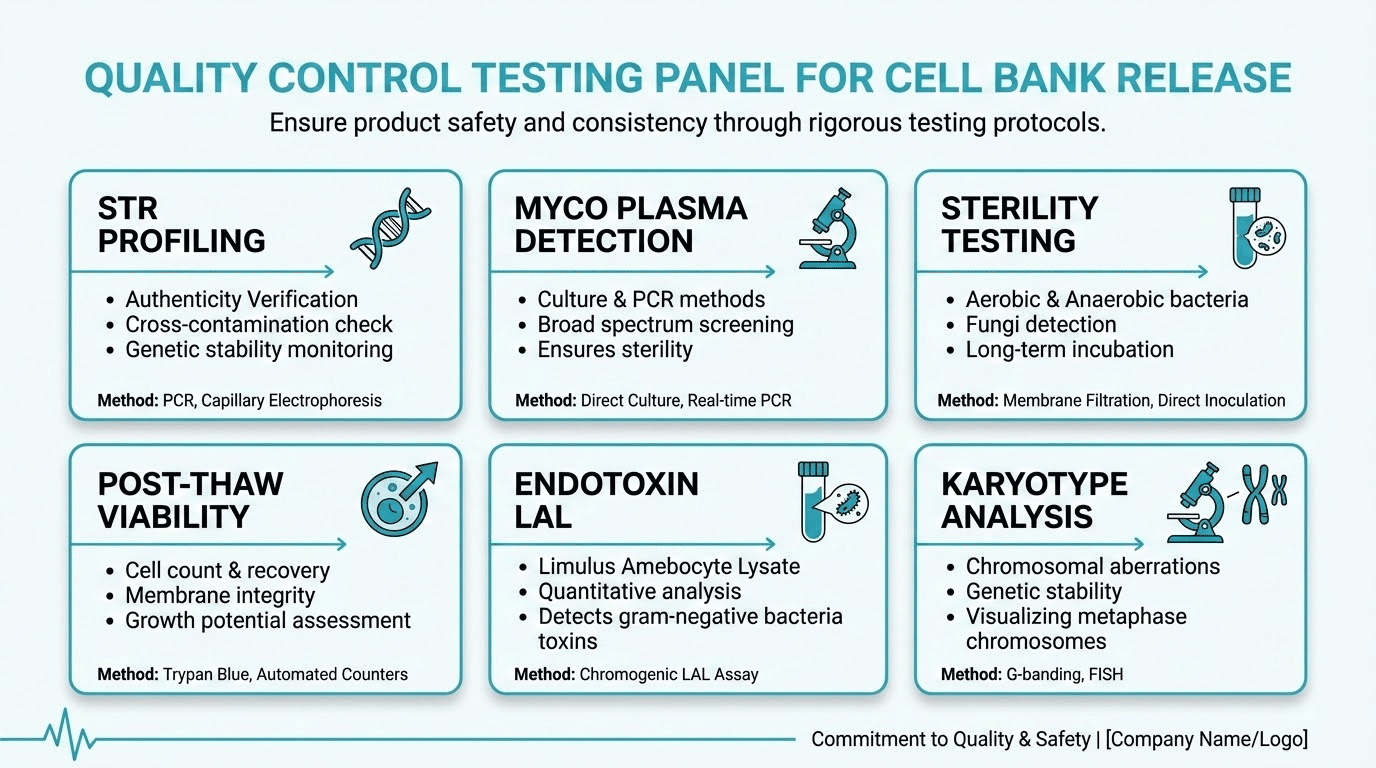
The scope of quality control testing depends on the intended use — research, preclinical, or clinical/commercial. A typical QC panel includes identity testing (STR profiling for human cell lines), mycoplasma detection, sterility testing, post-thaw viability, and in some cases endotoxin, karyotype, or adventitious virus screening.
Reference standards such as NIST cell line authentication protocols provide a framework for STR-based identity verification, which is now considered the gold standard for preventing misidentification.
GMP Cell Banking — What Does It Actually Mean for You as a Client?
GMP (Good Manufacturing Practice) in cell banking means controlled processes, comprehensive documentation, full traceability, environmental controls, and adherence to defined quality requirements. For the client, this translates into higher confidence that the bank will be accepted by regulatory authorities when the product moves into clinical trials or commercial production.
Practically, GMP cell banking involves Batch Records, Deviation/CAPA management, qualified equipment, validated methods, and clear release criteria. In Israel, pharmaceutical GMP oversight falls under the Ministry of Health’s Pharmaceutical Administration. Projects targeting European or US markets also align with EU GMP and FDA expectations. One advantage of working with an ISO 9001:2015-certified laboratory like Da-Ta Biotech is the existing quality infrastructure — documented SOPs, equipment qualification, and traceability systems — that supports the transition from research-grade to GMP-aligned workflows.
GMP Cell Banking Components
- Batch Records with full traceability
- Deviation/CAPA management systems
- Qualified equipment and validated methods
- Clear release criteria and documentation
- Environmental monitoring and controls
ICH Q5D — Why Does This Acronym Keep Appearing in Your RFP?
ICH Q5D is a guideline published by the International Council for Harmonisation that describes principles for the derivation and characterization of cell substrates used in manufacturing biological products. It is the primary regulatory reference when establishing MCB/WCB systems for products on a clinical or commercial pathway. While not every project requires strict Q5D compliance, aligning your cell banking approach with its principles early avoids costly rework later. Regulatory reviewers expect to see that you have considered passage limits, cell substrate history, and appropriate characterization — all topics covered in Q5D.
Expert Insight: While not every project requires strict Q5D compliance, aligning your cell banking approach with its principles early avoids costly rework later. Regulatory reviewers expect consideration of passage limits, cell substrate history, and appropriate characterization.
How Is a Cell Bank Actually Created? The End-to-End Workflow
The process follows a logical sequence: receipt and quarantine of incoming cells, controlled expansion to the target cell number, sampling for in-process and release QC, aliquotting into labeled cryovials, controlled-rate freezing, transfer to long-term storage, and finally, issuance of a Certificate of Analysis (CoA). Clear deliverables should be defined upfront: number of vials, volume per vial, cell concentration, post-thaw viability, and the complete quality documentation file.
Cell Bank Creation Workflow
- Step 1: Receipt and quarantine of incoming cells
- Step 2: Controlled expansion to target cell number
- Step 3: Sampling for in-process and release QC
- Step 4: Aliquotting into labeled cryovials
- Step 5: Controlled-rate freezing (−1°C/min)
- Step 6: Transfer to long-term cryogenic storage
- Step 7: Issuance of Certificate of Analysis (CoA)
Mistakes That Can Derail the Entire Process
Common pitfalls include undetected mycoplasma contamination (if testing is deferred), labeling errors that create confusion between lots, uncontrolled freezing rates (e.g., placing vials directly into a −80°C freezer without a controlled-rate step), and non-standardized thawing procedures that reduce viability. Each of these is preventable with validated protocols and attention to detail — areas where experienced CRO partners add significant value.
⚠ Common Pitfalls to Avoid: Undetected mycoplasma contamination, labeling errors between lots, uncontrolled freezing rates, and non-standardized thawing procedures. Each is preventable with validated protocols.
Shipping Cryopreserved Cells — Dry Shippers, Customs, and Chain of Custody
Moving frozen cells between sites or countries requires proper cryogenic packaging, continuous temperature monitoring, chain of custody documentation, and logistical coordination. The standard method uses a dry shipper — a container where liquid nitrogen is absorbed into the walls, so there is no free liquid (a key requirement for air transport under FAA and IATA regulations). Labeling must comply with dangerous goods rules, and transit times should be minimized. Contingency planning for customs delays or logistical disruptions is essential — a stuck shipment at ambient temperature can destroy an entire cell bank.
What Drives the Cost of Cell Banking in Israel?
Cell banking costs are determined by several variables: the type of bank (RCB vs. MCB vs. WCB), the number of vials produced, the scope and complexity of QC testing, the quality standard applied (research vs. GMP), and the duration and conditions of ongoing storage. It is advisable to break costs into components — setup and expansion, QC testing, documentation, monthly or annual storage fees, and retrieval or shipping charges — so you can compare proposals accurately.
Preparing an RFQ That Gets You an Accurate Quote
To receive a meaningful proposal, include the following in your request:
- Cell type and passage number
- Intended use (research/preclinical/clinical)
- Desired number of vials
- Required QC tests
- Documentation expectations (CoA, batch records)
- Timeline constraints and shipping/regulatory requirements
The more specific you are, the more accurate the quote — and the fewer surprises downstream.
Choosing a Cell Banking Provider Without Risking Your Samples
Selection should be based on process quality, storage security, documentation transparency, QC capabilities, and operational responsiveness — not price alone. Key criteria include 24/7 temperature monitoring with automated alerts, backup power and nitrogen supply, restricted access controls, a full audit trail, defined emergency procedures, and a clear SLA for vial retrieval and return.
Da-Ta Biotech, operating from the Science Park in Rehovot under ISO 9001:2015, provides the monitoring infrastructure, experienced R&D team, and documentation rigor that cell banking demands — functioning as a true β-site for R&D rather than just a storage facility.
Provider Selection Checklist
- 24/7 temperature monitoring with automated alerts
- Backup power and nitrogen supply systems
- Restricted access controls and security
- Full audit trail and documentation
- Defined emergency procedures
- Clear SLA for vial retrieval and return
Why You Should Never Store Cells Without Authenticating Them First
Storing cells without identity verification or purity testing can “freeze a problem” for years. When you eventually thaw those vials for a critical experiment or regulatory submission, discovering that the cells are misidentified, cross-contaminated, or mycoplasma-positive means wasted time, money, and potentially invalidated data. Integrating cell line services — STR profiling before banking, mycoplasma testing before expansion, stability testing after thaw — ensures that your biological asset is genuinely usable when you need it.
Tissue Culture Support as an Extension of Cell Banking
Tissue culture support is the operational wrapper around cell banking: expansions, routine maintenance, passage management, freezing, and even cell rescue when cultures behave unexpectedly. For small teams, for projects with heavy experimental demands, or when standardization across batches is critical, outsourcing tissue culture operations to an experienced laboratory frees your scientists to focus on the science itself.
Da-Ta Biotech’s tissue culture capabilities — including custom cell culture preparations, isolation of cellular fractions, and production of cellular products — integrate directly with their cell banking workflows, creating a seamless pipeline from cell receipt to banked, characterized, ready-to-use material.
Frequently Asked Questions
Ready to Establish Your Cell Bank?
What is the current status of your cell line — and are you confident it will perform the same way six months or two years from now? Whether you need a research-grade bank for early screening or a fully documented MCB/WCB system for regulatory submission, Da-Ta Biotech’s experienced R&D team is here to help you build a reliable cell banking foundation.