Drug Candidate Screening Services: A Complete Guide to Compound Screening, Lead Identification, and Candidate Evaluation
Written by Dr. Rinat Borenshtain-Koreh, PhD, DVM — CEO, Da-Ta Biotech LTD
With over 25 years of hands-on experience in Biotech and Biomed R&D — spanning biological model development, in-vitro assays, in-vivo experiments, and FDA application support — Da-Ta Biotech delivers drug candidate screening services that convert compound libraries into ranked, actionable leads. Our ISO 9001:2015-certified workflows and integrated ADME/DMPK profiling give research teams the scientific confidence needed to make faster, more defensible go/no-go decisions.
Selecting the right molecule from thousands of compounds is one of the most consequential decisions in drug discovery. Drug candidate screening services provide the structured, data-driven framework that transforms a broad compound library into a shortlist of viable candidates — ranked by activity, selectivity, ADME properties, and initial safety profiles. Da-Ta Biotech delivers these services through a combination of biochemical and cell-based assays, early ADME/DMPK profiling, and rigorous quality controls, enabling research teams to reach faster and more confident decisions.
🔬 Expert Insight
The single most costly mistake in drug discovery is advancing a compound that should have been eliminated in early screening. Integrating ADME profiling and rigorous counterscreens at the hit-to-lead stage — rather than deferring them to preclinical studies — consistently reduces downstream attrition, conserves resources, and produces leads with a realistic path to clinical development. This is not an optional enhancement; it is the foundation of a scientifically sound pipeline strategy.
What Are Drug Candidate Screening Services and Who Needs Them?
Drug candidate screening services encompass a critical set of tests designed to rank and filter compounds so that only the most promising molecules advance toward further development. The process typically begins with compound screening across validated assay platforms — biochemical or cell-based — and progresses through hit confirmation, selectivity profiling, and early developability assessment. The objective is straightforward: reduce risk and resource waste by eliminating poor performers early.
These services are designed for pharmaceutical companies seeking to populate their pipelines, biotech startups that need external laboratory capacity, academic researchers translating discoveries into translatable leads, and contract research organizations managing multi-client portfolios. Whether you are screening ten compounds or ten thousand, the core question remains the same — which molecule deserves your next investment?
Pharma Companies
Populate and de-risk drug discovery pipelines with externally validated compound data before committing major internal resources.
Biotech Startups
Access expert laboratory capacity without the overhead of building in-house screening infrastructure from scratch.
Academic Researchers
Translate laboratory discoveries into translatable leads with the rigorous validation standards required for industrial and clinical partners.
How Does the Drug Candidate Screening Workflow Operate from End to End?
The workflow follows a structured funnel. It begins with target definition and model selection, where the biological target is characterized and the most appropriate assay platform is chosen. From there, the process moves through several filtering stages, each narrowing the pool of candidates based on increasingly stringent criteria.
Each stage acts as a gate. Compounds that fail to meet predefined criteria are deprioritized, ensuring that resources are concentrated on molecules with genuine potential for lead compound identification.
What Is the Difference Between a Hit, a Lead, and a Drug Candidate?
Hit
Any compound producing a measurable signal of activity in a screening assay. A starting point — not a conclusion.
Lead
A hit that survived validation rounds and initial optimization, demonstrating improved potency, selectivity, and early developability.
Drug Candidate
A lead rigorously evaluated across efficacy, safety, and pharmacokinetics — deemed ready for preclinical and clinical development.
Four Types of Compound Screening — and How to Choose the Right One
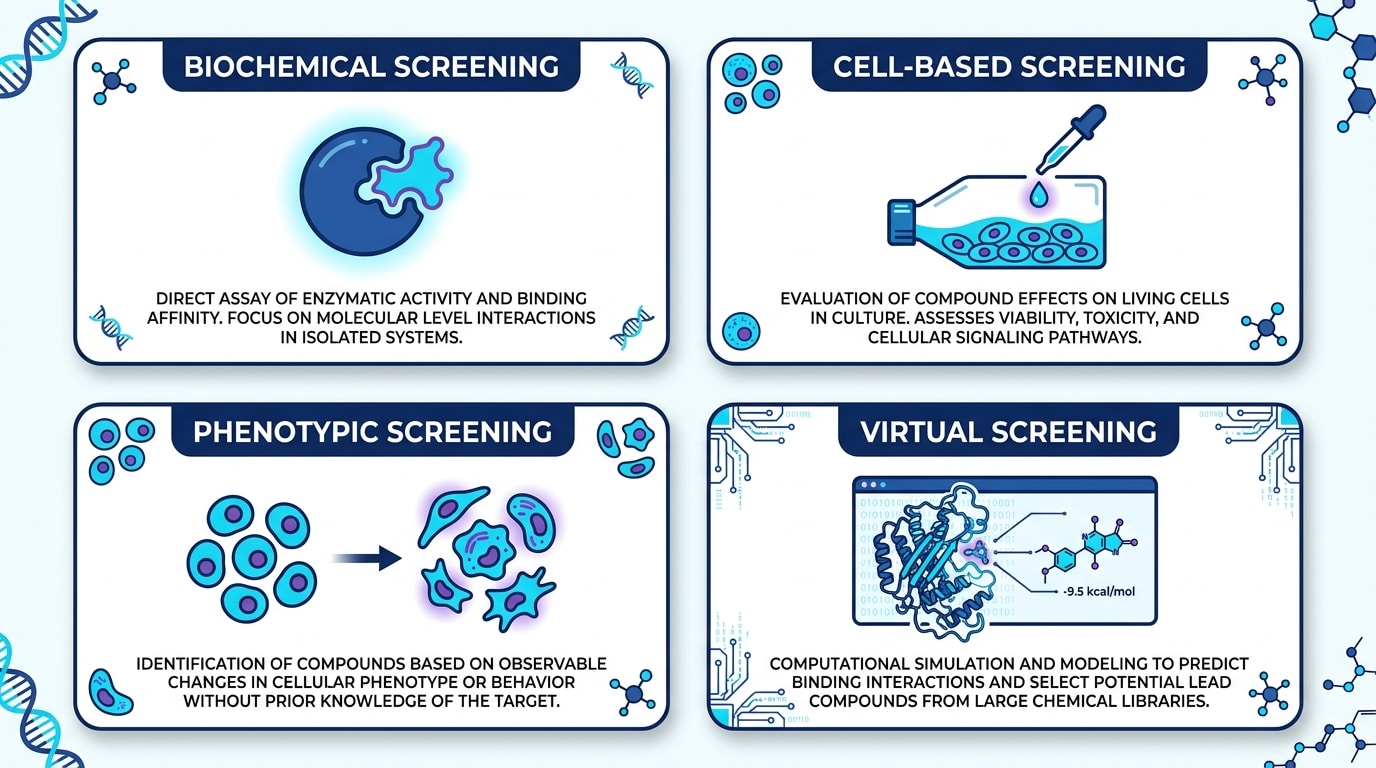
The choice of screening method depends on the target biology, the type of molecule under investigation, and the specific decision point in development. No single approach suits every program. Here is how the main methods compare:
🔬 Biochemical Screening
Measures direct interactions between compound and target — enzyme inhibition, receptor binding, or PPI disruption. Fast and quantitative; best for well-characterized targets.
🧬 Cell-Based Screening
Places the compound in a biologically relevant context, capturing downstream signaling, cellular uptake, and cytotoxicity simultaneously. Ideal for measuring cellular and biochemical function.
🔭 Phenotypic Screening
Valuable when the exact MOA is unknown. Evaluates compound effects on complex biological phenotypes — morphology, proliferation, or differentiation — rather than a single molecular event.
💻 Virtual (In Silico) Screening
A complementary approach that narrows down large compound libraries computationally before experimental testing. Research from Tel Aviv University has demonstrated how in silico high-throughput screens can identify potential selective inhibitors — reducing the library size that must be tested experimentally and dramatically lowering early-stage costs.
Beyond Potency: What Does Drug Candidate Evaluation Actually Include?
Potency alone does not make a drug. Robust drug candidate evaluation extends into multiple critical dimensions that determine whether a compound can realistically progress through the drug development pipeline.
- Selectivity: Does the compound hit the right target and not others?
- Mechanism of Action: How does the compound produce its effect?
- Stability: Does it survive in biological matrices long enough to act?
- Solubility & Permeability: Can it reach its site of action?
- Metabolic Interactions: Will it interfere with other drugs (DDI risk)?
- Early Toxicity Signals: Is it safe enough to continue investment?
Comprehensive profiling is what converts raw screening data into clear, defensible go/no-go decisions. Da-Ta Biotech’s drug candidate evaluation services include robust early toxicological evaluation services to assess safety profiles before committing to costly in vivo studies.
“A molecule may be highly potent in a cell-based assay but metabolically unstable, poorly permeable, or extensively protein-bound — rendering it ineffective in vivo. The evaluation framework must account for all of these variables simultaneously.”
— Dr. Rinat Borenshtain-Koreh, PhD, DVM, CEO, Da-Ta Biotech LTD
What Common Metrics Appear in Screening Reports?
Clients can expect reports that include clear, contextualized data across these dimensions:
- IC50/EC50 values — quantitative potency measures
- Selectivity windows — ratio of on-target vs. off-target activity
- Cytotoxicity flags — early indication of cell damage at relevant concentrations
- Stability & permeability indicators — metabolic half-life, apparent permeability coefficients
- Clear recommendations for next steps — not just data, but scientific direction
When Should You Integrate ADME Screening Into Candidate Selection?
The short answer: earlier than most teams think. Integrating in vitro ADME during the hit-to-lead and lead optimization stages prevents the costly mistake of advancing compounds with poor developability profiles.
✅ Why Early ADME Integration Works
- Prevents advancement of potent-but-undevelopable compounds
- Enables parallel decision-making instead of sequential surprises
- Cost-effective compared to discovering failures in expensive in vivo studies
- Ethically preferable — reduces unnecessary animal experiments
- Aligns with published best practices in high-throughput ADME screening
Which In Vitro ADME/DMPK Assays Are Most Critical?
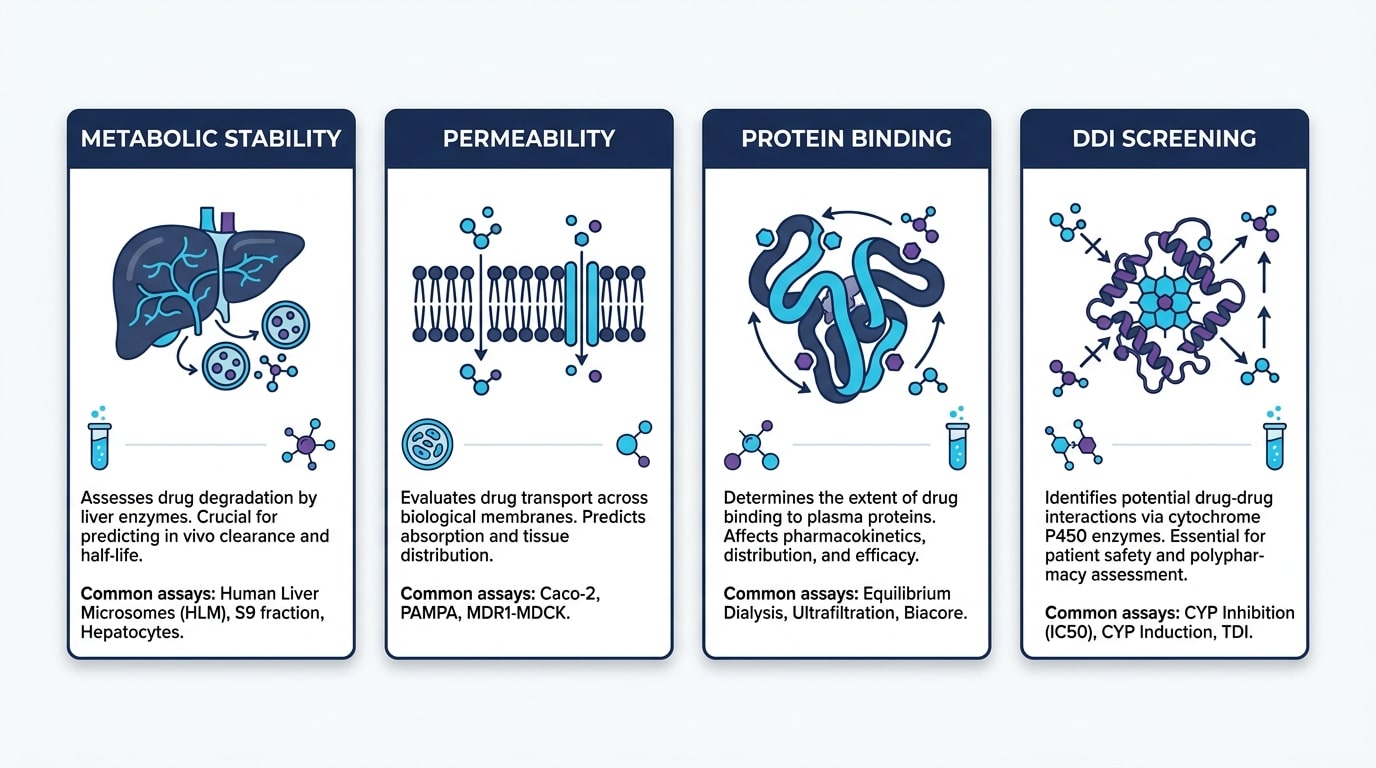
Four categories of in vitro assays form the backbone of drug candidate screening services at the ADME level. Each addresses a distinct developability concern:
Metabolic Stability
Using liver microsomes or hepatocytes to reveal how quickly the body breaks down a compound. Critical for predicting in vivo half-life and dosing frequency.
Permeability
Caco-2 or PAMPA assays predict absorption across biological membranes. Compounds with poor permeability rarely achieve therapeutic concentrations at target sites.
Protein Binding
Determines how much compound circulates freely versus bound to plasma proteins. Highly bound compounds may require higher doses to achieve free therapeutic concentrations.
⚠️ Drug-Drug Interaction (DDI) Screening — A Regulatory Priority
DDI studies evaluate CYP450 inhibition and induction potential — a requirement with significant regulatory weight. The FDA’s ICH M12 guidance and FDA guidance for in vitro metabolism- and transporter-mediated DDI studies outline specific expectations. Addressing these requirements early avoids costly regulatory delays downstream.
How to Prioritize Assays When Screening Many Compounds?
A tiered approach conserves resources while ensuring no critical liability is missed:
TIER 1 — Full Set
Fast, low-cost assays: solubility, microsomal stability, single-point permeability. Applied to all compounds.
TIER 2 — Passing Compounds
Full dose-response curves, hepatocyte stability, CYP inhibition panels for compounds passing Tier 1.
TIER 3 — Finalists
PK predictions and preliminary toxicity profiling integrated for remaining lead candidates before final selection.
How Da-Ta Biotech Ensures Reliable Lead Compound Identification
Reliable lead identification is not about finding one positive result. It requires repeated validation through biological replicates, full dose-response characterization, counterscreens to exclude assay artifacts, and stringent quality controls at every stage.
Methodology Highlight
Scoring Framework Integration
Da-Ta Biotech employs a multi-dimensional scoring framework that balances activity data against potential liabilities — solubility, metabolic stability, cytotoxicity — to produce a ranked candidate list reflecting real-world developability rather than single-assay performance.
Quality Assurance
Z’-Factor & Statistical Validation
Every campaign is designed with defined acceptance criteria, positive and negative controls, statistical thresholds, and Z’-factor evaluation on every plate — ensuring that lead compound identification data is robust, reproducible, and defensible.
“Published research on QC metrics for high-throughput screening underscores the importance of validated statistical tools for distinguishing genuine hits from noise. Delivering interpretation alongside data — not just raw numbers — is what transforms a screening vendor into a scientific partner.”
— Dr. Rinat Borenshtain-Koreh, PhD, DVM
This integrated approach is supported by Da-Ta Biotech’s depth of experience in biological laboratory solutions. Every project begins with clear scientific alignment and ends with ranked, actionable candidates — not ambiguous data that requires a second interpretation layer.
Compound Screening vs. Drug Screening: A Terminology Clarification That Matters
📌 Important Clarification for Research Teams
In drug discovery, compound screening refers to the systematic testing of chemical compounds for therapeutic potential. The term drug screening, however, carries ambiguity — it is also used in workplace or forensic contexts to mean testing for illicit substance use. For clarity: Da-Ta Biotech’s drug screening services are exclusively focused on pharmaceutical R&D — identifying, validating, and profiling compounds as potential therapeutics. Clear language in project documentation helps avoid confusion and ensures alignment between scientific teams and service partners.
Realistic Timelines: How Long Does a Screening Project Take?
Timelines vary depending on project complexity. Straightforward campaigns using established assays and modest compound sets may complete within one to two weeks. Complex engagements with de novo assay development, large libraries, and comprehensive ADME profiling extend further.
Da-Ta Biotech’s ISO 9001:2015-certified workflows are structured to provide transparent timelines at project initiation, with milestones communicated throughout — allowing research teams to plan downstream activities without guesswork.
What Deliverables Should You Expect from a Screening Partner?
A screening project should deliver more than a spreadsheet of numbers. Comprehensive deliverables from Da-Ta Biotech include:
- Raw data for independent verification by client teams
- Normalized analysis accounting for plate effects and controls
- QC reports demonstrating assay performance via Z’-factor and CV metrics
- Interpretive commentary explaining what the data means in scientific context
- Candidate ranking integrating potency, selectivity, and developability scores
- Recommendations for next experiments — specific, scientifically justified next steps
What Should Reports Include for Rapid Advancement?
For teams moving quickly toward investor presentations or IND-enabling studies, reports should clearly state the screening criteria applied, flag any identified outliers or anomalies, explain control performance, and propose specific hit-to-lead pathways. This level of detail enables informed decision-making without requiring clients to repeat analytical work internally.
A Practical Checklist: How to Choose a Drug Candidate Screening Provider
Not all service providers are equivalent. The following criteria guide selection toward a laboratory capable of delivering reliable, interpretable results:
🔎 Provider Selection Methodology — Da-Ta Biotech Standard
- Relevant Experience: Demonstrated expertise with similar biological models, targets, or therapeutic areas. Request case studies or representative data before committing.
- Assay Breadth: Capacity for both biochemical and cell-based screening, plus custom assay development for novel targets. Da-Ta Biotech provides comprehensive R&D services across a wide array of formats.
- Integrated ADME/DMPK: ADME profiling built into the screening workflow — not a separate outsourced step that creates timeline gaps and communication barriers.
- QC & Reproducibility Standards: Defined acceptance criteria, outlier handling protocols, and laboratory certification (e.g., ISO 9001:2015).
- Scientific Interpretation: The provider delivers interpretation and recommendations — not just raw data. A vendor delivers numbers; a scientific partner delivers understanding.
Defining Key Terms: Compound Screening and Lead Compound Identification
What Is Compound Screening?
Compound screening is the systematic process of testing a library of chemical compounds against a biological target or phenotype to identify active “hits.” Those hits are then validated and progressed to leads through iterative confirmation and optimization. It is vital in the biotechnology industry for identifying novel therapeutic agents efficiently and with scientific rigor.
What Is Lead Compound Identification?
Lead compound identification is the process of selecting and refining hit compounds that meet predefined criteria for advancement. The lead must demonstrate improved potency, better selectivity, acceptable initial ADME properties, reduced toxicity, and favorable physicochemical characteristics that support formulation and delivery.
“The lead must demonstrate a balanced profile across several dimensions — not just the best IC50 on the list. This is what separates rigorous drug discovery from wishful thinking.”
— Dr. Rinat Borenshtain-Koreh, PhD, DVM, CEO, Da-Ta Biotech LTD
Frequently Asked Questions
Ready to Move Your Compound Library Forward?
Come to us with your scientific challenge. Da-Ta Biotech’s team is here to help you design the right screening strategy, generate reliable data, and identify leads worth advancing.