Cancer Research Services in Israel: A Comprehensive Guide for Biotech and Pharma Companies
From 25+ Years of Oncology Research Experience: Israel’s dense ecosystem of biotech startups, academic medical centers, and specialized CROs has transformed the country into a global hub for anti-cancer drug development. For companies seeking validated in vitro assays and pre-clinical data, partnering with an ISO 9001:2015-certified laboratory like Da-Ta Biotech eliminates months of lab setup and delivers decision-grade results within weeks.
Introduction to Cancer Research Services in Israel
Israel has become a recognized hub for oncology innovation, with a dense ecosystem of biotech startups, academic medical centers, and specialized contract research organizations (CROs). For companies developing anti-cancer therapeutics, the ability to access validated in vitro assays and pre-clinical data quickly is a decisive competitive advantage. Cancer research services in Israel bridge the gap between early-stage discovery and the critical go/no-go decisions that shape a drug development program.
Da-Ta Biotech, an ISO 9001:2015-certified biological research laboratory located at the Science Park in Rehovot, provides cell-based assay services that support biotech and pharma companies throughout the R&D pipeline. From proof-of-concept experiments to data packages prepared for investor presentations, the company serves as a β-site for R&D — a scientific partner, not merely a vendor. The focus is practical: generate reliable, reproducible data that moves your project forward.
What Do Cancer Research Services in Israel Include for Biotech and Pharma Companies?
Cancer research services typically encompass the design, development, and execution of pre-clinical assays — primarily in vitro — along with anti-cancer drug screening, mechanism of action (MOA) validation, and the generation of decision-grade data. Common project types include viability and cytotoxicity measurements, apoptosis quantification, proliferation kinetics, migration and wound healing assays, EC50/IC50 determination, and expression or signaling pathway analyses.
The business value is straightforward. Rather than investing months and significant capital into building internal capabilities, companies can commission a focused study, receive a clear deliverable, and make an informed decision on whether to advance, optimize, or abandon a candidate. Pairing efficacy data with early toxicological evaluation services further reduces risk before more expensive stages such as animal studies or clinical trials.
Why Choose a Cancer CRO in Israel Instead of Building an In-House Lab?

Building a cell culture laboratory from scratch requires procurement of equipment, validation of standard operating procedures (SOPs), quality control (QC) setup, and hiring and training of personnel. For an early-stage company — seed through Series A — this can consume six to twelve months and a substantial portion of the available budget before even generating a single data point.
A cancer CRO eliminates that ramp-up period. Experiments can begin within days of finalizing a protocol. Operational costs shift from fixed to variable, and the company can scale up or scale down according to project load. Da-Ta Biotech’s infrastructure, including experienced R&D experts and well-established protocols, is available immediately. This model is particularly useful when a company needs to respond quickly to scientific advisory board feedback or investor due diligence requests.
Case Study: Accelerated Timeline for Series A Biotech
A Tel Aviv-based biotech company approached Da-Ta Biotech with an urgent need: their investors required EC50 data across three cancer cell lines within six weeks to proceed with a Series A funding round. By leveraging our established protocols and validated cell culture infrastructure, we delivered comprehensive dose-response data in just four weeks — enabling the company to secure their funding on schedule.
How to Select the Right Cancer CRO in Israel for Your Oncology Project?
Selecting a CRO based solely on price is one of the most frequent — and costly — mistakes in outsourced oncology research. The more reliable approach is to evaluate scientific alignment with your specific model, the CRO’s demonstrated reproducibility, transparency in deliverables, and a clearly documented quality assurance (QA) process. Ask to see example reports, understand how deviations are handled, and confirm whether the lab can work according to your SOP or whether a joint adaptation is needed.
Requesting a small pilot project before committing to a full study is strongly recommended. A pilot reveals practical issues — growth rate discrepancies, reagent compatibility, acceptance criteria thresholds — that are far cheaper to resolve early. Learning more about the scientific team and operational background of a CRO is essential; for example, Da-Ta Biotech expertise spans cell biology, biochemistry, and molecular biology, providing a broad foundation for diverse oncology assay types.
What to Ask During an Introductory Call
- What positive and negative controls does the lab run by default?
- How are acceptance criteria defined — and what happens when they are not met?
- What exactly will you receive: formatted study report, raw data files, executed protocol, statistical analysis?
- How does the lab handle deviations and unexpected results?
- Can you provide references from similar oncology projects?
Anti-Cancer Drug Screening: What It Means and What You Should Expect
Anti-cancer drug screening is a structured set of experiments designed to measure the efficacy and toxicity of compounds under controlled conditions. The goal is to rank drug candidates, identify therapeutic windows, and generate evidence that informs the next stage of drug development — whether that is lead optimization, formulation work, or a presentation to a regulatory consultant.
Typical deliverables include dose-response curves, EC50/IC50 values, condition-by-condition comparisons, heatmaps for multi-compound panels, and a go/no-go summary. These outputs are directly usable in investor decks and scientific advisory board meetings. When screening is coupled with safety profiling through early toxicological evaluation services, the resulting data package provides a more complete picture of a candidate’s potential.
Expert Insight: From my 25+ years in biotech R&D, I’ve observed that the most successful drug screening campaigns are those that define clear acceptance criteria upfront. A compound that shows 50% viability reduction at 10 μM with a CV below 15% across triplicates provides far more actionable data than a compound showing 80% reduction with high variability. Reproducibility drives decisions.
In Vitro Oncology Assays: Types, Advantages, and Demand

In vitro oncology assays are tests performed in cell cultures — and sometimes in advanced systems such as 3D spheroids — that measure the effect of compounds or biologics on cancer cells. Categories include viability and cytotoxicity, apoptosis, proliferation, signaling pathway activation, migration, and receptor-level analyses. Their main advantages are speed, relatively low cost compared to animal models, and precise control over experimental parameters.
For researchers and companies looking to understand robust assay design principles, the NIH/NCATS Assay Guidance Workshop provides a solid foundation covering cell-based assay development, high-content screening, and data analysis. Da-Ta Biotech employs validated, robust protocols across these assay categories, which means clients benefit from established workflows rather than experimental improvisation.
Endpoints That Drive Decisions
The most decision-relevant endpoints in oncology screening include EC50/IC50 values (half-maximal effective or inhibitory concentration), percentage of apoptotic cells, quantified changes in protein or pathway expression (e.g., via Western blot or ELISA), and wound closure rate in migration assays. Each endpoint answers a specific question about your molecule: Does it kill cancer cells? Through what mechanism? At what concentration? How selectively?
Distinguishing Cytotoxicity, Viability, and Apoptosis Assays
These three assay types are frequently confused, yet each measures something fundamentally different. Viability assays quantify how many cells remain metabolically active after treatment. Cytotoxicity assays measure cell damage or death, often by detecting membrane integrity loss or the release of intracellular enzymes. Apoptosis assays determine whether cell death occurs through a programmed pathway — as opposed to necrosis or general toxicity.
Understanding this distinction is critical for characterizing a compound’s mechanism of action. A molecule that reduces viability through apoptosis suggests a targeted, potentially therapeutic effect. One that simply causes necrosis may indicate non-specific toxicity. Combining these assays in a multiplex format improves the reliability of go/no-go decisions and provides a richer dataset for regulatory and investor discussions.
How EC50/IC50 Values Are Determined — and Why They Matter
EC50 (half-maximal effective concentration) and IC50 (half-maximal inhibitory concentration) are calculated from dose-response curves generated by exposing cells to a range of compound concentrations. The resulting sigmoidal curve is fitted to a mathematical model, and the midpoint indicates the concentration at which 50% of the maximal effect is observed. These values enable direct comparison of drug potency across candidates, conditions, and cell lines.
To generate reliable EC50/IC50 data, several parameters must be defined in advance: the concentration range (typically spanning at least two log orders above and below the expected value), the number of replicates per concentration (minimum triplicate), exposure duration, and appropriate positive and negative controls. Running the assay across at least two to three cell lines relevant to the therapeutic indication strengthens the dataset and reduces the risk of cell-line-specific artifacts.
Methodology: Da-Ta Biotech’s EC50/IC50 Protocol
Our standard EC50/IC50 determination protocol includes:
- 8-point concentration series (half-log dilutions)
- Triplicate wells per concentration
- Positive control (reference compound with known IC50)
- Vehicle control (DMSO at final concentration)
- 4-parameter logistic curve fitting with R² reporting
Running Cancer Research Projects According to Your Specific SOPs
Many biotech and pharma companies have internal SOPs developed over years of research. When outsourcing to a CRO, a common concern is whether the external lab can faithfully execute these protocols — or whether the data will be incomparable to historical results. The answer, in most cases, is yes: client SOPs can be adopted directly or adapted jointly, provided that acceptance criteria are clearly defined and any modifications are documented.
A short run-in phase is recommended to confirm that the SOP performs as expected within the CRO’s specific infrastructure (equipment calibration, reagent lots, cell passage numbers). This is especially important when regulatory submissions are anticipated. The ICH M10 guideline on bioanalytical method validation provides a useful framework for defining what constitutes a validated method and how to document compliance.
Cell Lines vs. Primary Cells: Choosing the Right Cancer Cell Model
Established cell lines — such as MCF-7, A549, HeLa, or HCT-116 — offer high reproducibility, easy availability, and well-characterized genetic backgrounds. They are the standard choice for rapid screening campaigns where throughput and consistency are priorities. Primary cells, isolated directly from patient or animal tissue, provide a closer approximation of in vivo biology but come with higher costs, donor-to-donor variability, limited passage numbers, and more complex culture requirements.
The practical approach for many projects is to begin with cell lines during the discovery and lead optimization phase, then validate key findings with primary cells or more complex models (such as patient-derived organoids) as the program matures.
Criteria for Selecting the Right Cell Lines
Genetic Match
Does the cell line express the relevant mutation, receptor, or pathway targeted by your compound?
Expected Sensitivity
A line with the target pathway constitutively active will yield more informative mechanistic data.
Practical Factors
Availability from repositories, growth rate, passage stability, and mycoplasma-free status.
What Turnaround Time Should You Expect for Oncology Assays in Israel?
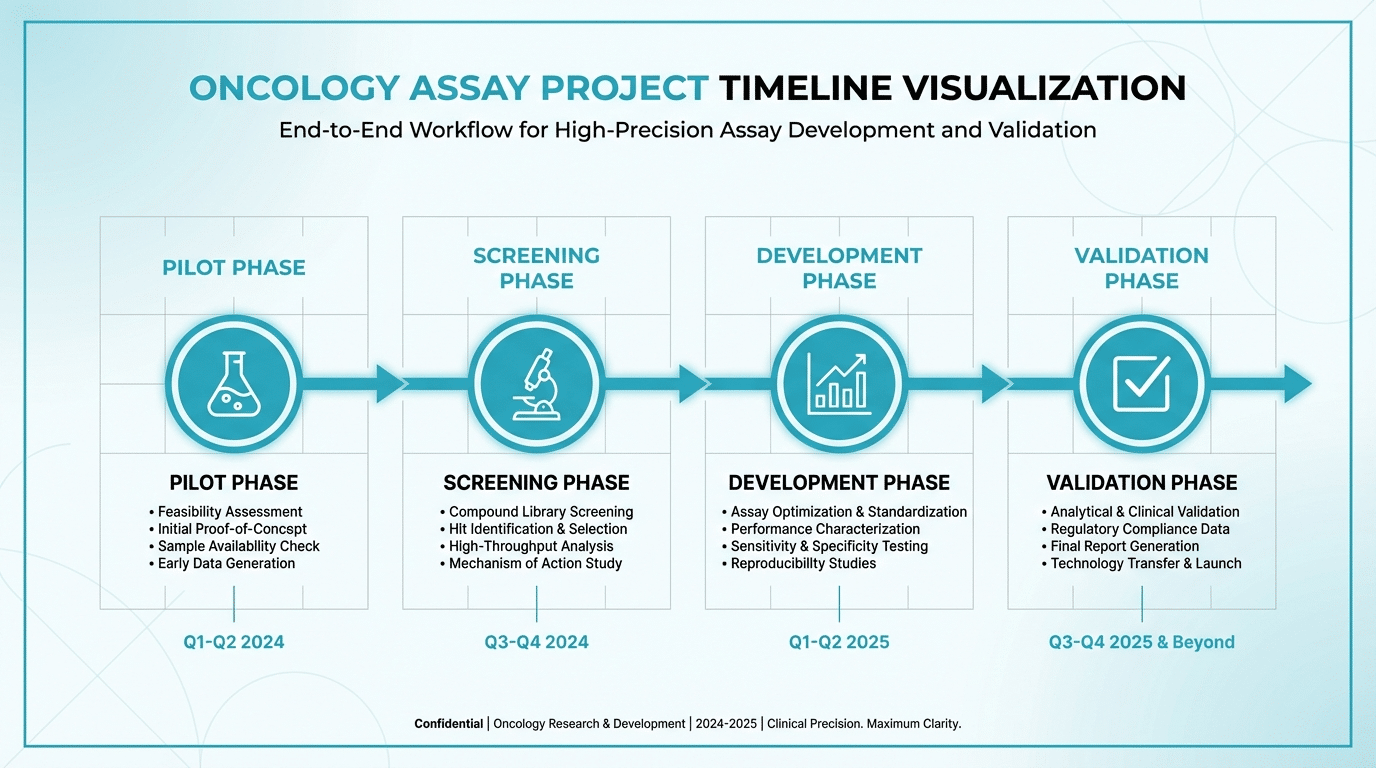
Project timelines depend on several variables. A straightforward pilot — for example, a single cell line, one compound at six concentrations in triplicate — can often be completed within two to four weeks. A more complex study involving new assay development, optimization, multiple cell lines, and dozens of compounds may require two to four months. Automation and high-throughput screening (HTS) capabilities can significantly shorten timelines when large compound libraries are involved.
Factors that commonly extend timelines include procurement of specialized reagents or cell lines, the need for protocol optimization, and QC-driven repeats. A multi-center study published on PubMed demonstrated that experimental, computational, and biological variables all contribute to variability in drug-response assays — underscoring the importance of allocating adequate time for robust, reproducible results rather than rushing to a deadline.
Cost Factors: What Influences the Price of Cancer Research Services?
The cost of cancer research services is primarily driven by assay complexity, the number of compounds and concentrations tested, the number of cell lines, replicates per condition, the depth of analysis, and the format of final documentation. A simple viability screen with a single readout costs significantly less than a multi-endpoint study with Western blot validation, statistical modeling, and a fully formatted study report.
Common hidden costs that catch companies off guard include QC-driven repeat experiments, preparation of compound stocks from raw material, additional controls requested mid-study, data reformatting, and advanced statistical analysis. The most effective way to manage your project budget is to define the work in phases: a pilot to confirm feasibility, an expanded screen based on pilot results, and a validation phase to confirm key findings. This staged approach reduces financial risk and generates decision points before committing additional resources.
⚠️ Common Budget Pitfall: Requesting “just one more cell line” or “a few additional concentrations” mid-study can increase costs by 30-50% and extend timelines by weeks. Define your experimental matrix completely before starting — or explicitly budget for scope expansion.
Deliverables from a Cancer CRO: What Should You Receive?
Quality CRO deliverables go beyond a simple email with attached graphs. A professional project should yield a structured study report, raw data in an agreed-upon format (typically spreadsheet files), annotated graphs and tables, a complete protocol description including any deviations, and a concise data interpretation section that guides your next decision. It is also important to define upfront the file naming convention, version control, and whether intermediate data (such as plate reader outputs) will be included.
Recommended Deliverables for a Screening Project
- Executive Summary — One to two pages highlighting key findings and recommendations
- Detailed Experimental Procedures — Cell lines, reagents, concentrations, timing
- Raw and Analyzed Data — Tabular and graphical formats
- Statistical Analysis Section — Methods and significance thresholds stated
- Conclusion Section — Findings mapped to original project objectives
- Deviation Log — If any deviations occurred during the study
A Common Mistake: Overlooking Reproducibility Until It Is Too Late
One of the most damaging mistakes in outsourced oncology research is treating reproducibility as an afterthought. Data that cannot be reproduced — whether internally or by a regulatory reviewer — undermines months of work and erodes investor confidence. Da-Ta Biotech addresses this through strict SOPs, regular calibration of all critical equipment, documented personnel training, and internal quality assurance processes that apply even to non-regulated studies.
Adherence to Good Laboratory Practice (GLP) principles for data integrity, traceability, and documentation ensures that results are defensible. Regular internal audits identify procedural drift before it affects data quality. When you partner with a CRO that provides comprehensive R&D Services, these quality systems are already in place — you benefit from institutional rigor without building it yourself.
“In 25 years of oncology R&D, I’ve seen promising drug candidates fail not because of biology, but because the supporting data couldn’t withstand scrutiny. Reproducibility isn’t a luxury — it’s the foundation of every successful development program.”
— Dr. Rinat Borenshtain-Koreh, CEO, Da-Ta Biotech
Regulatory and Ethical Landscape for Oncology Research in Israel
Oncology research in Israel operates within a well-defined regulatory framework. Clinical trials involving human subjects require approval from a Helsinki Committee, as mandated by the Israeli Ministry of Health. Animal studies are governed by the Animal Experimentation Law (1994) and overseen by the Council for Animal Experimentation. The standard progression — in vitro studies, then animal models, then human trials — ensures that compounds are evaluated responsibly at each stage.
For in vitro oncology work specifically, the regulatory burden is lighter than for clinical studies, but best practices still apply. Proper documentation, validated methods, and transparent reporting are expected by investors, regulatory consultants, and downstream partners. Da-Ta Biotech ensures compliance with all relevant Israeli regulations for in vitro research, providing clients with data packages that meet the standards expected at each development milestone.
How Da-Ta Biotech Addresses Common Oncology R&D Challenges
Frequently Asked Questions
Ready to Advance Your Oncology Program?
What scientific challenge is your compound facing right now — and what data would change the trajectory of your project? Whether you need a focused pilot screen, a multi-endpoint validation study, or a comprehensive data package for your next investor meeting, Da-Ta Biotech is here for you. Come to us with your oncology research question, and let our experienced R&D team help translate it into actionable results.
✓ Your Next Step: Contact Da-Ta Biotech for a complimentary scientific consultation. We’ll review your project objectives, recommend the optimal assay strategy, and provide a detailed timeline and budget estimate — typically within 48 hours of your initial inquiry.