Lentivirus Production Services in Israel: A Comprehensive Guide to Gene Delivery and Vector Engineering
From 25+ Years of Biotech R&D Experience: Lentiviral vectors have transformed gene delivery research — but the difference between a failed experiment and publication-ready data often comes down to one decision: choosing the right production partner. After supporting hundreds of lentivirus projects across academic and industry clients, I can tell you that local expertise, rigorous QC, and scientific partnership matter far more than the lowest price quote.
🔬 Exclusive Insight: Most researchers underestimate how much functional titer degrades during international shipping. A batch that tests at 10⁸ TU/mL at the source facility may arrive at your lab closer to 10⁶ — a 100-fold drop that turns a straightforward experiment into weeks of troubleshooting. Local Israeli production eliminates this variable entirely.
What Do Comprehensive Lentivirus Production Services Actually Include?
Lentiviral vectors have become one of the most powerful tools in modern biomedical research. Their ability to stably integrate transgenes into both dividing and non-dividing cells makes them indispensable for gene delivery across a wide range of applications — from basic research and functional genomics to pre-clinical gene therapy studies.
When researchers evaluate lentivirus production services Israel providers offer, it is important to understand the full scope of what a comprehensive service entails. A complete production workflow typically covers:
- Vector design consultation — strategic guidance on promoters, reporters, and regulatory elements
- Plasmid preparation — construction, amplification, and sequence verification
- Large-scale viral particle manufacturing in HEK293T cells
- Concentration and purification via ultracentrifugation or TFF
- Titration and rigorous quality control testing
Da-Ta Biotech, located at the Science Park in Rehovot, provides advanced lentivirus production services Israel researchers and companies rely on for both research-grade and pre-clinical applications. Working with a local Israeli provider means faster turnaround, direct face-to-face communication with experienced R&D scientists, seamless logistics with cold-chain integrity, and a thorough understanding of the local regulatory landscape.
Tailored Vector Engineering and Plasmid Preparation
Vector engineering is where much of the strategic value lies. Optimizing the promoter, reporter genes, and regulatory elements within the transfer vector allows researchers to achieve precisely the expression profile they need in their target cell type. Whether the goal is constitutive expression driven by CMV or EF1α, cell-type-specific expression, or inducible systems — thoughtful vector design is the foundation of successful gene delivery.
How Does the Lentivirus Production Process Work, Step-by-Step?
Understanding the manufacturing workflow helps researchers plan timelines and set expectations. The process begins with a project initiation consultation — a detailed discussion of the target cell type, desired titer, intended application (in vitro vs. in vivo), and any specific requirements for the vector or envelope. This is not a simple order form; it is a scientific conversation that shapes the entire project.
Core Manufacturing Stages
- Stage 1: Large-scale transient transfection of HEK293T producer cells
- Stage 2: Viral supernatant harvest at 48 and 72 hours post-transfection
- Stage 3: Concentration and purification (ultracentrifugation or TFF)
- Stage 4: Aliquoting into ready-to-use volumes
- Stage 5: Comprehensive QC testing and documentation
What Materials Are Needed to Initiate Lentivirus Production Services?
To begin a project, clients typically provide:
- Gene sequence or vector map
- Details on transfer and packaging plasmids
- Desired promoter and envelope pseudotype preference
- Target cell type and intended application
What Is the Typical Turnaround Time for Lentivirus Production?
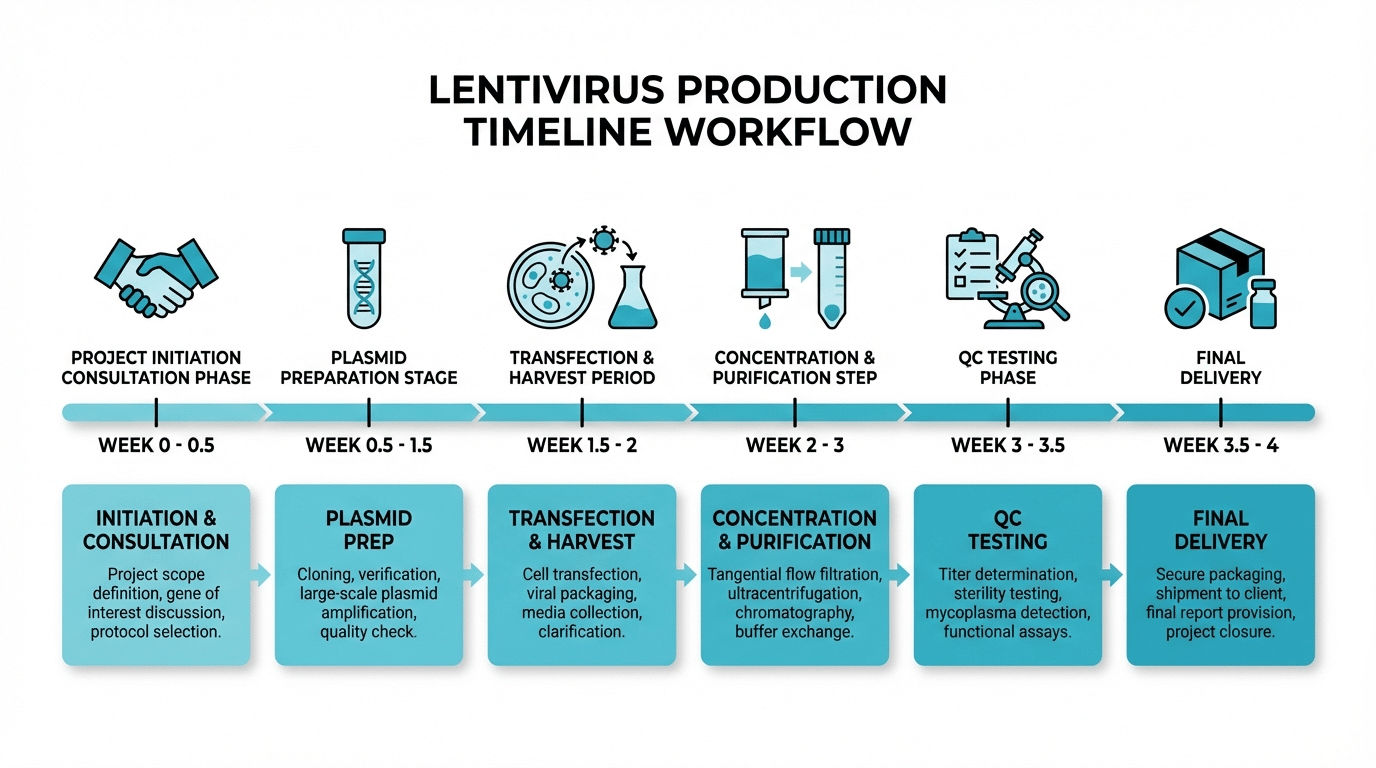
For standard research-grade lentivirus production projects where plasmids are available and requirements are well-defined, a typical turnaround time ranges from two to four weeks from project initiation to delivery.
✓ Projects Move Faster When:
- • Plasmids are ready-to-use
- • QC requirements are standard
- • Experimental goals are clearly defined
⚠ Timelines Extend When:
- • Large or toxic transgene inserts require optimization
- • Non-standard pseudotypes needed
- • In vivo-grade QC testing required
As documented in a State Comptroller report on laboratory testing logistics, factors such as process complexity, sample handling, and multi-step quality verification directly influence turnaround in any laboratory service environment.
When Is a Titer of 10⁶ TU/mL Enough — and When Do You Need 10⁸ or Higher?
There is no single “correct” titer for all applications. The titer required for successful gene delivery depends entirely on the experimental context — specifically the target cell type, the desired multiplicity of infection (MOI), and the total number of cells to be transduced.
Key Insight: MOI refers to the ratio of infectious viral particles to target cells. A higher MOI generally increases the percentage of transduced cells but may also affect cell viability. For easily transducible cell lines such as HEK293 or HeLa, titers of 10⁶ TU/mL may suffice. Primary cells, stem cells, and non-dividing cells often require 10⁸ TU/mL or higher.
Functional Titer vs. Physical Titer — A Common Source of Confusion
Functional titer measures the number of infectious viral particles capable of transducing target cells and driving transgene expression. Physical titer, measured by qPCR or p24 ELISA, quantifies total viral particles regardless of whether they are infectious.
⚠ Critical Warning: When ordering lentivirus production services, always clarify which titer assay will be used and ensure that functional titer data is included. Physical titer alone is insufficient for planning transduction experiments.
What Essential QC Tests Should You Demand for Lentivirus Production Services Israel?
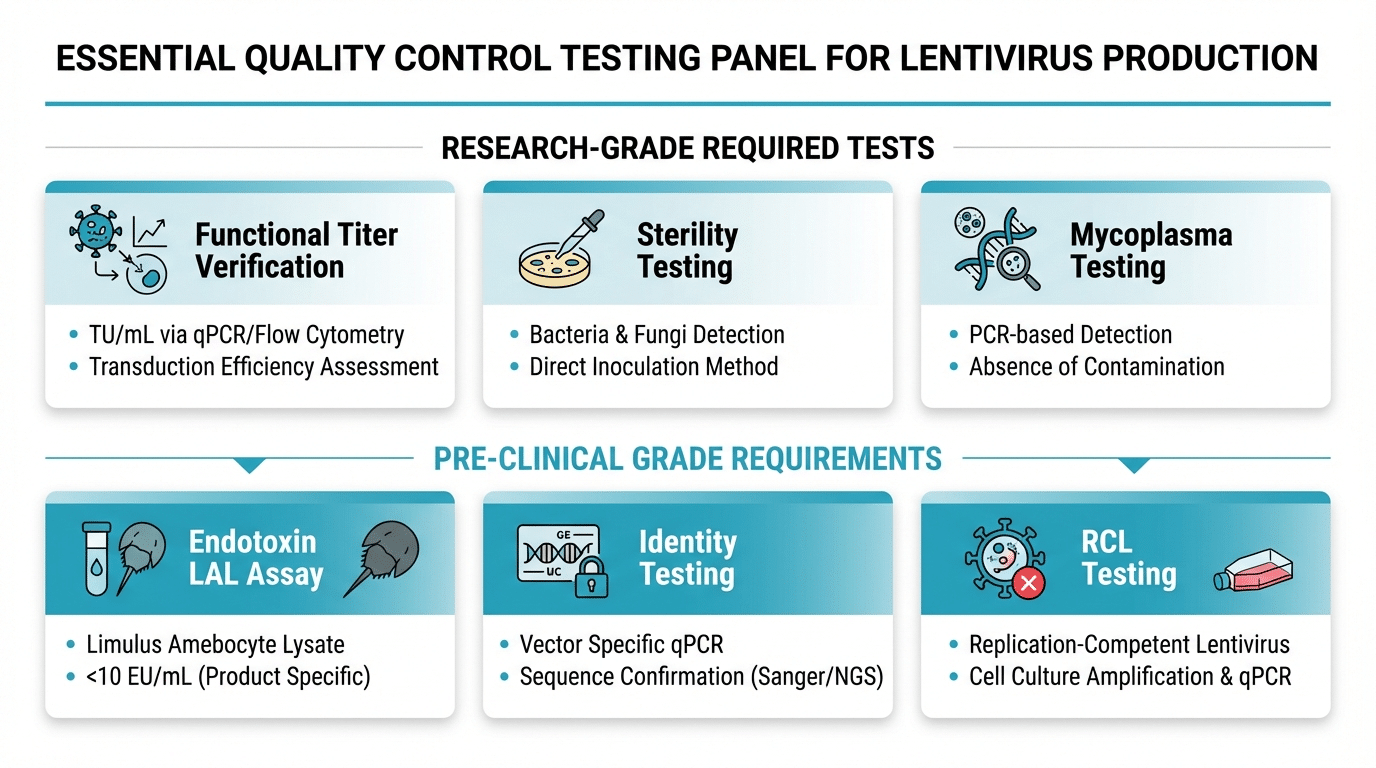
Quality control is not optional — it is the backbone of reliable, reproducible research. For research-grade lentivirus production, the minimum QC panel should include functional titer verification, sterility testing, and mycoplasma testing.
Recommended QC Panel Based on Application
Israeli laboratory quality standards, as outlined by the Ministry of Health’s quality assurance framework, emphasize robust quality management systems — principles that Da-Ta Biotech applies within its own ISO 9001:2015 certified operations.
How Does Vector Engineering Improve Gene Delivery Outcomes?
Vector engineering refers to the deliberate modification of lentiviral vector components to enhance performance, safety, and specificity. This requires deep molecular biology expertise and practical experience with diverse constructs and cell systems.
🧬 Promoter Optimization
CMV provides strong, broad expression. EF1α and PGK offer more consistent expression across cell types. Cell-type-specific promoters restrict expression to desired tissues.
🎯 Envelope Pseudotyping
Standard VSV-G provides broad tropism and high stability. Alternative envelopes can redirect tropism to specific cell types for targeted gene delivery strategies.
🛡️ Safety Features
Self-inactivating (SIN) LTR designs minimize the risk of insertional mutagenesis and recombination, improving the biological safety profile.
Biosafety Considerations for Working with Lentiviruses in Israel
Lentiviral vectors derived from HIV-1 are classified as requiring Biosafety Level 2 enhanced (BL2+) containment. According to the Weizmann Institute Safety Unit guidelines, work with lentiviral vectors must be performed in appropriate containment.
⚠ Key Safety Requirements
- • Work in a Class II biological safety cabinet
- • Use appropriate PPE (lab coat, gloves, eye protection)
- • Use safety-sealed centrifuge rotors
- • Follow institutional biosafety protocols for spill management
Israeli regulations governing work with biological agents — including occupational safety requirements detailed by the Israeli Occupational Safety and Health organization — provide the broader regulatory framework within which lentivirus production and handling must operate.
A Scenario: Your Lentivirus Batch Failed to Transduce Primary Neurons — What Went Wrong?
This is a common scenario that highlights why choosing the right production partner matters. A researcher receives a lentiviral batch, applies it to primary cortical neurons at the recommended MOI, and sees minimal or no transgene expression after 72 hours.
🔍 Systematic Troubleshooting Checklist
- Titer calculation: Was MOI based on functional or physical titer?
- Storage conditions: Were aliquots stored at −80°C and thawed correctly?
- Transduction enhancers: Was polybrene used?
- Promoter activity: Is the promoter active in post-mitotic neurons?
This kind of troubleshooting is where having a scientific partner — rather than a faceless production facility — provides tangible value. Da-Ta Biotech’s experienced R&D team walks clients through these variables and helps identify the root cause, often before a single additional experiment is needed.
— Dr. Rinat Borenshtain-Koreh, CEO, Da-Ta Biotech
Comparing 2nd and 3rd Generation Lentiviral Systems — Which Should You Use?
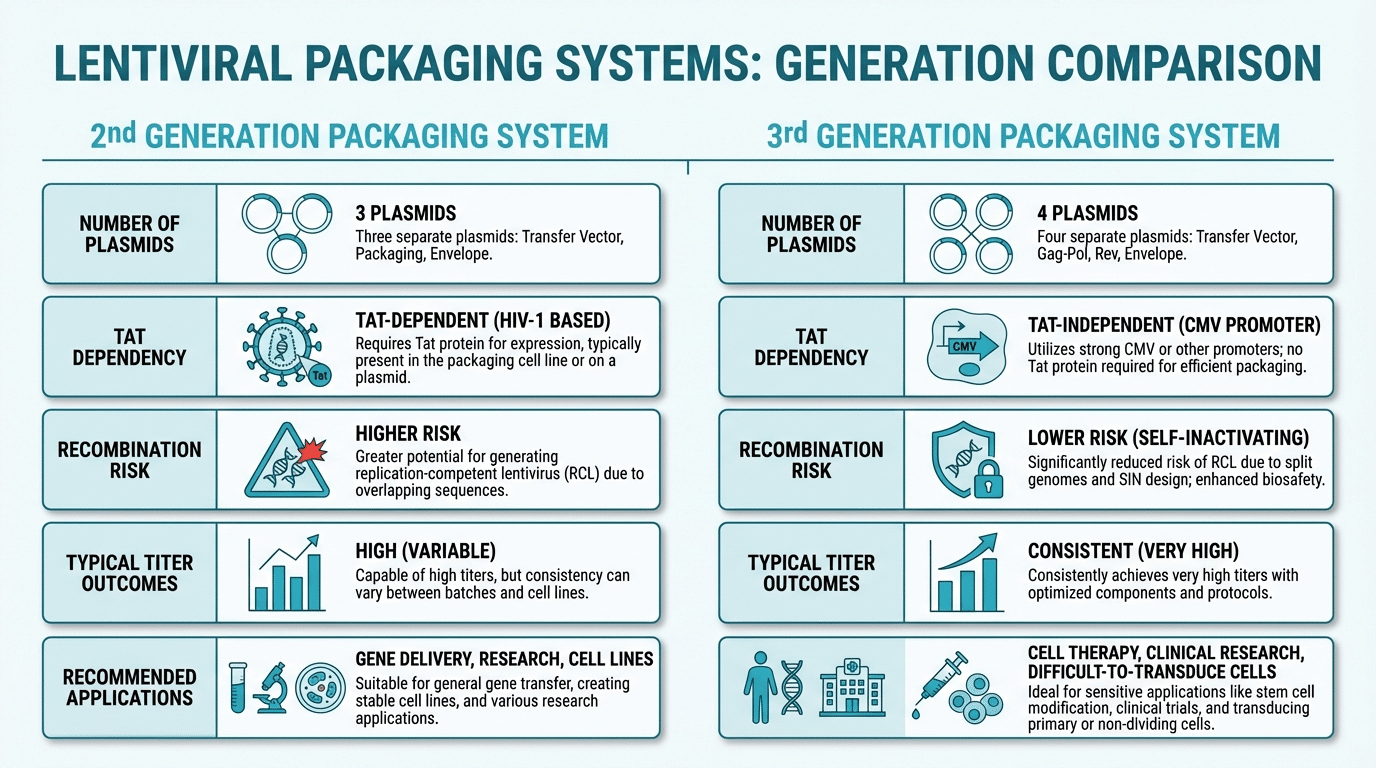
The choice between 2nd and 3rd generation lentiviral packaging systems is primarily a safety decision, though it has practical production implications as well.
For most in vitro research applications, 2nd generation systems offer robust titers with a simpler production workflow. For any application approaching in vivo use or where biosafety is a primary concern, the 3rd generation system is the appropriate choice. Da-Ta Biotech supports both systems and advises clients based on their specific requirements.
Why Researchers Across Israel Choose Da-Ta Biotech for Lentivirus Production
Choosing a lentivirus production partner is a decision that affects data quality, project timelines, and ultimately research outcomes. Several factors make Da-Ta Biotech a practical choice for researchers and biotech companies operating in Israel.
📍 Local Presence in Rehovot
Shipments arrive within hours rather than days, eliminating transit risks and customs delays associated with international shipping of temperature-sensitive biological materials.
🔬 Direct Scientist Communication
Direct communication with experienced R&D scientists — not sales representatives — ensures that project design decisions are scientifically sound from the outset.
✅ ISO 9001:2015 Certified
Validated protocols, documented procedures, and systematic quality management ensure batch-to-batch consistency and data reliability.
⚙️ Full Customization
Ability to customize every aspect — from vector design through purification grade to QC panel selection — providing the flexibility complex research projects demand.
Frequently Asked Questions About Lentivirus Production Services
Ready to Move Your Gene Delivery Project Forward?
Whether you are designing a new lentiviral construct from scratch, scaling up an existing vector for an in vivo study, or troubleshooting a transduction challenge that has stalled your research — the right scientific partner makes the difference between spinning wheels and generating data.
What does your next experiment require? Come to Da-Ta Biotech with your scientific challenge.
WE ARE HERE FOR YOU.