
Viscosity Testing Services in Israel: A Practical Guide to Accurate Measurement and Reliable Results
With over 25 years of biotech R&D expertise, our laboratory team has characterized thousands of formulations — from pharmaceutical gels to industrial coatings. This guide shares the precise methodology and critical insights that separate actionable viscosity data from numbers that lead to costly production failures.
🔬 Exclusive Laboratory Insight
Over 60% of viscosity testing requests we receive lack critical information — temperature range, shear rate requirements, or clear testing objectives. This single oversight adds days to turnaround time and increases costs by 20-40%. The methodology outlined below eliminates these delays entirely.
Your Formulation Behaves Differently on the Production Line — Could Viscosity Be the Missing Data Point?
Every material that flows — whether it is a pharmaceutical gel, a cosmetic emulsion, a coating, or a food product — possesses a measurable resistance to that flow. That resistance is viscosity, and understanding it under the right conditions can mean the difference between a product that performs as intended and one that fails during filling, pumping, or application. Viscosity testing services provide the controlled laboratory environment, validated instruments, and scientific expertise needed to generate data you can actually use.
At Da-Ta Biotech, viscosity measurement is offered as part of a broader suite of physical characterization services. Operating under ISO 9001:2015 quality management and staffed by experienced R&D scientists, the lab provides not just numbers but interpretation — connecting your viscosity data to real-world formulation behavior. Whether your goal is quality control, regulatory submission, or early-stage R&D screening, defining the right test conditions from the start is what turns a measurement into a decision-making tool.
How Is Viscosity Actually Measured in a Laboratory?
At its core, viscosity measurement quantifies how much force is needed to make a fluid flow at a given rate. In the lab, an instrument applies a controlled shear stress or shear rate to a sample and records the response. Temperature is tightly regulated — often to ±0.1 °C — because even small fluctuations can shift results significantly. The two primary instrument categories are viscometers and rheometers, and the distinction matters for the type of data you receive.
Viscometer vs. Rheometer: Which One Fits Your Project?
A viscometer — such as a rotational (Brookfield-type) or capillary viscometer — typically provides a single-point or limited-range viscosity value. This is often sufficient for routine quality control on Newtonian fluids or for batch-release testing against a specification. It is fast, well-established, and cost-effective when the question is simply “does this batch match the previous one?”
A rheometer, on the other hand, generates a complete rheological profile: flow curves, yield stress, thixotropy, and viscoelastic properties. For non-Newtonian materials — gels, suspensions, emulsions — a rheometer reveals how the material will actually behave during processing and end use. Calibration of rheometers relies on certified reference fluids; NIST has published guidance on reference materials for both Newtonian and non-Newtonian measurement validation, underscoring the importance of traceable, well-calibrated instrumentation.
Dynamic Viscosity vs. Kinematic Viscosity — When Each One Applies
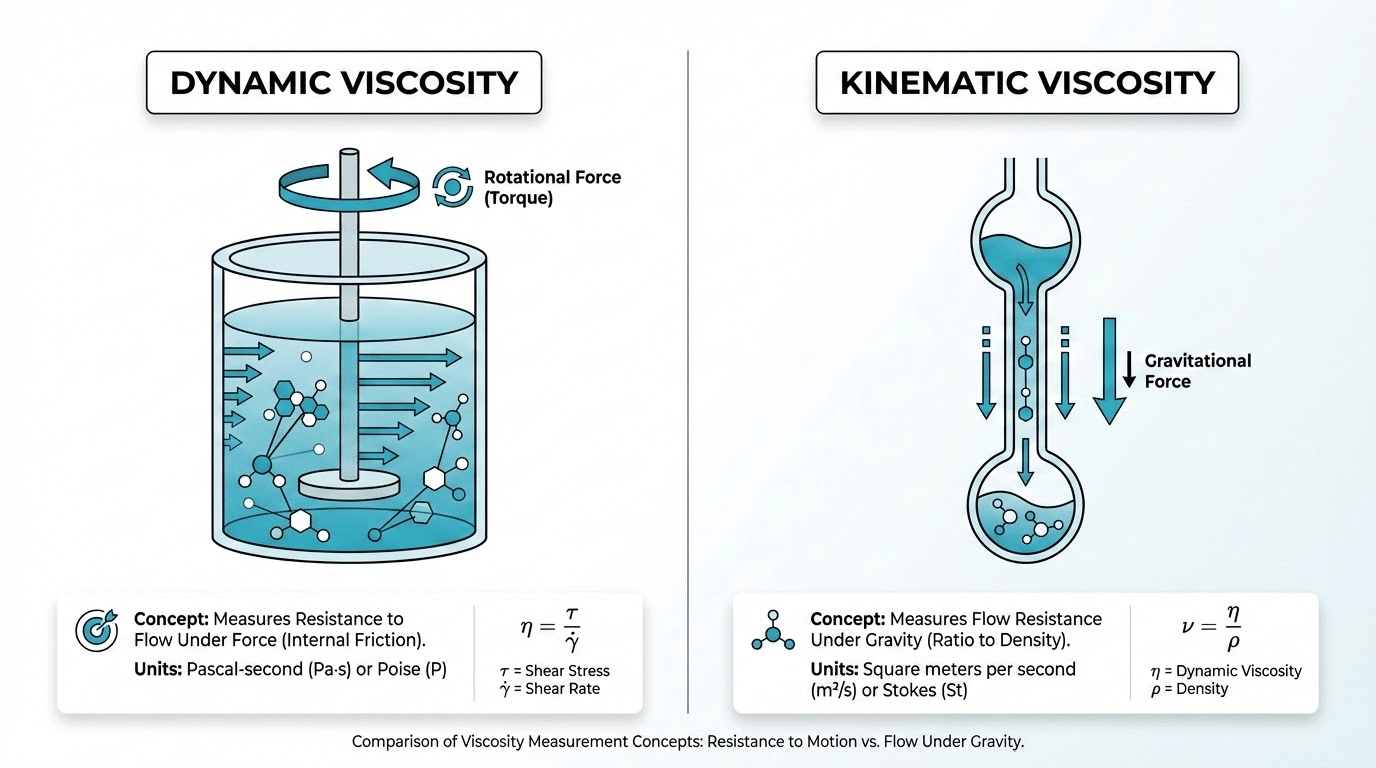
Dynamic viscosity (symbol η, units Pa·s or mPa·s) describes a fluid’s internal resistance to flow independent of density. It is the parameter most commonly reported for pharmaceutical, cosmetic, food, and coating formulations, where the question is “how thick does this feel or behave under a given force?”
Kinematic viscosity (symbol ν, units mm²/s or cSt) equals dynamic viscosity divided by the fluid’s density. It is the standard metric in the petroleum, lubricant, and hydraulic-fluid industries. The ISO 3104:2023 standard defines the capillary-viscometer method for determining kinematic viscosity and calculating the corresponding dynamic viscosity. The parallel ASTM D445 standard follows a similar capillary-flow principle and notes explicitly that the method is designed primarily for Newtonian fluids.
Choosing which parameter to report is not arbitrary. It depends on regulatory expectations, industry convention, and whether your material is Newtonian or not. A well-equipped viscosity testing lab will advise which measurement type — and which standard — aligns with your end-use requirements.
What Makes “Apparent Viscosity” So Easy to Misinterpret?
For a Newtonian fluid like water or a simple oil, viscosity is a fixed property at a given temperature. Measure it at any shear rate and you get the same number. Non-Newtonian materials — which include most real-world formulations — do not behave this way. Their viscosity changes with the applied shear rate, measurement geometry, and even the duration of shearing.
The IUPAC Gold Book defines apparent viscosity as the ratio of shear stress to shear rate calculated as though the fluid were Newtonian. If the fluid is actually non-Newtonian, the value depends on the type and dimensions of the instrument. This means that quoting a single “viscosity” number for a shear-thinning cream without specifying the shear rate and geometry is scientifically incomplete and can lead to failed comparisons between batches or labs.
⚠️ Critical Warning
Always define — and document — the exact conditions under which apparent viscosity was measured. When you work with a testing partner that understands this distinction, you avoid costly misinterpretation that can derail entire production batches.
A Common Mistake: Sending a Sample Without a Clear Testing Objective
One of the most frequent issues that delays results and inflates costs is an underspecified test request. “Please measure the viscosity” is not enough information when your sample is a non-Newtonian emulsion that might be evaluated at body temperature, ambient temperature, or the temperature inside a filling machine. Clear communication between client and lab is the foundation of useful data.
Essential details to provide include:
- Testing objective (QC release, formulation screening, stability comparison)
- Relevant temperature or temperature range
- Expected or required shear rate range
- Sample type and any known sensitivities (evaporation, air sensitivity, shear history)
- Available sample quantity
When Da-Ta Biotech receives a well-defined brief, the team can propose the optimal method and geometry, provide an accurate quote, and deliver results that directly answer the formulation question.
What a Well-Written Brief Looks Like
📋 Example Test Request Brief
“We need a flow curve for our topical emulsion at 25 °C and 32 °C, shear rate range 0.1–1000 s⁻¹, three replicates. Goal: compare viscosity profile of current batch against reference batch for scale-up assessment. Sample volume available: 50 mL.”
With this level of detail, the lab can confirm suitability of instrumentation, estimate turnaround, and quote precisely — no back-and-forth delays.
Sample Quantity: How Much Material Do You Actually Need?

Sample requirements vary with the measurement technique and the number of conditions tested. A rheometer with a cone-and-plate geometry might need as little as 0.5–2 mL per measurement. A rotational viscometer with a concentric-cylinder setup may require 10–20 mL. Capillary viscometers for kinematic viscosity call for enough fluid to fill the instrument reservoir, typically 5–15 mL.
If your protocol includes multiple temperatures, replicate measurements for statistical confidence, or method development for a new material, the total volume increases accordingly. During early-stage R&D — when material is scarce — a lab experienced in small-volume techniques can often adapt geometries to work with limited samples. This flexibility is one of the practical advantages Da-Ta Biotech offers to biotech and pharma clients developing novel formulations where every milliliter counts.
Turnaround Time: What Determines How Quickly You Get Results?
Standard viscosity measurements on a well-defined sample with an established method can often be completed within a few business days. Factors that extend the timeline include:
- Need for method development or optimization
- Testing across a broad temperature or shear-rate matrix
- Large numbers of samples or batches in a single submission
- Current workload of the laboratory
For time-critical quality control — such as batch-release testing during a production campaign — expedited processing is typically available upon request. Discussing timelines upfront, alongside the technical scope, helps both parties plan efficiently.
What Influences the Cost of Viscosity Testing in Israel?
Pricing for viscosity testing services in Israel is not a single fixed rate. Several variables shape the final quote, and understanding them helps you budget accurately and avoid paying for unnecessary measurements.
✓ Cost Optimization Tip
Defining clear acceptance criteria before testing begins ensures that every measurement serves a purpose. A focused brief with a well-understood endpoint is the most effective way to control cost without sacrificing data quality.
What Will Your Final Report Include?
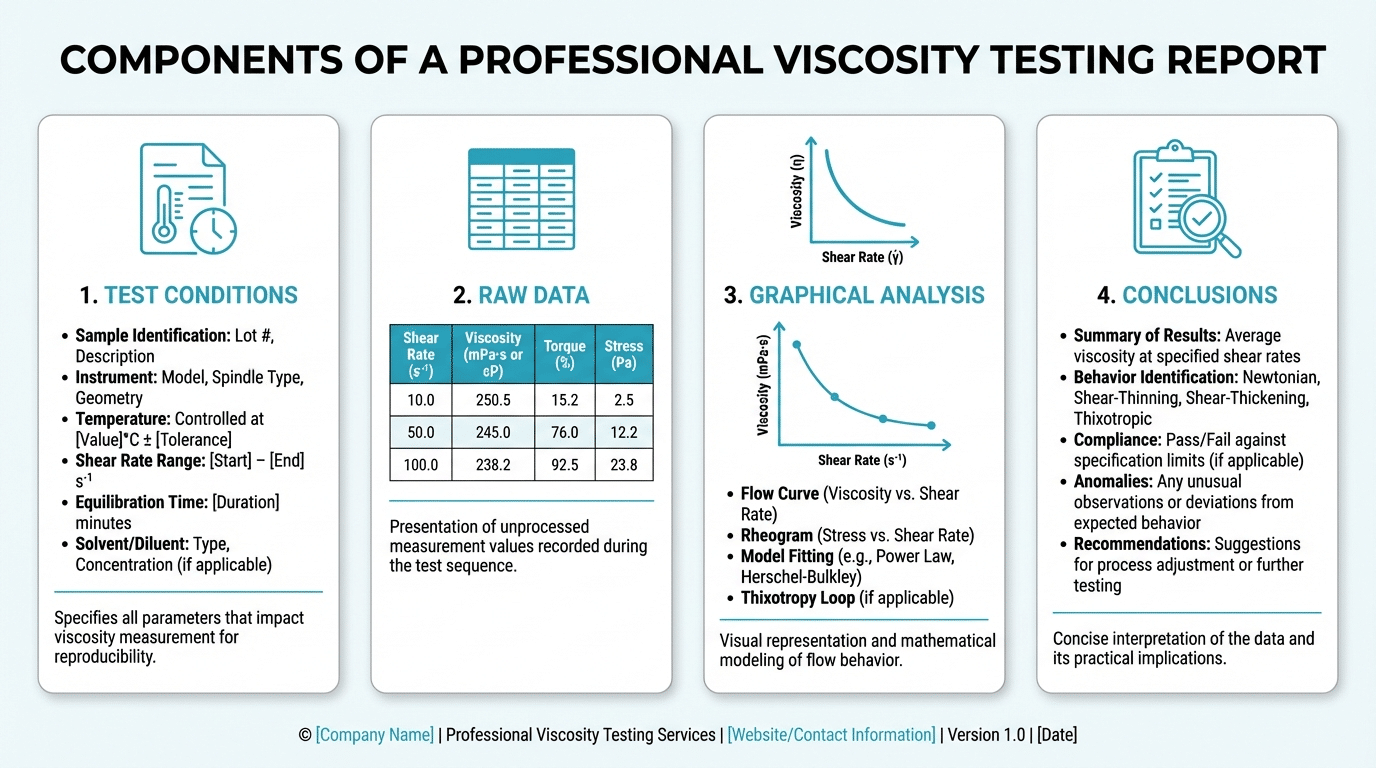
A comprehensive viscosity testing report from a professional lab should contain more than a single number. Typical deliverables include:
- Full description of test conditions (instrument, geometry, temperature control method, standard followed)
- Raw data in tabular format
- Graphical representation of key relationships
- Summary of conclusions tied to the original testing objective
For non-Newtonian materials, graphs are particularly valuable. A flow curve — viscosity plotted against shear rate — instantly reveals whether a material is shear-thinning, shear-thickening, or exhibits yield stress behavior. Temperature-sweep plots show how viscosity changes across a relevant thermal range, which is critical for storage stability and process design.
Da-Ta Biotech provides reports designed for direct use in regulatory submissions, investor presentations, or internal R&D decision-making. The lab’s scientists interpret the data in context, highlighting what the numbers mean for your specific formulation challenge — not just what was measured.
Physical Characterization Beyond Viscosity: Seeing the Full Picture
Physical characterization encompasses a range of measurements that collectively describe how a material behaves: its flow properties, structural integrity, stability over time, and response to environmental conditions. Viscosity is a central parameter within this framework, but it rarely tells the whole story on its own.
Consider a topical pharmaceutical cream. Its viscosity at a defined shear rate confirms whether it will flow through a filling nozzle. But understanding its yield stress tells you whether it will stay on a shelf without separating. Measuring its viscoelastic modulus reveals whether the consumer will perceive it as “rich” or “watery.” Combining these measurements into a coherent physical characterization profile connects formulation to real-world performance across the entire product life cycle — from manufacturing through end use.
Da-Ta Biotech’s approach to physical characterization integrates viscosity testing with complementary analytical techniques, giving clients a multi-dimensional view of their material. This holistic perspective helps identify root causes when a formulation changes, rather than just documenting that a change occurred.
Accreditation, Standards, and Regulatory Context: Picking a Qualified Lab
Not every viscosity measurement needs to be performed by an accredited lab — but many regulatory and commercial contexts require it. In Israel, ISRAC (the Israel Laboratory Accreditation Authority) grants accreditation to ISO/IEC 17025 for testing and calibration laboratories. This accreditation certifies that a lab demonstrates technical competence, impartiality, and consistent operation within a defined scope.
Before commissioning work, verify that the lab’s accreditation scope covers the specific test method and material type relevant to your needs. A lab accredited for kinematic viscosity of petroleum products is not necessarily accredited for rheological characterization of pharmaceutical gels. The ISRAC public registry allows you to search for accredited labs and review their scope of accreditation.
Standards themselves evolve. For example, ISO 3104:2020 has been withdrawn and replaced by ISO 3104:2023. Working with a lab that tracks standard revisions and updates its protocols accordingly protects your data from obsolescence and regulatory challenge. Da-Ta Biotech maintains its quality system under ISO 9001:2015 and follows current editions of relevant test methods, providing clients with traceable, defensible results.
When a Scenario Changes Everything: Scaling Up from Bench to Production
📊 Case Study: Scale-Up Failure Prevention
A formulation scientist develops a promising topical gel at bench scale. The viscosity is measured at 25 °C with a rheometer at low shear rates — the data looks perfect. Then the product enters pilot-scale manufacturing, where it is pumped at high shear rates through narrow tubing and filled at elevated temperatures. Suddenly, the product is too thin, fills overflow, and the batch is lost.
The solution: By requesting viscosity data across the full range of process-relevant shear rates and temperatures during the development phase, the formulation team would have identified the shear-thinning behavior before committing to a production run. This is precisely the kind of anticipatory testing that a capable viscosity testing lab provides — measuring not only at the “comfortable” conditions but at the conditions that the material will actually encounter.
Benchmarking Your Formulation: How Comparative Viscosity Data Drives Decisions
Viscosity testing is rarely a one-time event. Typical programs involve comparing multiple formulation candidates, tracking batch-to-batch consistency, evaluating stability over time, or benchmarking against a competitor’s product profile. In each case, the value of the data lies in the comparison, and comparisons are only valid when measurement conditions are identical.
A qualified viscosity testing lab will ensure that the same geometry, temperature, shear protocol, and sample preparation procedure are applied across all samples in a comparative study. This rigor transforms raw viscosity numbers into actionable business intelligence — enabling decisions on formulation selection, shelf-life claims, or process parameter adjustment with confidence.
“The value of viscosity data lies not in isolated numbers, but in rigorous comparisons under identical conditions — transforming measurement into decision-making power.”
— Da-Ta Biotech R&D Laboratory
Frequently Asked Questions About Viscosity Testing
Ready to Get Accurate Viscosity Data for Your Formulation?
If you are developing a new formulation, troubleshooting a production issue, or need reliable batch-release data, the right viscosity testing partner can save you time, material, and costly surprises. What specific flow behavior challenge is your current project facing?
Reach out to the experienced R&D team to discuss your testing needs, define the right method, and receive a tailored quote.