
Molecular Genetic Testing Services Israel: A Practical Guide for Researchers and Biotech Companies
Expert Credentials: With over 25 years leading biotech R&D projects — from proof-of-concept through FDA application support — I’ve overseen thousands of molecular genetic tests across diverse matrices. This guide distills hard-won insights into actionable intelligence for researchers and decision-makers navigating Israel’s molecular testing landscape.
🔬 Exclusive Industry Insight: The difference between reliable molecular data and costly project delays often comes down to three factors: sample quality assessment before testing begins, clearly defined acceptance criteria, and choosing the right service tier for your regulatory context. This guide addresses each decision point with practical frameworks.
Molecular genetic testing has become an indispensable component of modern biotech R&D, pharmaceutical development, and clinical research. In Israel, a growing ecosystem of laboratories and research institutions provides these services — but understanding what you actually receive, how to evaluate quality, and which service tier fits your project can be the difference between reliable data and costly delays. This guide addresses the practical questions that researchers, project managers, and biotech decision-makers face when engaging molecular genetic testing services in Israel.
Understanding Molecular Genetic Testing Services in Israel
Molecular genetic testing is the applied practice of using molecular genetics methods to produce measurable, reproducible results for research or commercial purposes. At its core, the service encompasses DNA/RNA extraction from biological samples, amplification and detection via methods such as PCR assay, data analysis, and formal result reporting. These are not theoretical exercises — they deliver tangible outputs that inform decisions about drug candidates, biomarkers, pathogen presence, and genetic variants.
Key applications include variant verification for gene therapy projects, pathogen detection in preclinical safety studies, mutation testing for oncology research, and biomarker quantification for diagnostics development. Every project culminates in deliverables: a structured results report, QC documentation, and a clear description of the methodologies used.
Da-Ta Biotech specializes in providing comprehensive molecular biology services tailored to various research and industrial needs. Operating under ISO 9001:2015, the laboratory serves as a β-site for R&D — accompanying clients from proof-of-concept through to demonstrations of efficiency, with full traceability at every stage.
What Is the Difference Between Molecular Genetics and Molecular Genetic Testing?
These two terms are sometimes used interchangeably, but they describe different things. Molecular genetics is the broader scientific discipline. It investigates genes, their expression patterns, regulatory mechanisms, and the role of genetic variants in biological processes. Think of it as the body of knowledge — the “why” and “how” of gene function at a molecular level. Research in molecular genetics has revealed, for instance, how gene mutations serve as evolutionary mechanisms under selection pressure, with pleiotropic effects on organism growth and adaptation.
Molecular genetic testing, on the other hand, is the practical application of that knowledge. It employs validated protocols, controlled conditions, and standardized reporting to answer a specific question: Is a particular mutation present? What is the expression level of a target gene? Does a sample contain a specific pathogen? The distinction matters commercially — when you contract a testing service, you are purchasing an answer with documented evidence, not a research exploration.
Key Distinction Summary
- Molecular Genetics: The scientific discipline studying gene structure, function, and variation
- Molecular Genetic Testing: Applied service delivering documented answers using validated methods
The Foundational Role of PCR Assay in Molecular Testing
If molecular genetic testing has a workhorse, it is the PCR assay. Polymerase Chain Reaction amplifies specific DNA or cDNA segments, enabling rapid and sensitive identification or quantification of genetic targets. Whether you need to confirm the presence of a transgene, detect a viral pathogen, or measure transcript abundance, PCR is often the first technique considered — and for good reason. It is fast, highly sensitive, and adaptable to a wide range of sample types and targets.
Every reliable PCR assay depends on three pillars: well-designed primers and probes that bind specifically to the target, positive and negative controls that validate each run, and rigorous contamination prevention protocols that protect against false positives.
PCR vs. qPCR: What’s the Difference?
Standard (end-point) PCR answers a qualitative question: Is the target present or absent? The amplified product is typically visualized on a gel after the reaction is complete. Quantitative PCR (qPCR) goes further — it uses fluorescent probes or dyes to monitor amplification in real time, cycle by cycle. This enables precise quantification of the starting template. For gene expression studies, viral load measurements, or copy number analysis, qPCR is the method of choice. For best practices in qPCR, the MIQE Guidelines provide essential recommendations for experimental design and reporting.
Factors Influencing Sensitivity and Specificity
Primer design is the single most critical factor. Poorly designed primers lead to non-specific amplification, missed targets, or both. The sample matrix also plays a role — inhibitors present in blood, tissue, or FFPE extracts can reduce amplification efficiency dramatically. Finally, template quality matters: degraded DNA or RNA yields unreliable results regardless of how well the assay is designed.
💡 Expert Tip: When evaluating PCR services, ask specifically about primer design methodology and validation data. A laboratory that can show you specificity testing results against closely related sequences demonstrates the rigor your project deserves.
How to Select a Reliable Laboratory for Molecular Biology Services in Israel
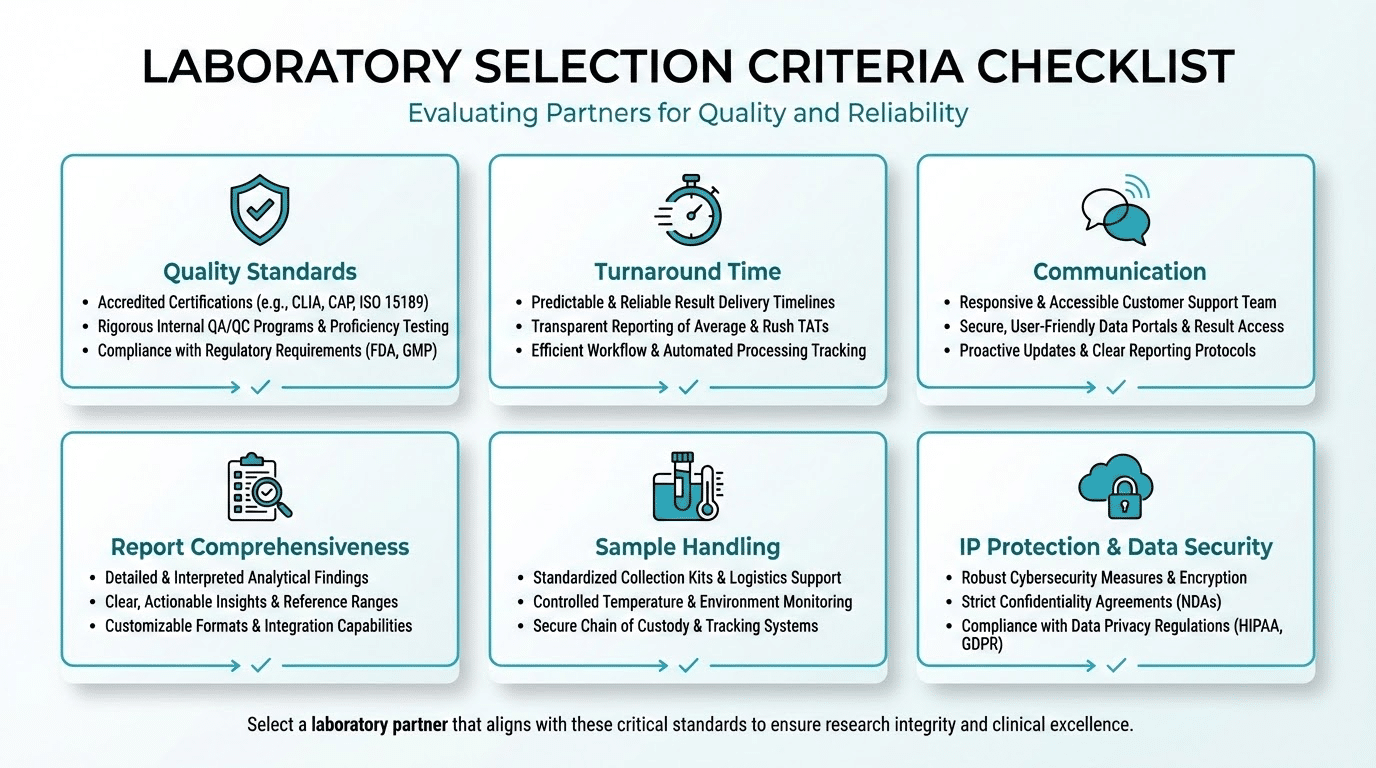
Choosing a laboratory for molecular biology services is not simply a procurement decision — it directly affects data quality and, ultimately, your project timeline. Start by evaluating the laboratory’s quality control processes: Do they run appropriate positive and negative controls on every plate? How do they handle technical and biological replicates? What are their sample rejection criteria?
Transparency is equally important. A laboratory that provides detailed methodology descriptions, raw data access, and clear documentation of any deviations builds trust and supports regulatory submissions. The ability to handle challenging samples — FFPE blocks, low-yield extractions, samples with known inhibitors — is another differentiator. When choosing a provider of molecular genetic testing services Israel, it is crucial to verify their adherence to national standards by checking official lists of medical laboratories, such as the Registry of Medical Laboratories by the Israeli Ministry of Health.
Commercial Checklist for Supplier Selection
Learn more about Da-Ta Biotech’s commitment to quality and expertise in serving the biotech industry.
Typical Turnaround Time for Molecular Genetic Test Results in Israel
One of the most common questions from project managers: How long until results? The honest answer is — it depends. A routine PCR test on well-characterized samples using an established protocol can deliver results within days. Complex projects that require assay development, optimization, or full analytical validation can take weeks to months.
Factors that influence TAT include the type of test (a simple qualitative PCR versus a multiplex qPCR panel), current laboratory workload, and whether the assay already exists or needs to be built from scratch. Da-Ta Biotech’s approach of providing dedicated project management for each engagement helps maintain clear timelines and early identification of potential delays.
Strategies to Shorten TAT
Three actions consistently reduce turnaround time. First, define your requirements clearly before engagement — ambiguity in project scope is the leading cause of delays. Second, provide high-quality samples with complete documentation (source, collection method, storage conditions, any known issues). Third, agree on acceptance criteria and decision thresholds upfront so that result interpretation does not become a bottleneck.
✓ Success Factor: Projects that provide complete sample documentation and pre-defined acceptance criteria typically achieve 30-40% faster turnaround compared to projects requiring mid-stream clarifications.
What Types of Samples Are Required for Molecular Testing?
The type of sample depends on your biological target and application. Blood and plasma are common for genetics and biomarker studies. Saliva offers a convenient, non-invasive collection method but requires proper preservation to prevent DNA degradation. Tissue samples — fresh, frozen, or formalin-fixed paraffin-embedded (FFPE) — demand specific extraction protocols, particularly FFPE, which introduces cross-linking artifacts that can compromise nucleic acid quality.
Regardless of sample type, three factors are non-negotiable: correct collection technique, appropriate preservation from the moment of collection, and full documentation that travels with the sample. A perfectly designed assay cannot compensate for a degraded sample.
Common Collection Errors That Degrade Quality
Temperature control failures are the most frequent culprit. RNA degrades rapidly at room temperature — even a 30-minute delay without proper cooling can compromise expression data. Using inappropriate preservatives (for example, formalin concentration too high or too low for FFPE) creates downstream extraction challenges. Incomplete labeling causes sample mix-ups that invalidate entire experiments. Proper sample handling is fundamental for accurate Gene Expression Assay and other molecular genetic testing services.
⚠️ Warning: RNA samples left at room temperature for more than 30 minutes show measurable degradation. Always maintain cold chain from collection through delivery to the testing laboratory.
How Accurate Are PCR Tests, and What Causes “Borderline” Results?

A well-designed and properly executed PCR assay is among the most accurate analytical methods available in molecular biology. Sensitivity can reach single-copy detection under optimal conditions. However, “borderline” results do occur, and understanding why is critical for proper interpretation.
The most common cause is low target concentration — when the amount of template DNA is near the assay’s Limit of Detection (LoD), stochastic effects mean that some replicates amplify while others do not. Poor sample quality introduces variability. Inhibitors carried over from extraction reduce amplification efficiency, shifting Ct values higher. Improperly set decision thresholds — for example, a Ct cutoff that does not account for the specific assay’s performance characteristics — can misclassify results.
Controls are the safeguard. Every run should include a No Template Control (NTC) to detect contamination, a positive control to confirm the assay is functioning, and ideally an internal control to assess inhibition within each sample.
Interpreting High vs. Low Ct Values
The Ct (Cycle threshold) value indicates how many amplification cycles were needed before the fluorescent signal crossed a defined threshold. A low Ct (e.g., 15–20) means abundant target — the assay detected it early. A high Ct (e.g., 35–38) means very little target was present. Results near the assay’s established LoD Ct value require careful interpretation and, ideally, repeat testing. For highly accurate PCR assay results and other molecular genetic testing services Israel, consider Da-Ta Biotech’s R&D solutions.
Ct Value Interpretation Guide
- Ct 15–25: High target abundance — strong positive result
- Ct 26–34: Moderate target — clear positive
- Ct 35–38: Low target — near LoD, consider retesting
- No Ct / >40: Target not detected or below LoD
What Differentiates Clinical Testing from R&D and Industrial Testing?
Not all molecular genetic testing operates under the same framework. Clinical testing — testing that informs patient care decisions — is governed by stringent regulatory standards. Every step requires extensive documentation, interpretation follows predefined guidelines, and traceability must be absolute. Decision thresholds are fixed, validated, and auditable.
R&D and industrial testing, by contrast, offers more flexibility. Protocols can be adapted mid-project. Comparison between methods is common. The goal is often proof-of-concept or feasibility rather than a clinical diagnosis. However, “flexible” does not mean “sloppy.” Data quality and reproducibility still matter because these results drive investment decisions, patent filings, and regulatory strategy. Da-Ta Biotech’s experience spanning both domains — from early-stage feasibility studies to rigorous validation — means protocols are always designed with the end application in mind.
Defining the “Use Case” for Accurate Quotes
When requesting a quote, clearly define your use case. A proof-of-concept study requires different analytical rigor than a GLP-adjacent validation. The more precisely you describe the intended use of results, the more accurate and fair the quote will be. Include the biological question, the regulatory context (if any), the required level of QC documentation, and whether you need raw data or interpreted reports.
The Process of PCR Assay Development
Developing a new PCR assay from scratch is a structured, multi-stage process. It begins with requirement definition: What target sequence? What sample matrix? What level of sensitivity is needed? What is the intended use — screening, quantification, or confirmation?
From there, the process moves through design (primer/probe selection and in-silico validation), optimization (annealing temperatures, reagent concentrations, cycling conditions), analytical performance evaluation (sensitivity, specificity, linearity for quantitative assays), and robustness testing (performance across operators, instruments, and reagent lots). The final deliverables include a Standard Operating Procedure (SOP), performance data, linearity range, and acceptance criteria for routine use.
Essential Data for Rapid Initiation
To start an assay development project quickly, provide the target gene or sequence (GenBank accession number if available), a detailed description of the sample matrix (blood, tissue, cell culture supernatant), the required analytical range (e.g., 10–10⁶ copies/mL), and any known challenges (low abundance, high background, closely related non-target sequences). This information allows the laboratory team to begin primer design and experimental planning without unnecessary back-and-forth.
📋 Assay Development Stages
- Stage 1: Requirement definition and target specification
- Stage 2: Primer/probe design and in-silico validation
- Stage 3: Optimization of reaction conditions
- Stage 4: Analytical performance evaluation
- Stage 5: Robustness testing and SOP documentation
How Is Analytical Validation Performed for Molecular Tests?
Analytical validation proves that a test accurately and reliably measures what it claims to measure, under defined and documented conditions. This is not optional for tests that support commercial decisions, diagnostics registration, or batch release — it is the evidentiary backbone.
Key metrics include Limit of Detection (LoD) and Limit of Quantification (LoQ), precision (repeatability and reproducibility), accuracy (agreement with a reference method or known standard), specificity (no cross-reactivity with non-target sequences), and interference testing (performance in the presence of common sample contaminants). For robust analytical validation, industry guidelines such as those from the Clinical and Laboratory Standards Institute (CLSI) EP17 are often followed to determine metrics like LoD and LoQ.
Validation vs. Verification — When to Use Each
Validation establishes the performance characteristics of a new or significantly modified method. Verification confirms that a previously validated method performs as expected in a specific laboratory’s hands, with its specific equipment and personnel. If you are implementing a commercially available kit as-is, verification may suffice. If you are developing a novel assay or making significant modifications, full validation is required.
Five Common Mistakes That Compromise Molecular Testing Projects
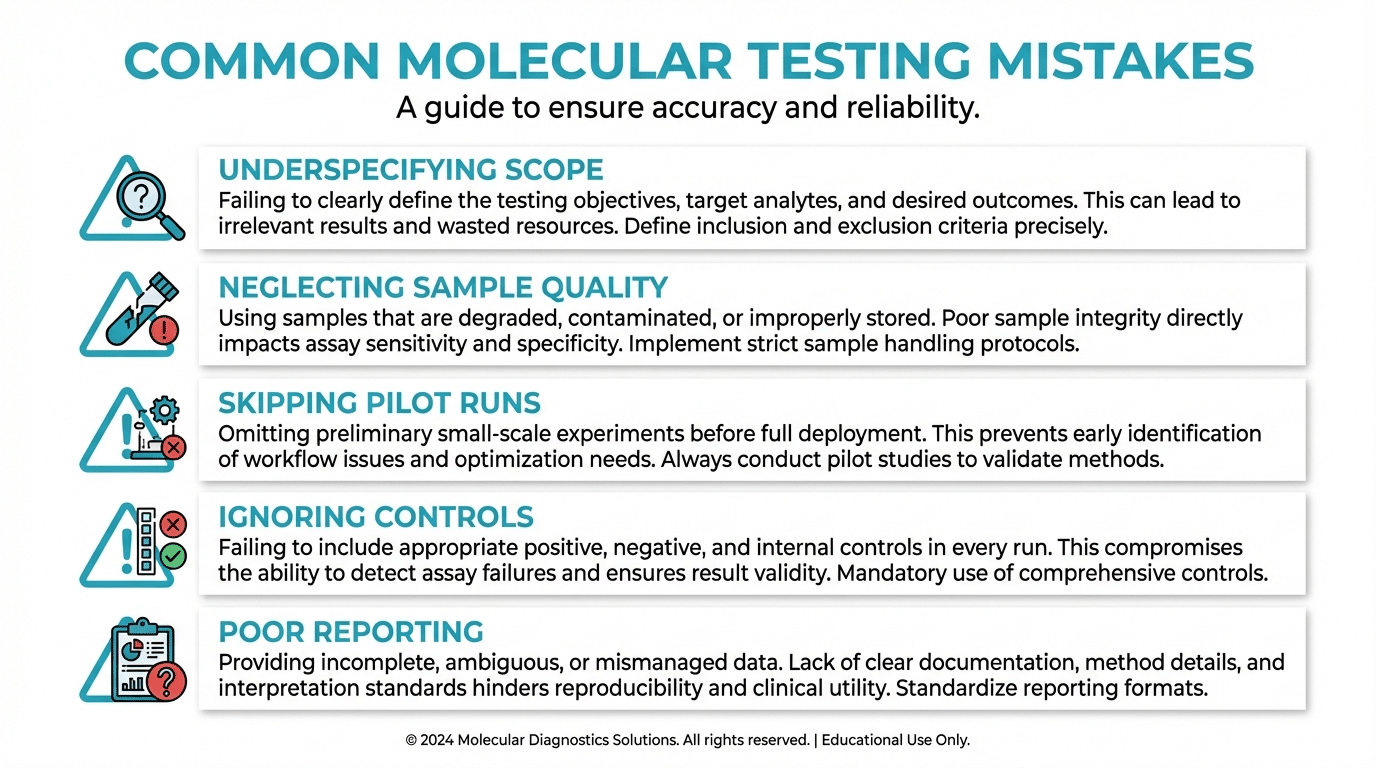
Even experienced researchers encounter pitfalls. The first is underspecifying the project scope — vague requirements lead to mismatched expectations and rework. The second is neglecting sample quality assessment before testing begins; investing in assay runs on degraded material wastes time and budget.
Third, skipping pilot runs. A small feasibility study before committing to full-scale testing can reveal matrix effects, inhibitor problems, or primer specificity issues early. Fourth, ignoring the importance of proper controls — running samples without NTC, positive controls, or internal controls makes results uninterpretable. Fifth, treating the results report as an afterthought. A report that lacks QC data, raw values, or method descriptions has limited utility for regulatory submissions or publication.
❌ Mistake #1
Underspecifying project scope — vague requirements cause mismatched expectations and costly rework
❌ Mistake #2
Neglecting sample quality assessment — testing degraded material wastes time and budget
❌ Mistake #3
Skipping pilot runs — missing early opportunities to detect matrix effects or primer issues
❌ Mistake #4
Ignoring proper controls — running without NTC or positive controls makes results uninterpretable
❌ Mistake #5
Treating reports as afterthoughts — incomplete documentation limits regulatory and publication utility
How Does a Professional Laboratory Prevent PCR Contamination?
Contamination is the arch-enemy of PCR-based testing. Because PCR amplifies even trace amounts of DNA, a single molecule of carry-over product from a previous run can generate a false positive. Professional laboratories employ a multi-layered prevention strategy.
Physical separation is the foundation: reagent preparation, template addition, and amplification occur in separate rooms or dedicated areas with restricted access. Workflow is strictly unidirectional — personnel and materials move from clean to contaminated zones, never backward. Dedicated equipment (pipettes, centrifuges, vortexes) stays in each zone. Negative controls are included on every plate to detect any breach.
Signs of Contamination and Corrective Actions
The clearest sign is amplification in the NTC well. Other indicators include unexpectedly low Ct values across all samples, inconsistent results between replicates, or amplification of targets in known negative samples. Corrective actions include immediate cessation of testing, decontamination of all surfaces and equipment, replacement of reagent stocks, and root cause investigation. Every deviation and corrective action is documented — at Da-Ta Biotech, this documentation forms part of the project record, ensuring full traceability for the client.
🔬 Laboratory Practice: Da-Ta Biotech maintains physically separated work zones with unidirectional workflow, dedicated equipment per zone, and mandatory NTC controls on every plate. All contamination events and corrective actions are documented as part of the ISO 9001:2015 quality system.
Can Discrete Services with NDA and IP Protection Be Provided for Genetic Projects?
Absolutely. Confidentiality is standard practice in molecular genetic testing services Israel, particularly for projects involving proprietary sequences, novel biomarkers, or pre-patent research. The engagement typically begins with a mutual NDA that defines data ownership, restricts access to project information, and specifies the conditions under which samples and data are stored, returned, or destroyed.
Key pre-definitions include: Who owns the designed primers and probes? Can the laboratory use de-identified data for internal method improvement? What is the sample retention policy after project completion? These questions should be resolved before any material changes hands.
Da-Ta Biotech works under strict confidentiality frameworks, with project-level access controls and documented sample chain-of-custody. This is not an add-on — it is embedded in the standard operating model.
What Factors Influence the Cost of Molecular Genetic Testing Services in Israel?
Pricing for molecular genetic testing services Israel reflects several variables. The type of test is the starting point — a routine qualitative PCR costs less than a quantitative multiplex assay. Sample volume matters: higher throughput often reduces per-sample cost. Matrix complexity is a factor; extracting quality nucleic acids from FFPE is more labor-intensive than from fresh blood.
The need for assay development or validation significantly increases cost compared to running an established protocol. Depth of QC — whether you need basic pass/fail or detailed statistical analysis — affects the reporting workload. Turnaround time is another lever: rush services require priority scheduling and may incur premium charges. One-off projects generally cost more per unit than routine service agreements with predictable volumes.
How to Build a Brief for an Accurate Quote
A well-structured brief accelerates quoting and avoids surprises. Include: the biological question or hypothesis, sample type and estimated quantity, target gene or sequence, required deliverables (raw data, interpreted report, SOP), any regulatory context, desired TAT, and budget constraints. The more complete your brief, the more precise and competitive the quote.
Comparing Routine PCR Service, Assay Development, and Full Validation
Understanding which tier matches your project prevents overspending on unnecessary validation for a feasibility study — or underspending on a project that requires regulatory-grade evidence. Da-Ta Biotech’s experienced R&D team works with clients to define the appropriate service level before work begins, ensuring resources are allocated efficiently and results meet their intended purpose.
How Da-Ta Biotech Addresses Core Needs in Molecular Testing Projects
Frequently Asked Questions
“The difference between reliable molecular data and costly delays often comes down to three factors: sample quality assessment before testing, clearly defined acceptance criteria, and choosing the right service tier for your regulatory context.”
— Dr. Rinat Borenshtain-Koreh, CEO, Da-Ta Biotech
Ready to discuss your molecular genetic testing project with experienced R&D scientists who understand both the science and the practical requirements? Come to Da-Ta Biotech with any scientific challenge — contact the team to define your project scope and receive a tailored proposal.