
Formulation Development Services Israel: A Practical Guide for Drug and Topical Product Development
Written by Dr. Rinat Borenshtain-Koreh, PhD, DVM — CEO of Da-Ta Biotech LTD, with over 25 years of hands-on experience in Biotech and Biomed R&D, biological model development, in-vitro assays, and in-vivo experiments supporting projects up to FDA application level.
Turning a promising active molecule into a stable, marketable product is rarely a straight line. It is a structured journey through chemistry, biology, regulation, and patient experience. This guide unpacks how formulation development services Israel actually work in practice — from the first solubility test to the final stability dossier — with a sharp focus on topical products and the realities of working under Israeli Ministry of Health (MOH) standards.
🔬 Expert Insight
Successful formulation development is not about finding a recipe that works in the lab — it is about designing a product that survives scale-up, passes regulatory scrutiny, and is used correctly by patients. Every decision made in preformulation echoes through to the commercial shelf life. Projects that skip API characterization at week one consistently fail at month eighteen.
What Do Formulation Development Services Israel Actually Involve?
Formulation development services Israel serve as the bridge between a raw active pharmaceutical ingredient (API) and a stable, effective drug product the patient can actually use. Professional formulation is a core pillar among broader R&D services for the biotech industry in Israel, and it begins long before any cream is mixed or any tablet is pressed.
The first stage of pharmaceutical formulation is API characterization: solubility profiles across pH, thermal and oxidative stability, polymorphism, hygroscopicity, and compatibility with potential excipients. From there, formulation development becomes iterative — selecting inactive ingredients (excipients) that meet the Quality Target Product Profile (QTPP) defined for the product. Local expertise matters here, especially when navigating MOH expectations for a quality dossier, which must include data on the API and finished product, manufacturing processes, analytical methods, impurities, packaging and stability, as detailed by the MOH chemical safety assessment unit.
✓ Key Takeaway
API characterization is the non-negotiable foundation of every formulation project. Without it, excipient selection is guesswork — and guesswork is expensive at scale.
Where Does Pharmaceutical Formulation End and Drug Product Development Begin?
The two terms are often used interchangeably, but they are not the same. Pharmaceutical formulation refers specifically to the “recipe” — the chemistry of stabilizing the API together with excipients in a defined dosage form. Drug formulation services, in the broader sense, encompass the full Drug Product Development cycle: process design, scale-up, analytical method development and validation, packaging selection, and regulatory documentation.
The recipe also dictates the manufacturing route — whether it will be dry blending, wet granulation, hot-melt extrusion, or emulsification. Once the recipe is locked, the formulation must undergo in vitro assay development services to predict biological behavior before any clinical trial begins. Skipping the analytical-biological bridge is one of the most common reasons formulations fail to translate from bench to clinic.
“A formulation that performs in a 100 g bench batch but fails during scale-up was never truly formulated — it was only mixed. The recipe must be designed for the manufacturing process, not the other way around.”
— Dr. Rinat Borenshtain-Koreh, PhD, DVM, CEO Da-Ta Biotech LTD
How to Choose a Formulation Development Partner in Israel
Marketing pages all sound similar. The real differences appear in how a partner structures the engagement. A serious laboratory or CDMO will issue a transparent quotation (RFQ) with defined milestones, standard operating procedures (SOPs), and clear success criteria for each phase of formulation development.
Three practical checks before signing: confirm that the resulting “recipe” and intellectual property remain owned by the client; ask which capabilities are truly on-site versus outsourced (turnaround time and confidentiality both depend on this); and verify that the team works according to a Quality by Design (QbD) approach, as outlined in the ICH Q8 (R2) guideline. A partner that builds QTPP and Critical Quality Attributes (CQAs) into the project from day one is operating at a different level than one that simply mixes ingredients until something works.
Quick Evaluation Checklist
Why Preformulation Is the Most Critical Step in Drug Formulation Services
Preformulation is the risk management phase of drug formulation services. It is where the project decides whether the molecule is realistically developable in the desired form — or whether the team is about to spend a year solving the wrong problem.
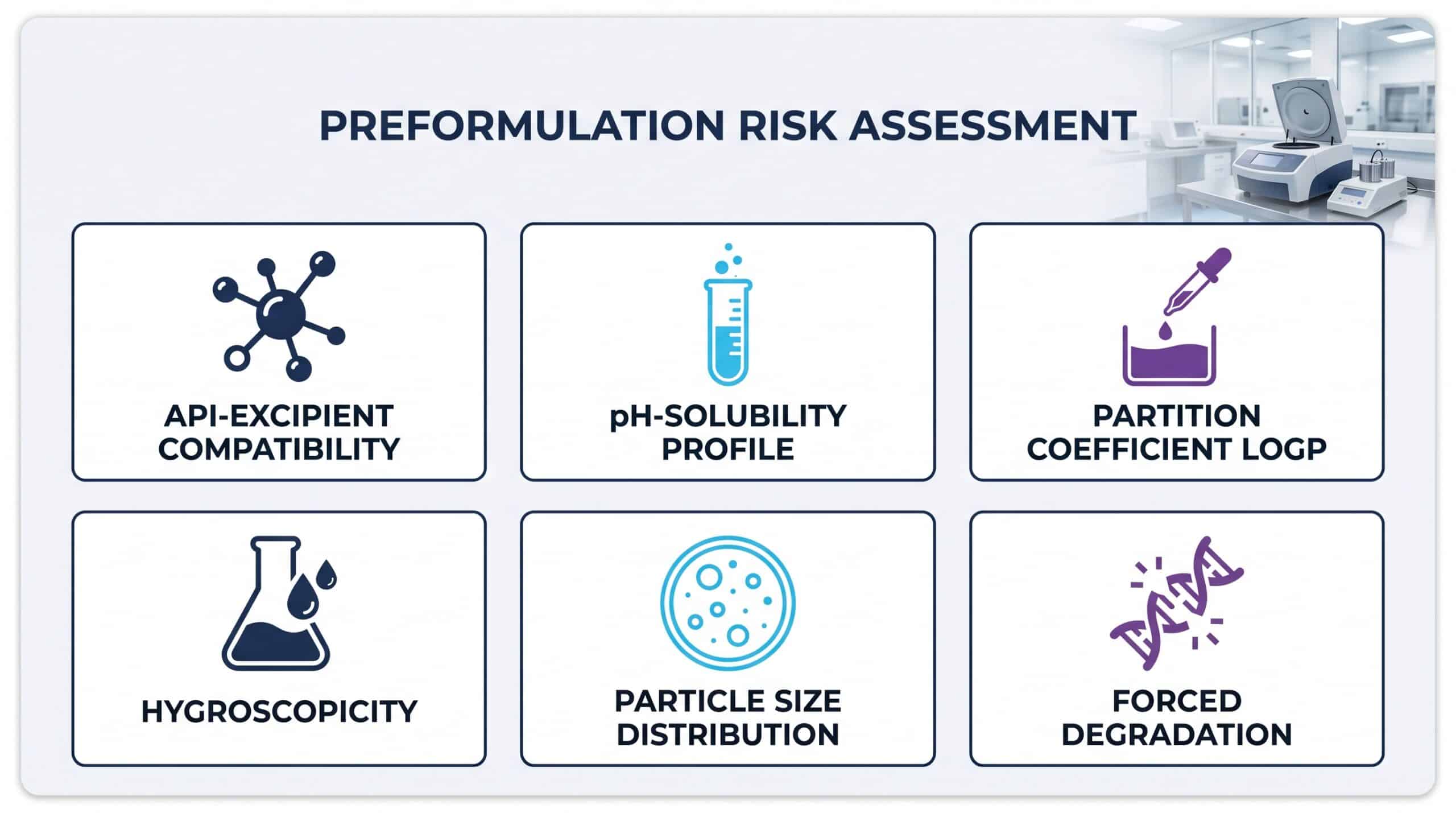
Typical preformulation tests include API-excipient compatibility studies (often by isothermal stress or DSC), pH-solubility profiles, partition coefficient (logP), hygroscopicity, particle size distribution, and forced degradation. Skipping these tests is the most reliable predictor of “lab-only” formulations — products that look beautiful in a 100 g batch and collapse during scale-up. For advanced delivery systems such as gene or RNA delivery, formulation development may also require integration with suitable molecular biology methods to ensure cellular uptake and biological function.
🔢 Compatibility Testing
API-excipient compatibility via DSC and isothermal stress identifies degradation pathways before formulation iteration begins, saving 3–6 months of misdirected development.
📈 Solubility Profiling
pH-solubility mapping across the physiological range reveals whether the dosage form choice is viable — or whether a salt screen or amorphous dispersion strategy is needed from day one.
⚙ Forced Degradation
Thermal, photolytic, hydrolytic, and oxidative stress studies generate the impurity profile needed to validate analytical methods and set specification limits confidently in the dossier.
What Makes Topical Formulation Development Unique Compared to Oral or Injectable Drugs?
Topical formulation development — for creams, gels, ointments, lotions, and foams — adds a layer that oral and injectable products do not face: the patient experience. Spreadability, skin feel, fragrance compatibility, residue, cooling sensation, and absorption rate all influence adherence. A pharmacologically perfect cream that feels greasy will be abandoned by patients within a week.
The technical challenge is that most topicals are multi-phase systems. Keeping an oil-in-water or water-in-oil emulsion stable for 24–36 months under realistic storage conditions is non-trivial. The U.S. FDA SUPAC-SS guidance on nonsterile semisolid dosage forms outlines expectations for in vitro release testing (IVRT), which has become a standard tool for demonstrating consistency between batches and after post-approval changes in formulation development.
🔎 Expert Perspective
Patient adherence is a formulation variable. Sensory testing — panel evaluation of spreadability, tackiness, absorption rate, and residue — should be built into the development timeline, not treated as a cosmetic afterthought. Products patients stop using cannot demonstrate efficacy.
- Multi-phase emulsion systems require precise emulsifier HLB matching
- In vitro release testing (IVRT) is the key regulatory tool for post-approval changes
- Skin penetration studies differentiate local vs. systemic delivery intent
- Packaging material selection is part of formulation, not a downstream decision
How Do You Develop a Stable and Consistent Topical Cream or Gel?
Stable topicals are built on the “phase” approach. The oil phase (emollients, occlusives, oil-soluble actives) and the water phase (humectants, water-soluble actives, buffers) are heated separately, then combined under controlled shear with a carefully chosen emulsifier system. Small changes — homogenization speed, cooling rate, order of addition — can change the entire product.
Rheology is the second pillar. Viscosity must be high enough that the product stays where it is applied, but low enough that the patient can spread it without dragging. Yield stress and shear-thinning behavior are measured during early topical formulation development. The third pillar is preservation: any water-containing product is a potential microbial habitat, so antimicrobial effectiveness testing (challenge test, USP <51>) is non-negotiable in serious drug formulation services.
⚙
Pillar 1: Phase Architecture
Separate oil-phase and water-phase preparation with controlled temperature and emulsifier selection. Process parameters locked and documented as CPPs.
📈
Pillar 2: Rheology Control
Viscosity, yield stress, and shear-thinning measurements ensure the product behaves correctly during manufacturing, packaging, and patient use.
🛡
Pillar 3: Preservation
Antimicrobial effectiveness testing (USP <51>) under relevant pH and water-activity conditions ensures compliance across the full product shelf life.
Common Pitfalls in Topical Formulation Development
Three failure modes appear again and again in topical formulation development projects.
⚠ Three Most Common Failure Modes
-
1
Phase Separation — Visible as creaming, cracking, or syneresis. Usually the result of an inadequate emulsifier blend or insufficient HLB matching. Detected early via accelerated centrifuge testing and freeze-thaw cycling. -
2
Packaging Incompatibility — Certain actives adsorb onto plastic tubes, react with metal pump components, or migrate through low-density polyethylene. The product passes release testing and fails six months later in the warehouse. -
3
Viscosity Drift — A cream that was 45,000 cP at release becomes 18,000 cP after four months because a polymer is hydrolyzing — or 80,000 cP because the wax network is reorganizing. Structured stability programs catch these patterns before they become commercial failures.
“Packaging is part of the formulation. The container-closure system is not chosen after the product is developed — it is chosen as part of the product development. Clients who discover packaging incompatibility at month six could have found it at week four.”
— Dr. Rinat Borenshtain-Koreh, PhD, DVM
How Much Does Formulation Development Cost — and What Drives the Price?
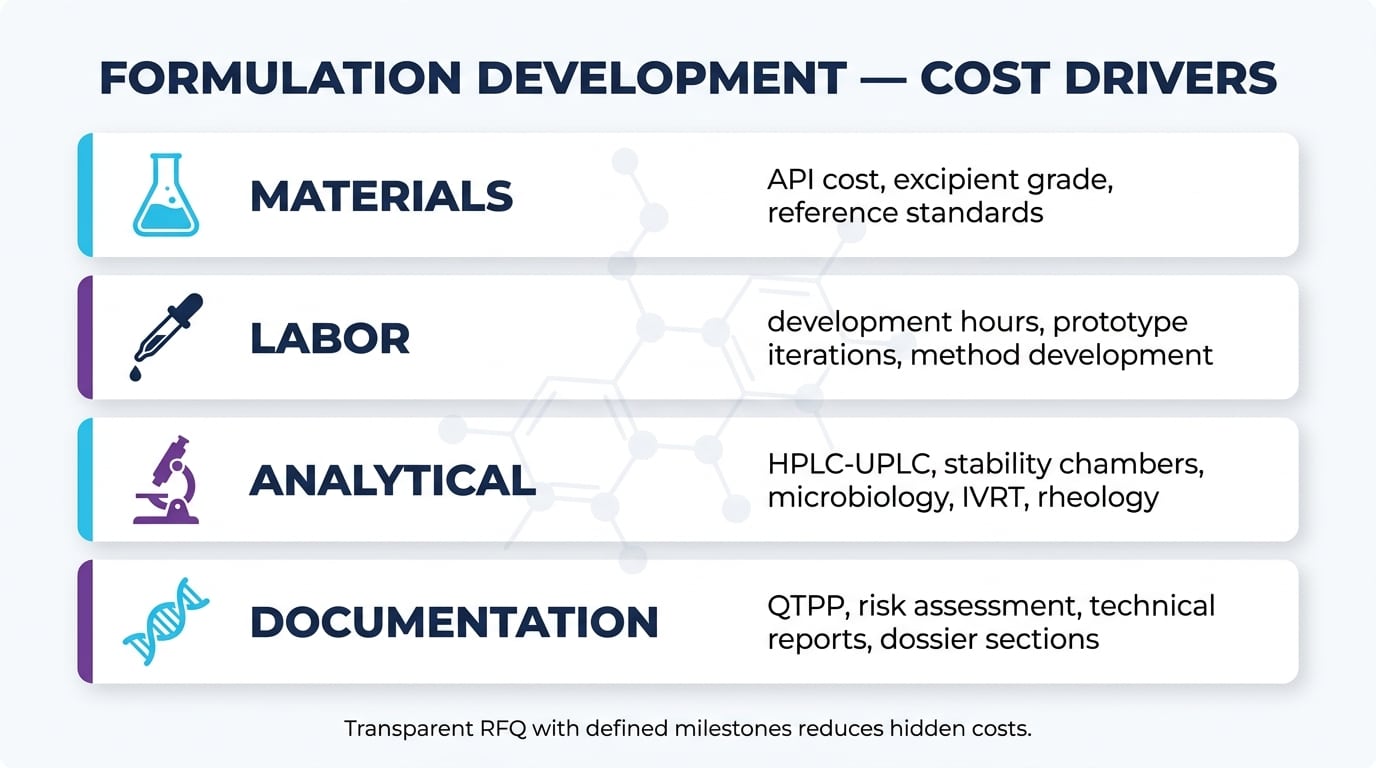
There is no single price tag for drug formulation services. Costs are driven by three main factors: the number of formulation iterations needed to hit the QTPP, the complexity of the delivery system (a simple aqueous gel is not a nanoemulsion), and the depth of analytical testing required.
The most effective way to avoid hidden costs is a transparent RFQ that lists deliverables, success criteria, and a clear change-control mechanism if the scope expands.
📋 Our Methodology: Quality by Design (QbD) from Day One
Every project at Da-Ta Biotech starts with a written QTPP — a document defining what the product must do, how it must behave, and what the patient experience should be. From the QTPP, we derive CQAs (Critical Quality Attributes) and CPPs (Critical Process Parameters). This is not documentation box-ticking: it is the map that prevents expensive detours.
- Phase 1: API characterization and preformulation (weeks 1–6)
- Phase 2: Prototype iterations and in vitro testing (weeks 6–20)
- Phase 3: Stability program and analytical method validation (months 5–18)
- Phase 4: Dossier compilation and tech-transfer support (concurrent)
Which Stability and Microbial Tests Are Required for a Regulatory Dossier in Israel?
Israel typically follows ICH stability Zone II/IVa expectations, depending on the product and intended markets. A standard program combines accelerated stability (40°C / 75% RH for six months) with real-time stability (25°C / 60% RH or 30°C / 65% RH) over 24–36 months, plus intermediate conditions when needed. Photostability and in-use stability may also apply for pharmaceutical formulation projects.
Cosmetic topicals and pharmaceutical topicals follow different paths. Cosmetic products are notified rather than registered, and require a Responsible Representative and a product dossier under the 2023 Israeli Pharmacists Regulations (Cosmetics), as described on the MOH page for cosmetic product marketing notification. Pharmaceutical topicals require a full quality dossier with CMC, stability, and validated analytical methods. Mapping the right path early is one of the highest-leverage decisions in formulation development.
How Da-Ta Biotech Supports Formulation Development Projects
The relative advantage of working with a local R&D laboratory shows up in the small details: faster sample turnaround, direct conversation with the scientists running the assays, and the ability to adjust an experimental design mid-week instead of mid-quarter. Below is a practical mapping of common business needs and how the laboratory addresses them in real projects.
FAQ — Common Questions About Formulation Development Services
Ready to Move Your Formulation Forward?
If you are evaluating partners, designing a preformulation plan, or trying to decide whether your topical product is ready for stability — what is the single biggest unknown in your current project, and how would you measure it? Talk it through with our team and learn more about our Biological Laboratory for R&D in Israel to see how we handle complex formulation challenges, from proof-of-concept to dossier-ready data.
Come to us with any scientific challenge — we are here for you.
🎉 What You Get Working With Us
- On-site laboratory in Rehovot with ISO 9001:2015 quality framework
- Direct scientific dialogue — not a project manager, the scientist doing the work
- ICH-aligned documentation ready for MOH, EMA, or FDA regulatory use
- Client retains full IP ownership of recipe, methods, and data
This article is intended for informational purposes and reflects the author’s professional expertise. It does not constitute regulatory advice. Always consult a qualified regulatory professional for your specific product and target market.