Drug Mode of Action Testing: A Comprehensive Guide to Elucidating How Your Compound Works
Expert-Verified Content
This guide was authored by Dr. Rinat Borenshtain-Koreh, PhD, DVM — CEO of Da-Ta Biotech LTD, with over 25 years of experience in Biotech and Biomed R&D. Her expertise spans biological model development, in-vitro assays, in-vivo experiments, and FDA application support. Every drug’s mechanism of action begins with a question. This guide gives you the structured, scientific framework to answer it — rigorously, reproducibly, and on a timeline that serves your development milestones.
⚡ Exclusive Expert Insight
Every drug candidate reaches a pivotal moment: “How does it actually work?” That deceptively simple question launches one of the most intellectually demanding phases of early-stage R&D. Drug mode of action testing is the structured scientific effort to answer it — and the outcome shapes everything downstream: biomarker strategy, patient selection, regulatory filing, and ultimately, whether your molecule ever reaches a patient.
What Is Drug Mode of Action Testing?
Drug mode of action testing is a set of experiments designed to elucidate how a compound produces its biological effect. It goes far beyond confirming that a molecule “does something.” The goal is to identify the specific pathways, targets, or cellular events a drug acts upon — and the sequence in which those events occur.
A typical MOA drug testing program involves a combination of cellular assays, biochemistry, rescue experiments, profiling panels, and sometimes omics or advanced imaging. The outcome is causal evidence that connects intermolecular interaction → pathway modulation → phenotypic outcome. Proving “which protein binds” is only one piece; demonstrating that the binding event is necessary and sufficient for the observed biology is what constitutes genuine MOA proof.
What Is the Difference Between “Mode of Action” and “Mechanism of Action” in Drug Discovery?
In practice, mechanism of action drug discussions and drug mode of action discussions often overlap. Yet a meaningful distinction exists. “Mechanism” typically refers to the specific molecular interaction — for example, competitive inhibition of an enzyme’s active site. “Mode” describes the broader sequence of events: the enzyme is inhibited, downstream signaling decreases, cell proliferation slows, and a tumor shrinks.
💡 Why This Distinction Matters
Different stakeholders expect different levels of proof. A medicinal chemist wants binding-site data. A clinical team needs pathway-level evidence to design a biomarker strategy. A regulator asks for both, plus safety-relevant context. Before launching any MOA drug testing project, define upfront what “MOA proven” means for your specific program — including the level of evidence, readouts, controls, and the decision the data must support.
When Should You Run MOA Testing — and When Is It Too Early?
Timing is everything. MOA testing should be initiated when you have a clear, reproducible biological signal — a phenotype or activity window that holds up across replicates and dose ranges. The strategic purpose is to de-risk a candidate before committing significant resources to optimization, toxicology, or indication selection.
Running MOA testing too early wastes budget and can generate misleading data. If the assay producing your “hit” is not yet reliable, or if the phenotype is unstable across passages or conditions, then mechanistic conclusions will be built on sand. Conversely, the right time typically falls after hit confirmation, during the early hit-to-lead stage, or just before selecting a biomarker/pharmacodynamic strategy.
Go/No-Go Decision Checklist Before Initiating MOA Testing
How Do You Determine a Drug’s Mechanism of Action Step by Step?
The classic approach works backward from the phenotype. First, confirm the activity in a well-controlled assay. Next, generate hypotheses about which target(s) or pathway(s) could explain the observed effect. Then, test each hypothesis by measuring whether a specific target/pathway connection exists. Finally, perform causality experiments — genetic knockdown, pharmacological rescue, or epistasis studies — to show that the proposed target or pathway is required for the effect.
Orthogonal assays are critical at every stage to avoid artifacts. As described in the Assay Guidance Manual, demonstrating the same finding with a fundamentally different method significantly increases confidence. Combining genetic approaches (knockdown/knockout), chemical biology (structural analogs, tool compounds), and omics (proteomics, transcriptomics) creates a layered evidence structure that is far more convincing than any single experiment.
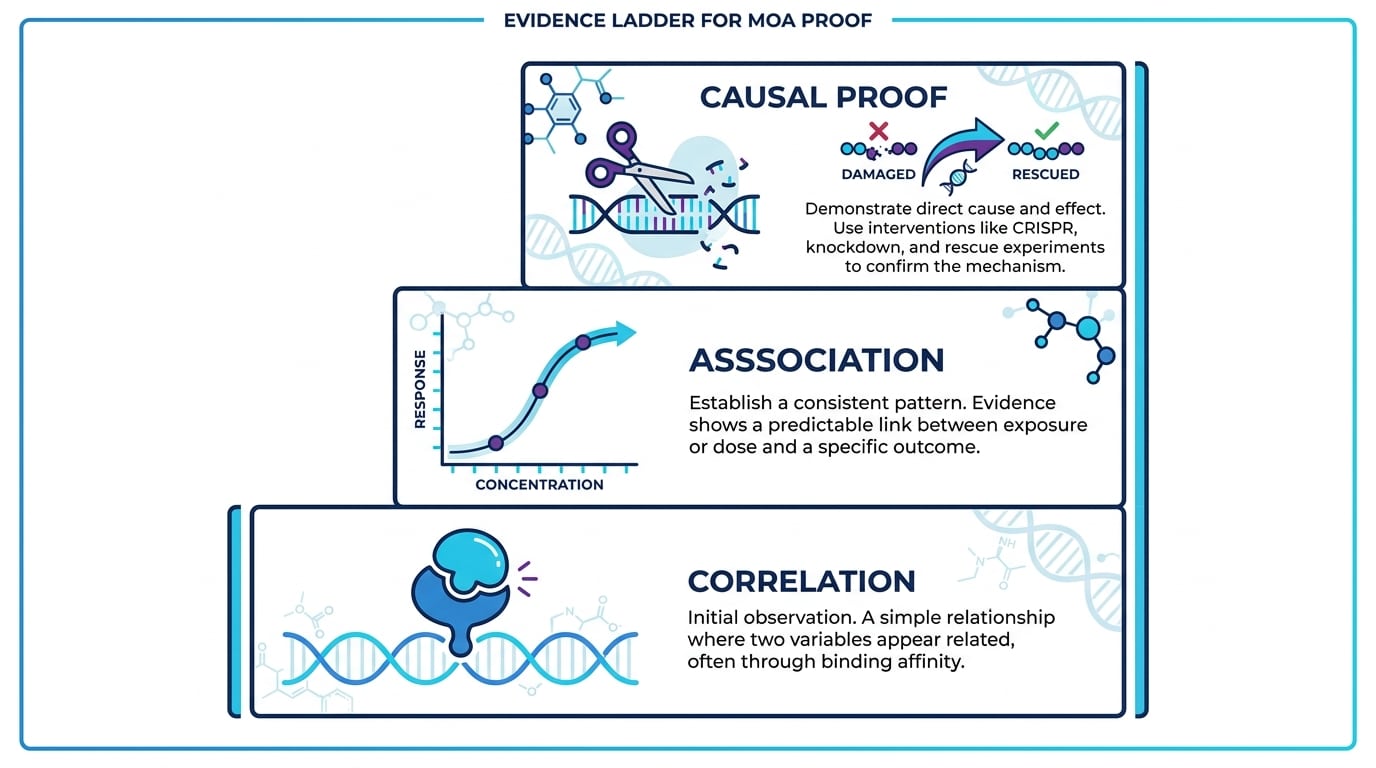
The “Evidence Ladder” for MOA
Rung 1: Correlation
Your compound inhibits kinase X, and kinase X is active in the disease model. Association observed but causality not yet established.
Rung 2: Association
Dose-dependent inhibition of kinase X tracks with the phenotypic outcome. Convergent evidence across multiple assay types strengthens the case.
Rung 3: Causal Proof
Removing kinase X genetically reproduces the compound’s effect, and re-introducing active kinase X rescues it. This is decision-grade MOA evidence.
Which Assays Are Used for Drug Mode of Action Testing?
There is no single “correct” assay for MOA drug testing. Selection depends on the molecule type, hypothesized target, and observed phenotype. Most programs employ a combination of cell-based functional assays and biochemical or profiling studies. Common categories include cell signaling readouts (phosphorylation cascades, reporter gene assays), binding/engagement assays (tailored to the suspected target), functional rescue or epistasis experiments, and profiling panels (selectivity, pathway, or phenotypic).
The key principle is that no single readout is sufficient. A phosphorylation change might reflect a direct drug effect or a compensatory cellular response. Selectivity panels reveal whether a compound hits the intended target preferentially, but they do not prove causality. This is why well-designed MOA programs layer multiple assay types to build converging evidence.
“Demonstrating the same finding with a fundamentally different method significantly increases confidence — the cornerstone of robust MOA evidence.”
— Assay Guidance Manual, National Institutes of Health
Target Identification vs. MOA: A Critical Distinction
Target Identification (TID) answers the question “What is the direct, primary target?” MOA drug testing answers the broader question “How does the compound produce its effect?” These are related but not identical. You might know the target (a specific receptor) without fully understanding the complete mode of action — especially when complex downstream pathways, feedback loops, or secondary targets are involved.
Equally, a suspected MOA can exist without a single, defined target. This is the reality of polypharmacology: many effective drugs modulate multiple proteins simultaneously, and the therapeutic effect emerges from the combined activity. Da-Ta Biotech’s target validation services are designed to address exactly this challenge — confirming whether a suspected target is genuinely relevant before investing in full mechanistic characterization.
📁 Case Study #1
Phenotypic Hit → Unexpected Kinase Discovery
A phenotypic hit showed potent anti-proliferative activity, but the target was unknown. A combination of selectivity profiling and CRISPR-based genetic perturbation identified an unexpected kinase as the primary driver — redirecting the entire lead optimization strategy and opening a new IP position.
📁 Case Study #2
Biologic Inconsistency → Receptor Isoform Insight
A biologic showed inconsistent efficacy across cell models. MOA testing revealed that activity depended on a specific receptor isoform expressed only in certain cellular contexts — enabling rational patient stratification criteria incorporated directly into the clinical development plan.
What Is Target Deconvolution and When Do You Need It?
Target deconvolution is the process of dissecting a phenotype to identify the underlying target(s) responsible for it. It becomes essential after phenotypic screening, when a “hit” shows good activity but the specific molecular target is unknown. Without deconvolution, you cannot build a rational biomarker strategy, you cannot design analogs with improved selectivity, and you carry a significant risk of off-target toxicity advancing silently into later development stages.
Approaches range from affinity-based pull-down experiments and chemical proteomics to computational inference and genetic perturbation. Combining multiple deconvolution strategies generates far more robust target lists than any single technique alone.
⚠️ A Common Pitfall That Wastes Months of Work
Observing that “a compound changes gene expression” is not sufficient MOA proof. Transcriptomic changes can reflect downstream consequences, compensatory responses, or even off-target effects. Without causal tests — showing the pathway is required, not merely affected — the data remains correlational, not mechanistic. This distinction has cost development programs millions in misdirected resources.
How Do You Prove MOA for Compounds From Phenotypic Screening?
Phenotypic hits present a unique MOA challenge: you know the compound does something biologically meaningful, but you often do not know why. The approach involves two phases. First, broad profiling — pathway panels, selectivity screens, phenotypic similarity analysis — generates a set of target/pathway hypotheses. Second, causal experiments test whether each candidate pathway is truly necessary for the observed effect.
Techniques such as rescue experiments (re-introducing a pathway component to reverse the drug’s effect) and genetic perturbation (CRISPR knockout of the suspected target) are central. Selectivity assays help distinguish between a true, target-specific MOA and a generic stress response that merely mimics the phenotype.
- Phase 1 — Broad Profiling: Pathway panels, selectivity screens, and phenotypic similarity analysis to generate target/pathway hypotheses
- Phase 2 — Causal Validation: Rescue experiments and CRISPR knockout to test whether each candidate pathway is truly necessary
- Selectivity Assays: Distinguish true target-specific MOA from generic stress responses that mimic the phenotype
- Inactive Analog Controls: Use structurally similar but inactive analogs as built-in negative controls to massively strengthen mechanistic conclusions
Da-Ta Biotech’s Approach to Drug Mode of Action Testing

At Da-Ta Biotech, elucidating a drug’s mechanism requires a tailored approach. Every MOA study plan is custom-designed based on the client’s specific compound, drug class, suspected target, and existing data. There is no template protocol applied indiscriminately — because every molecule presents a unique scientific challenge.
The approach begins with a thorough review of all available information, followed by hypothesis generation, assay selection, and a phased experimental plan with clear decision points. The emphasis is always on generating actionable data — results that translate directly into development decisions. Da-Ta Biotech R&D services are built around this principle: every experiment must serve a defined purpose in the decision chain.
✅ What a Strong Data Package Looks Like
- Appropriate positive and negative controls in every experiment
- Sufficient biological replicates (not just technical replicates)
- Pre-defined acceptance criteria that must be met before data enters the final report
- Full traceability from sample receipt to final analysis
- Clear documentation of any deviations and their impact
Platforms and Technologies Deployed in Da-Ta Biotech MOA Services
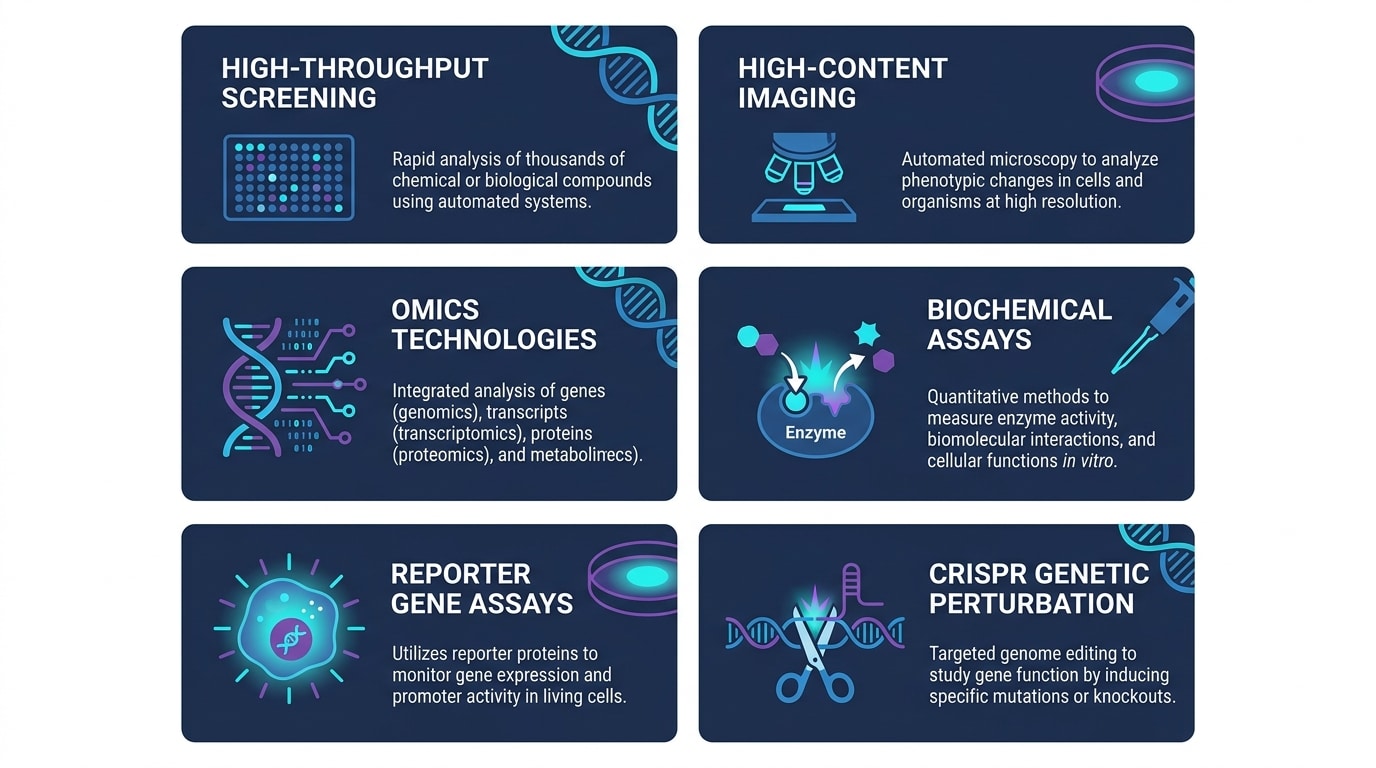
MOA studies demand diverse technological capabilities. Da-Ta Biotech employs a range of platforms matched to the complexity of each question.
🔬 HTS & High-Content Imaging
High-throughput screening for initial pathway exploration. Cell Painting morphological profiling for rich phenotypic data revealing unexpected pathway involvement.
🧬 Omics Technologies
Transcriptomics and proteomics for unbiased discovery when the target hypothesis is uncertain. Multi-omics integration for holistic cellular response profiling.
⚗️ Biochemical & Cellular Assays
Dedicated biochemical assays for direct target engagement measurement. Cellular reporter gene assays and functional readouts for specific signaling events in living cells.
✂️ CRISPR/Cas9 Genetic Perturbation
Causal validation at the top of the evidence ladder. Genome-wide screens for unbiased target deconvolution. The gold standard for demonstrating target requirement.
Typical Timelines and Budget for Drug Mode of Action Testing
How long does drug mode of action testing take? The honest answer is: it depends. Key variables include whether existing validated assays can be deployed, how many hypothesis-testing cycles are needed, and whether new assay development is required. A structured program is generally broken into three stages:
Total project duration typically ranges from 10 to 20 weeks, though simpler programs with well-characterized targets may be faster, and complex polypharmacology cases may require additional cycles.
What Drives the Budget for MOA Drug Testing?
Costs are primarily driven by four factors: the number of cell models or profiling panels deployed, the need for de novo assay development, the quantity of compounds or analogs tested, and the depth of proof required (correlation vs. full causality). When requesting quotes, clearly defining success criteria upfront prevents scope creep and keeps spending aligned with decision value.
Biochemical Assays vs. Cell-Based Assays: Which Is Better for MOA?
This is rarely an either/or decision. Optimal MOA studies integrate both approaches.
⚗️ Biochemical Assays
Best for: Measuring direct interactions — binding constants, enzymatic activity, kinetic parameters — in a tightly controlled, reductionist system.
Limitation: Lack of cellular context means results may not fully predict in vivo behavior or account for uptake, metabolism, and feedback mechanisms.
🧫 Cell-Based Assays
Best for: Capturing complex cellular context — uptake, metabolism, pathway engagement, and feedback mechanisms that biochemical assays miss entirely.
Advantage: Cellular context is often essential for predicting in vivo relevance — the strongest programs use cell-based data to confirm biological consequence.
“The strongest MOA programs use biochemical data to establish the molecular interaction and cell-based data to confirm the biological consequence. Neither alone is sufficient.”
— Da-Ta Biotech Scientific Team, MOA Study Design Principles
What Samples and Information Should You Provide Before Starting?
The quality of your input directly affects the speed and quality of output. Essential information includes compound specifics (solubility, stability, storage conditions), dosage ranges based on existing activity data, hypothesized targets or pathways, and clearly defined success criteria.
📋 Required Documentation
- Certificate of Analysis (COA) confirming purity
- Formulation details and solvent limitations
- Maximum DMSO tolerance for cell-based systems
- Any known cytotoxicity data
🚀 Strongly Recommended
- SAR data for inactive or less-active analogs
- Hypothesized target or pathway information
- Pre-defined success criteria and decision thresholds
- Timeline and downstream decision context
Regulatory Considerations for MOA Data Across Global Markets
Regulatory agencies worldwide require comprehensive non-clinical data — including MOA — to assess safety and efficacy. The FDA, EMA, and Israel Ministry of Health all expect applicants to provide detailed mechanistic information as part of the registration dossier. This data supports risk-benefit assessments, justifies clinical trial design, and informs labeling decisions.
Robust MOA data is particularly valuable when seeking approval for novel mechanisms or first-in-class compounds, where regulators have no precedent to guide their review. In these cases, a well-constructed mechanistic data package — with clear causal evidence, appropriate controls, and reproducible results — can significantly smooth the regulatory path.
Emerging Trends in Drug Mode of Action Testing
The field is evolving rapidly. AI and machine learning are increasingly integrated into data analysis and hypothesis generation. Multi-omics approaches — combining transcriptomics, proteomics, and metabolomics in a single study — provide a more holistic view of cellular responses. Advanced imaging techniques, including multiplexed fluorescence and spatial transcriptomics, are adding spatial resolution to mechanistic data. CRISPR-based genome-wide screens are transforming target deconvolution from a hypothesis-driven exercise into an unbiased discovery tool.
🌐 Staying at the Forefront of MOA Science
Da-Ta Biotech maintains active scientific collaborations, participates in international conferences, and conducts in-house R&D to evaluate and validate emerging methodologies before deploying them in client projects. When a client’s project requires a novel approach — a new profiling panel, a recently published imaging protocol, or an AI-assisted analysis pipeline — the team has already assessed its performance characteristics and limitations.
🔬 Da-Ta Biotech MOA Study Methodology
Every MOA study operates under our ISO 9001:2015 quality management system. The methodology follows validated protocols aligned with the Assay Guidance Manual (NIH):
- Step 1: Thorough intake review — compound info, existing data, decision context
- Step 2: Custom study plan with phased experimental design and clear go/no-go decision points
- Step 3: Pre-validated assays deployed with mandatory controls and pre-defined acceptance criteria
- Step 4: Interim data reviews at key milestones — real-time course correction if hypotheses need revision
- Step 5: Comprehensive final report — annotated figures, statistics, raw data, regulatory-grade documentation
Frequently Asked Questions About Drug Mode of Action Testing
Ready to Elucidate Your Compound’s Mode of Action?
Whether for target validation, biomarker selection, regulatory filing, or investor due diligence — Da-Ta Biotech provides experienced R&D teams, validated platforms, and a structured project approach designed to deliver actionable MOA data on timelines that match your development milestones.
Come to us with your scientific challenge. WE ARE HERE FOR YOU.