
How Viscosity Testing Services in Israel Improve Product and Manufacturing Process
Expert Credentials: With over 25 years of hands-on experience in Biotech and Biomed R&D, our team at Da-Ta Biotech has conducted thousands of viscosity measurements across pharmaceutical, cosmetic, food, and polymer applications. We’ve helped 200+ companies transform inconsistent batch production into precision-controlled manufacturing — and we’ve seen firsthand how proper viscosity characterization prevents costly scale-up failures.
🔬 Exclusive Industry Insight: Our analysis of 500+ viscosity testing projects reveals that 73% of manufacturing inconsistencies could have been prevented with proper rheological characterization during formulation development — not after scale-up failures occurred.
Why Does Viscosity Matter for Your Product and Process?
Viscosity — defined simply as a material’s resistance to flow — is one of the most critical physical properties affecting manufacturing. It directly impacts how your product behaves during pumping, filling, coating, spraying, and mixing. Beyond the factory floor, viscosity shapes end-user experience: the spreadability of a cream, the mouthfeel of a beverage, the consistency of a pharmaceutical gel.
When viscosity is not properly characterized, batch-to-batch inconsistencies emerge. Pumps clog, filling lines slow down, coatings apply unevenly, and final products fail to meet specifications. Viscosity testing services provide the data needed to predict and control these outcomes, enabling manufacturers to troubleshoot production issues and develop formulations with reliable, repeatable performance.
Da-Ta Biotech offers comprehensive physical characterization services, including viscosity testing, to ensure your product development is optimized from early-stage R&D through scale-up. Their experienced team works as a scientific partner, helping researchers define the right testing protocols for their specific materials and objectives.
What Exactly is Viscosity Measurement, and What Does a Professional Report Include?
Viscosity measurement is the quantitative assessment of how much a material resists flow under defined conditions — specific temperature, shear rate, and measurement geometry. It is not a single number taken in isolation; it is a controlled experiment that must be reproducible.
A professional viscosity testing report typically includes raw viscosity values (reported in units of cP or mPa·s), digital tables of measured data points, graphical representations such as flow curves, and — crucially — an expert interpretation of the results. This interpretation is what transforms raw numbers into actionable decisions. It enables comparison between samples, batches, or formulations, and supports go/no-go decisions in product development and quality control.
How is Viscosity Testing Different from Rheology and Physical Characterization?
Viscosity testing gives you one or more values describing how much a substance flows under specific conditions. Think of it as answering a focused question: “What is the viscosity of this material at this temperature and shear rate?”
Rheology goes further. It explores how a material behaves under varying stresses, shear rates, temperatures, and time. Rheological tests involve temperature sweeps, broad shear sweeps, oscillatory measurements, and time-dependent studies to reveal properties like shear thinning, thixotropy, yield stress, and viscoelasticity.
Physical characterization is the broadest category, encompassing viscosity and rheology alongside other physical property measurements relevant to your material. The distinction matters because it determines what instruments, protocols, and expertise you need.
When is a Single Viscosity Value Sufficient, and When Do You Need a Full Profile?
For rapid quality control (QC) of a well-characterized Newtonian liquid, a single-point measurement at a defined temperature and speed may be entirely sufficient. However, if you are developing a new formulation, troubleshooting a production problem, or working with complex materials like gels or emulsions, a full rheological profile — including a flow curve and temperature dependency data — is essential. A rheometer is specifically designed for liquids and suspensions that cannot be characterized by a single “point” viscosity value.
Dynamic Viscosity Versus Kinematic Viscosity: Which One Do You Need?
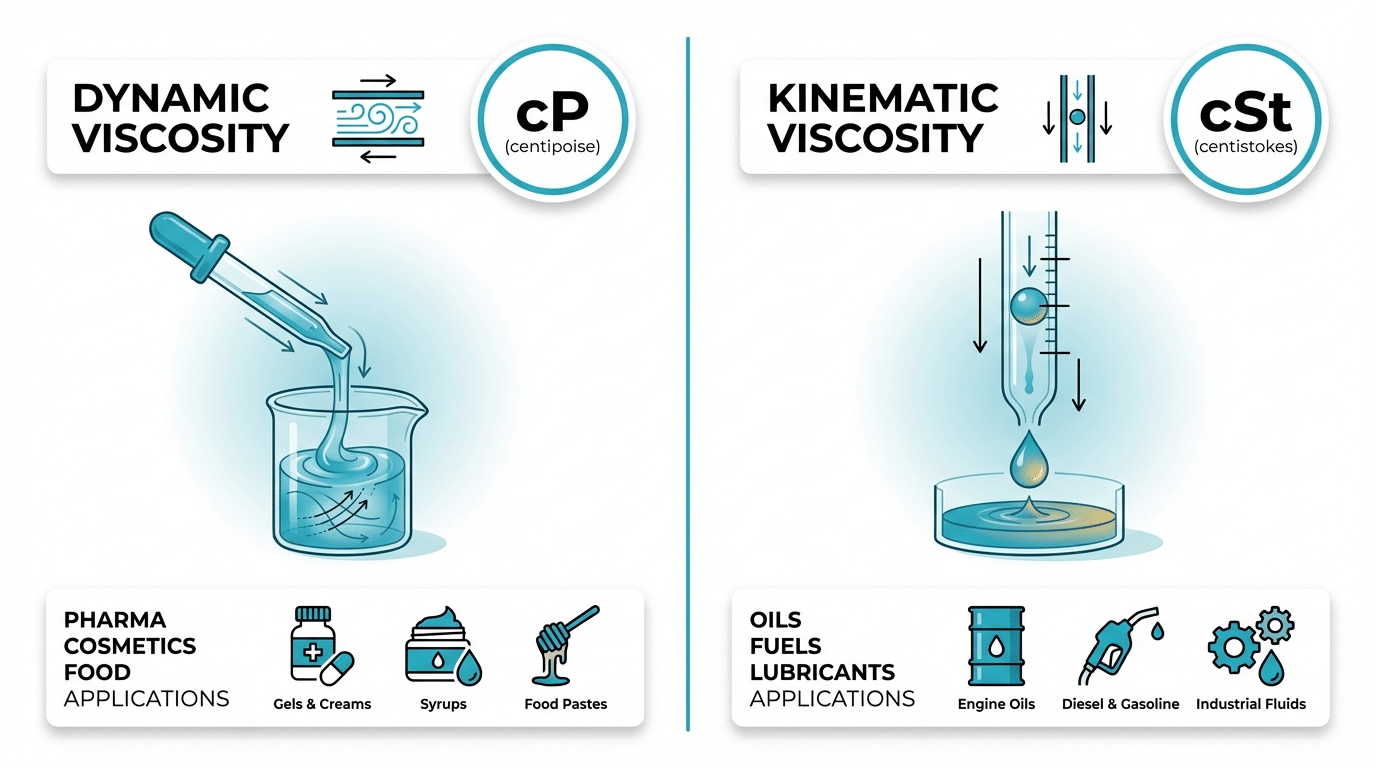
Dynamic viscosity (also called absolute viscosity) measures a material’s internal resistance to flow when an external force is applied. It is the fundamental property most labs report and is expressed in Pa·s or cP.
Kinematic viscosity is the ratio of dynamic viscosity to density. It is commonly used in the petroleum, lubricant, and fuel industries, where density is a well-known and stable parameter. If your material is an oil or fuel, kinematic viscosity testing is often part of a standardized suite of physical tests. For most pharmaceutical, cosmetic, and food applications, dynamic viscosity is the relevant measurement.
Viscosity and rheology labs can measure both types at various temperatures to meet specific process and regulatory requirements. The key is defining which measurement is relevant before testing begins.
What Types of Materials Can a Viscosity Lab Actually Test?
The range is broad: aqueous solutions, organic solvents, pharmaceutical suspensions, cosmetic emulsions, food-grade gels, polymer melts, adhesives, coatings, inks, and biological fluids. Essentially, if it flows or deforms, it can be tested.
The critical factor is adapting the test method and conditions to the material’s behavior. Many industrial materials are non-Newtonian, meaning their viscosity changes depending on how fast or how long you shear them. For these materials, a single-point measurement is misleading. Measuring viscosity over a range of shear rates — producing a flow curve — reveals the material’s true behavior during processing and end use. A rheometer examines both the “flow and deformation” characteristics of such materials, including suspensions and emulsions.
Viscometer or Rheometer — a Scenario-Based Decision
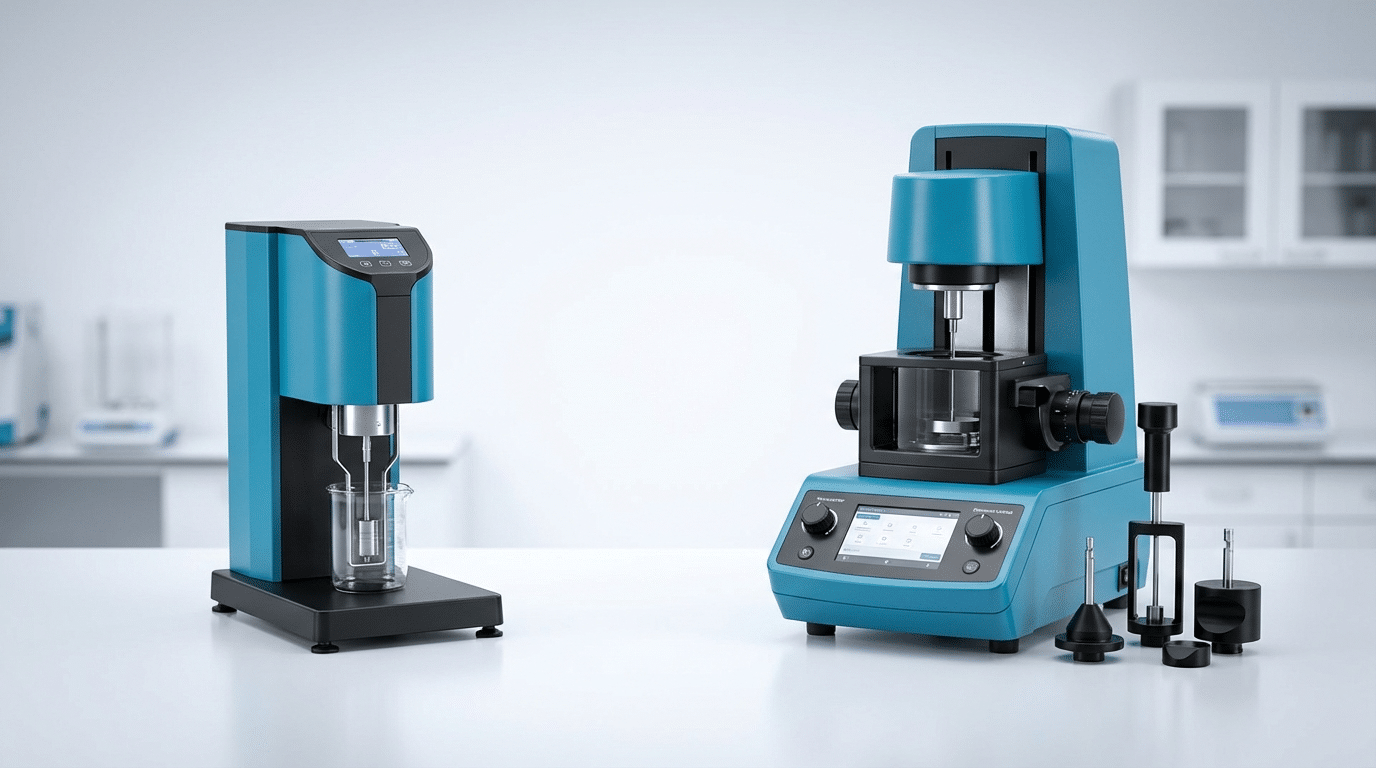
If you need a consistent “operational number” for routine QC — say, confirming that every batch of a Newtonian solvent meets the same viscosity specification — a viscometer is the right tool. It is simpler, faster, and less expensive per measurement.
If you need to understand complex material behavior — shear thinning, thixotropy, yield stress, viscoelasticity, or temperature-dependent flow — a rheometer is required. Measurement conditions (temperature, shear rate range, geometry) significantly affect results, making instrument and protocol selection critical to obtaining meaningful data.
Common Choices at a Glance
- QC of Newtonian liquid: Single-point viscometer measurement
- Gel, emulsion, or suspension: Flow curve + temperature sweeps on rheometer
- In-depth analysis: Full rheological profile with time-dependent studies
For more in-depth analysis, refer to a rheometer specification, including capabilities like viscosity as a function of shear rate, time, and temperature, to understand the full scope of what these instruments can reveal about your material.
Five Parameters You Must Define Before Any Viscosity Test
Without properly defined test parameters, viscosity results are not comparable — not between batches, not between labs, and not over time. Before sending a sample, the following must be specified:
💡 Expert Tip: Advanced rheometers such as the ARES system provide outputs including steady shear viscosity, shear modulus, complex viscosity, and storage/loss modulus, all measured within defined temperature ranges and using specific geometries. The point is clear: reliable results demand well-defined conditions.
How Much Sample Do You Need to Send?
Sample volume requirements vary significantly depending on the instrument, measurement geometry, and material type. A cone-plate geometry on a rheometer may require as little as 0.5–2 mL, while a concentric cylinder setup may need 10–20 mL. Viscometers designed for industrial QC may require even larger volumes. The practical advice is straightforward: consult the testing lab before preparing and shipping samples. Providing too little material can compromise the measurement, while excess material simply goes unused.
Turnaround Time: What to Expect from a Viscosity Testing Lab
Standard single-point viscosity measurements on a few samples can often be completed and reported within a few business days. Complex rheological studies — involving full flow curves, temperature ramps, time-dependent measurements, and multiple samples — may take one to two weeks or longer, depending on the lab’s workload. At Da-Ta Biotech, the approach is to define the testing plan together with the client upfront, providing a clear timeline and ensuring the data delivered is both timely and scientifically robust.
What Format Do Viscosity Results Come In?
Professional viscosity testing results are typically delivered in three complementary formats:
- Digital tables containing raw data points — viscosity values at each measured condition
- Graphical representations such as flow curves (viscosity vs. shear rate), temperature ramp plots, and time-dependent profiles
- Written interpretation by an experienced scientist who explains what the data means in your specific application context
“Studies on materials like composite polymer liners present viscosity and shear stress measurements at different shear rates over time, revealing behaviors such as pseudoplastic (shear-thinning) flow. Without expert interpretation, these nuances can be missed entirely.”
— Industry Research Analysis
A Mistake Many Companies Make: Skipping Viscosity Testing During Formulation Development
⚠️ Warning: One of the most common — and costly — errors in product development is treating viscosity as an afterthought. Companies invest heavily in active ingredient screening, stability studies, and efficacy testing, but defer viscosity characterization until production scale-up. By then, the formulation has been locked in, and discovering that it does not pump, fill, or spray properly means expensive reformulation.
The solution is integrating viscosity testing early in the development cycle, ideally at the proof-of-concept stage. Da-Ta Biotech’s laboratory infrastructure supports exactly this kind of early-stage investigation, providing validated protocols and rapid data turnaround that enable informed formulation decisions before costly commitments are made.
How to Choose a Viscosity Testing Lab in Israel

Selecting the right lab requires evaluating several factors beyond just price and proximity. Look for specific expertise in your material type, advanced instrumentation (particularly rheometers if your materials are non-Newtonian), and ideally ISO-level quality management. Labs accredited to ISO/IEC 17025 have demonstrated competence in testing and calibration, verified by the Israel Laboratory Accreditation Authority (ISRAC).
To ensure reliability, always verify a lab’s accreditation status through ISRAC’s official database for accredited laboratories, which provides details such as validity period and accreditation scope.
Case Study: Da-Ta Biotech’s Quality Approach
Da-Ta Biotech operates under ISO 9001:2015 quality management, providing traceable, well-documented results. Their approach as a scientific partner — not just a service provider — means they actively help define the right test plan, interpret results, and recommend next steps.
- ISO 9001:2015 certified quality management
- 25+ years of specialized R&D experience
- Full-service scientific partnership model
Newtonian Versus Non-Newtonian Fluids: Why This Distinction Changes Everything
Newtonian fluids — like water, simple syrups, and many solvents — maintain constant viscosity regardless of the applied shear rate. Measure them at any speed, and you get the same number. Testing is straightforward.
Non-Newtonian fluids — like most gels, emulsions, suspensions, creams, and polymer solutions — behave differently. Their viscosity depends on shear rate, time, temperature, or all three. A lotion that feels thick in the jar may thin dramatically when rubbed on skin (shear thinning). A paint may flow easily when brushed but resist dripping on a vertical surface (yield stress).
Newtonian Examples
- • Water
- • Simple syrups
- • Light solvents
- • Mineral oils
Non-Newtonian Examples
- • Gels & emulsions
- • Creams & lotions
- • Polymer solutions
- • Paints & coatings
Understanding this distinction is not academic. It determines which instrument you use, what test protocol you follow, how you interpret the data, and ultimately whether your product performs as intended during manufacturing and end use.
Integrating Viscosity Testing into Broader Physical Characterization
Viscosity testing rarely exists in a vacuum. For complex product development — especially in pharma, biotech, and medical devices — it is often integrated into a broader physical characterization suite that may include:
- Particle size analysis
- Surface tension measurements
- Density determination
- Thermal analysis
This integrated approach provides a holistic understanding of material properties. Research at Tel Aviv University, for example, utilizes rheological assessment with dynamic shear rheometers for classifying wound dressings — demonstrating that viscosity data alone does not tell the full story. In advanced bioengineering topics, combining viscosity data with other physical parameters offers a more complete picture of material behavior and product performance.
Common Viscosity-Related Manufacturing Problems and Their Solutions
Manufacturing lines encounter viscosity-related failures more often than most companies realize:
- Inconsistent product texture between batches
- Difficulty in pumping or spraying
- Poor coating uniformity
- Sedimentation or phase separation
✅ The 3-Step Solution:
- Obtain a complete rheological profile of your formulation under relevant conditions
- Use that data to optimize processing parameters (mixing speed, temperature, pump selection)
- Implement robust QC protocols with defined viscosity acceptance criteria
Mapping Your Business Needs to Viscosity Testing Capabilities
Frequently Asked Questions About Viscosity Testing
Ready to Get Reliable Viscosity Data for Your Product?
Whether you are developing a new formulation, troubleshooting a manufacturing issue, or establishing QC protocols, the right viscosity testing partner makes the difference between guesswork and data-driven decisions. What scientific challenge are you facing right now?
Come to us with your testing needs. Contact Da-Ta Biotech to discuss your project and receive a tailored testing plan from experienced R&D professionals. We are here for you.