
FACS Services: A Complete Guide to Fluorescence Activated Cell Sorting for Biotech R&D
Expert Insight: With over 25 years of experience in biotech R&D and FDA application support, I’ve guided hundreds of research teams through the complexities of cell sorting. The difference between a successful FACS experiment and a failed one often comes down to preparation, proper controls, and expert guidance — elements that many researchers underestimate until it’s too late.
What Are FACS Services and Why Do They Matter for Your Research?
FACS services — Fluorescence Activated Cell Sorting — provide researchers with the ability to physically separate and collect specific cell populations from a heterogeneous mixture. Built on the principles of Flow Cytometry, FACS uses fluorescent markers and light scatter properties to identify cells of interest in a single-cell suspension, then directs them into collection tubes or multi-well plates based on predefined gating strategies.
What makes FACS particularly valuable? It enables isolation of rare cell populations, enrichment of target subsets, and even deposition of individual cells into single wells for downstream applications. Whether you need a pure population of T-cell subsets for functional assays, tumor cells for genomic profiling, or stem cells for cloning — cell sorting provides the precision that magnetic bead separation or manual methods simply cannot match.
How Do FACS Services Differ from General Flow Cytometry Services?
This is a common point of confusion. Flow Cytometry services focus on measuring and analyzing cells — you receive data files, histograms, and statistics that describe your sample. The cells pass through the instrument and are discarded. FACS, on the other hand, includes the physical separation step: selected cells are collected alive into tubes or plates for further experimentation such as culture, sequencing, or functional assays.
Sorting demands more extensive sample preparation, additional controls, and careful planning to maintain cell viability. The instrument configuration differs as well — sorters use charged droplets and deflection plates to route cells, which introduces variables like nozzle size, sheath pressure, and sort speed that do not apply to analysis-only instruments.
Why Choose Professional FACS Services Instead of Operating Equipment Independently?
Cell sorting is a sensitive process. It involves simultaneous management of instrument performance, sterility, biosafety protocols, compensation settings, and gating strategies. Even experienced researchers encounter clogs, aborted sorts, or contaminated collections when working without dedicated support. Each failed run costs time, reagents, and irreplaceable biological material.
Professional FACS services in Israel and elsewhere provide trained operators who handle these variables daily. They maintain instrument calibration, perform quality checks before each session, and apply validated protocols that improve reproducibility. A standard but critical requirement — filtering through a 40µm strainer immediately before sorting to prevent clumps and clogs — is routinely enforced in managed facilities, as outlined in established sample preparation guidelines for cell sorting.
Working with a professional service also means access to expert consultation on panel design, fluorochrome selection, and troubleshooting. Da-Ta Biotech provides this consultative approach as part of its biological laboratory solutions, helping researchers define objectives and optimize experimental design before a single cell enters the sorter.
A Scenario: Your Target Population Is Only 0.5% — What Happens Next?
Imagine you need 50,000 pure cells from a population that represents just 0.5% of your sample. Simple math suggests you need at least 10 million starting cells — but in practice, you need significantly more. Losses occur at every stage: during staining, washing, filtering, and the sort itself. Dead cells, doublets, and debris further reduce the usable fraction.
⚠️ Critical Planning Rule: Bring two to five times more cells than the theoretical minimum. If your target is 1% of the sample and you need 100,000 sorted cells, prepare tens of millions of starting cells. Underestimating this requirement is one of the most common causes of failed sorting experiments.
The actual sorting speed depends on the event rate (how many cells pass the laser per second) and the percentage of positive cells in your preparation. Facilities such as the Penn State Flow Cytometry facility note that both factors directly determine machine time and sort duration.
How Does the Ordering and Execution Process Work?
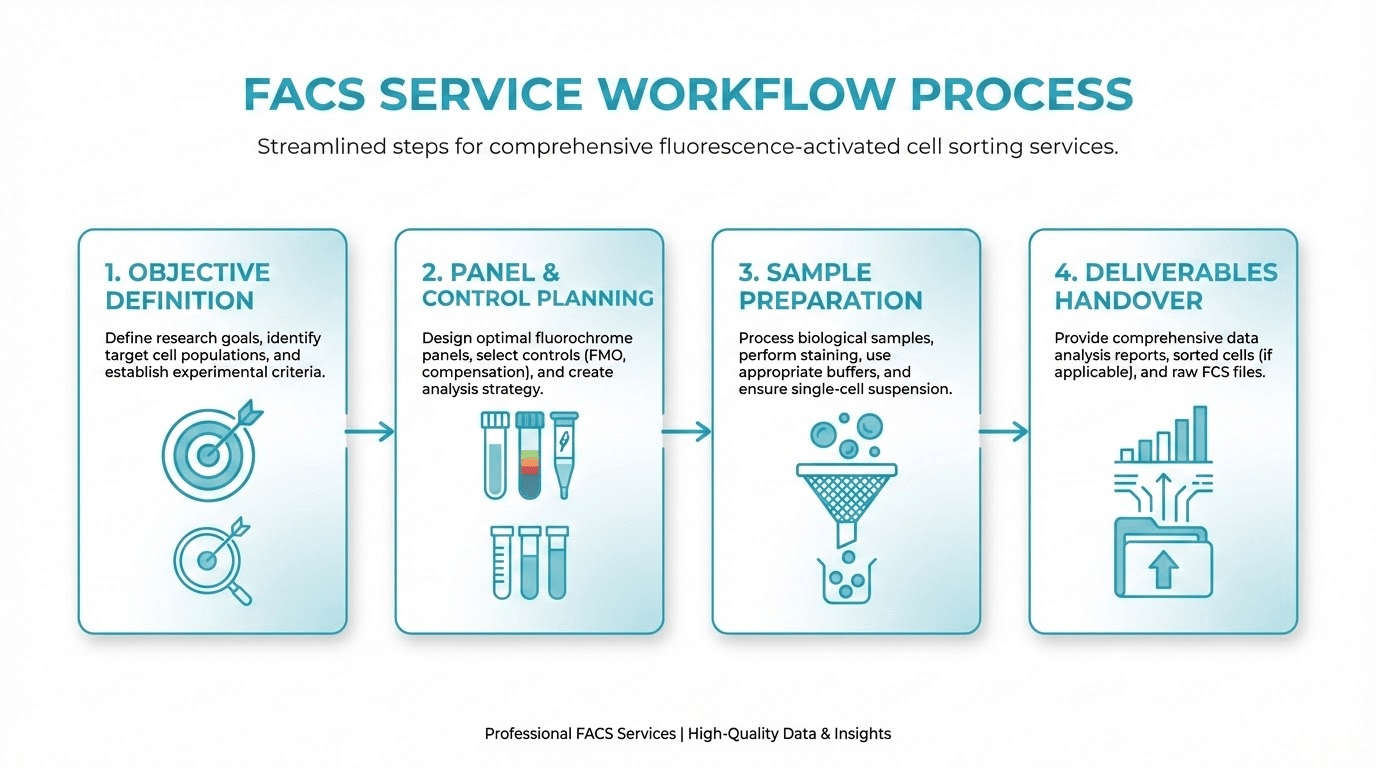
The process typically follows a structured workflow. First, you define your objectives: what population needs isolating, how many cells you require, and what you plan to do with them afterward (culture, RNA extraction, single-cell sequencing, functional assays). This characterization phase is essential — it determines panel design, nozzle selection, sort mode, and collection strategy.
Next comes panel and control planning. Your service provider helps select fluorescent markers, identifies required compensation controls, and determines whether FMO controls are necessary. The sample is then prepared according to specific guidelines and brought to the facility for sorting. After the run, deliverables are handed over.
What Does the Client Receive at the End?
Standard FACS Deliverables Include:
- Sorted cells — in bulk collection tubes or deposited into multi-well plates
- FCS files — containing the raw flow cytometry data
- Gating strategy documentation — showing exactly how populations were defined
- Run summary report — with purity checks and population statistics
Sample Preparation That Prevents Clogging and Maximizes Sort Quality
Poor sample preparation is the single most common cause of failed sorts. The goal is a clean single-cell suspension free of clumps, debris, and dead cells. Start by dissociating tissue thoroughly (enzymatic or mechanical, depending on the source), then wash and resuspend in an appropriate buffer or medium.
✓ Best Practice: Filter your sample through a 40µm cell strainer immediately before sorting — not 30 minutes earlier, not the night before. Clumps reform quickly, and even a few aggregates can clog the nozzle and interrupt the sort.
Recommended cell concentrations are typically 1–10 million cells per mL, depending on cell type and nozzle size. Working within this range reduces aggregation and improves sorting efficiency. Da-Ta Biotech routinely guides clients through these preparation steps, drawing on extensive experience with diverse cell types and tissue sources to help researchers arrive at the sorter with optimally prepared samples.
Which Filter Size — 40µm or Something Else?
A 40µm strainer is the most commonly used “final filter” for cell sorting. However, the optimal choice depends on your nozzle size and cell type. Larger cells may require a 70µm filter, while very small cells or samples sorted through a 70µm nozzle might benefit from a 35µm filter. The University of Warwick Flow Cytometry facility provides additional guidance on matching filter size to instrument fluidics.
Is a Viability Dye Necessary?
Yes — in most cases, including a viability dye is strongly recommended. Dead cells bind antibodies non-specifically, increase background fluorescence, and can distort your gating. Excluding dead cells with a viability marker (such as DAPI, PI, or fixable viability dyes) dramatically improves the purity and reliability of your sorted population.
Common Mistakes: Skipping Controls or Using the Wrong Ones
Controls are not optional in Flow Cytometry and FACS. At minimum, every multi-color experiment requires an unstained control and appropriate single-stain compensation controls. These controls establish baselines and quantify spectral spillover between channels — without them, your fluorescent signals cannot be accurately separated, and your gating becomes unreliable.
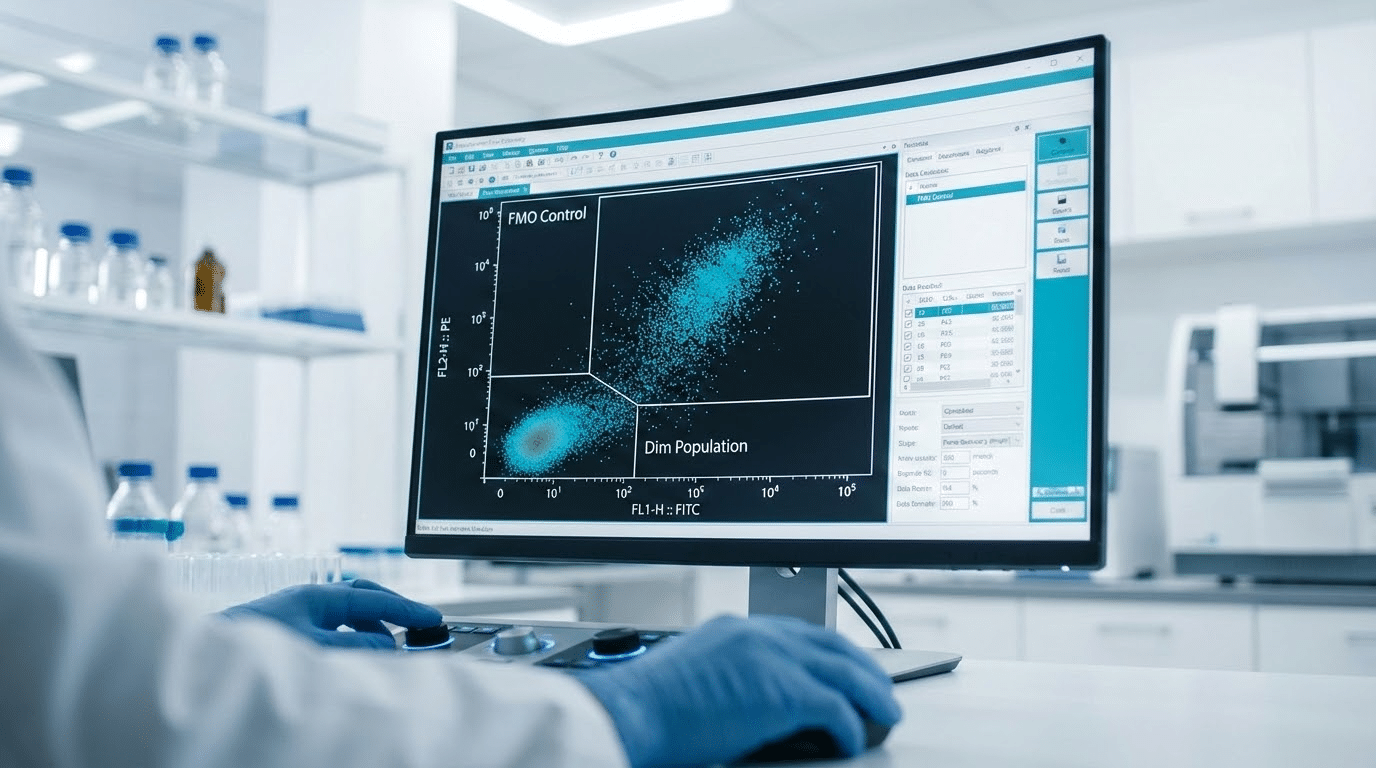
FMO (Fluorescence Minus One) controls serve a different purpose: they help define where to draw gates when spectral spread from neighboring fluorochromes makes it difficult to distinguish dim positive populations from negatives. FMOs are not substitutes for compensation controls — a distinction the professional flow cytometry community consistently emphasizes. Insufficient or incorrect controls can render data uninterpretable, wasting the entire experiment.
When Is FMO Truly Needed?
FMO controls become critical when you are trying to resolve a “dim” population — cells that express a marker at low levels and sit close to the negative population. In highly multiplexed panels where many fluorochromes contribute spectral spread into a given channel, an FMO control shows you exactly where the boundary falls in the absence of a specific fluorochrome. Without it, you risk either including false positives or excluding real positives from your sort gate.
“The purpose of FMO controls is not compensation — it’s gate placement. They reveal where spectral spread from other fluorochromes ends, allowing you to draw gates that accurately distinguish dim positive cells from negatives.”
— Flow Cytometry Best Practices Guidelines
What Is Single Cell Sorting and When Is It the Right Choice?
Single Cell Sorting deposits one cell per well into multi-well plates — 96-well, 384-well, or even 1536-well formats. This technique is used for cloning (generating monoclonal cell lines or hybridomas), single-cell genomics and transcriptomics, and producing antibody-secreting lines. It demands high sterility, carefully validated index sorting, and thoughtful planning of collection conditions — the media in each well, temperature, and recovery protocols all affect whether the single deposited cell survives and proliferates.
Bulk Sorting vs. Single Cell Sorting
Maintaining Cell Viability and Recovery After Sorting
Sorted cells have been through a physically stressful process — high pressure, exposure to sheath fluid, laser illumination, and electrical charging. To maximize viability and recovery, keep your sample cold and protected from light before and during sorting. Use collection vessels pre-loaded with rich media containing higher concentrations of serum (e.g., 50% FBS in culture medium) to cushion cells as they enter the tube at high velocity.
Viability Optimization Checklist
- Keep samples on ice and protected from light
- Pre-load collection tubes with 50% FBS in culture medium
- Minimize time between sorting and downstream processing
- Plate or process cells promptly after collection
How Long Does Cell Sorting Take and What Affects Speed?
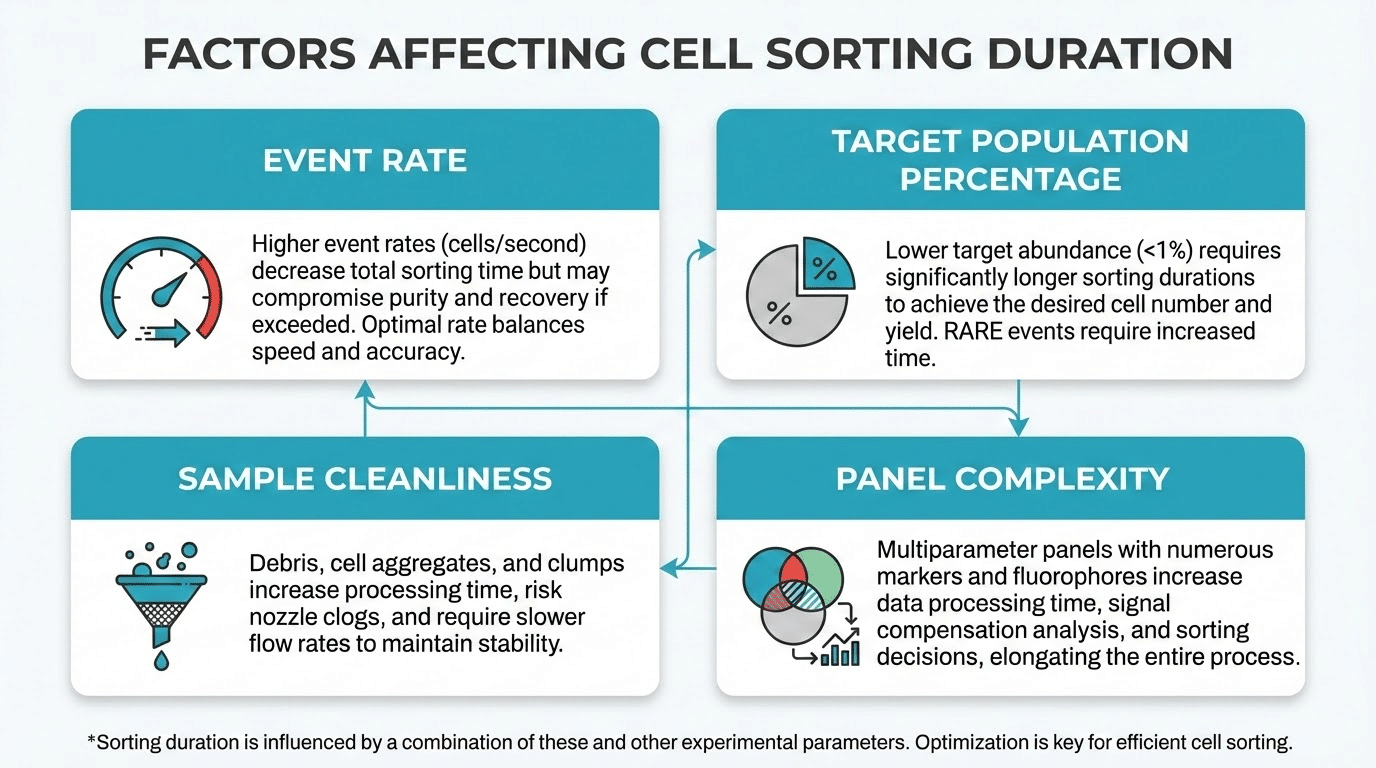
Sort duration is determined by several factors: the event rate (how fast cells pass through the instrument), the percentage of your target population within the sample, sample cleanliness, and panel complexity. Sorting a population that represents 30% of your sample will be dramatically faster than sorting one at 0.1%.
A clean, well-prepared sample with few dead cells and no clumps allows higher event rates and fewer interruptions. As described in the Guidelines for the use of flow cytometry and cell sorting, optimizing these parameters before the sort session is critical for efficient use of instrument time. For a typical enrichment sort of a moderately abundant population, expect one to three hours of sort time. Rare populations can require significantly longer sessions.
Biosafety Protocols That Protect Personnel and Ensure Quality Results
Cell sorting generates aerosols — fine droplets that can contain viable biological material. This makes biosafety a primary concern, especially when sorting human-derived samples, primary cells from clinical sources, or any material classified above BSL1. Professional FACS facilities implement Aerosol Management Options (AMO) — containment systems that capture aerosols before they reach the laboratory environment.
Personnel wear appropriate PPE (lab coats, gloves, eye protection), and all users are required to complete biosafety declarations and risk assessments before sorting begins. Equipment is sterilized between users, and waste is disposed of according to institutional and national safety standards. These protocols are not merely bureaucratic — they protect everyone in the facility and prevent cross-contamination that could compromise experimental results.
Biosafety Levels (BSL) and Sample Handling
BSL Classification Guide:
- BSL1: Non-pathogenic organisms, established cell lines — standard precautions
- BSL2: Human-derived samples, moderate-risk pathogens — specific containment required
- BSL3: Generally not accepted for sorting due to aerosol risk
Multi-Parameter Analysis and High-Speed Sorting Capabilities
Modern flow cytometer instruments used for FACS services can simultaneously detect 15, 20, or even 30+ parameters on a single cell. This multi-parameter analysis capability enables the differentiation of complex cell populations that would be impossible to resolve with fewer markers. Researchers can identify and sort subsets defined by multiple surface markers, intracellular proteins, or reporter genes in a single session.
High-speed sorting — processing tens of thousands of events per second — allows rapid handling of large sample volumes while maintaining cell viability. Specialized modes include single-cell deposition for genomics, four-way sorting to collect multiple subsets simultaneously, and index sorting that records the exact fluorescence profile of each deposited cell for retrospective analysis.
Tailoring FACS Services to Your Research Needs
A consultative approach — where experts work alongside the client to select fluorochromes, optimize staining protocols, and define sort parameters — produces better outcomes than a one-size-fits-all service. Da-Ta Biotech’s experienced R&D team supports clients through this entire data lifecycle — from panel planning to final interpretation of results, ensuring that insights are actionable and scientifically robust.
Frequently Asked Questions About FACS Services
Ready to Plan Your Next Cell Sorting Experiment?
Whether you are isolating a rare immune subset, generating clonal cell lines, or preparing samples for single-cell genomics, professional FACS services provide the expertise, instrumentation, and biosafety infrastructure that in-house setups often lack. The difference between a successful sort and a wasted sample frequently comes down to preparation, controls, and the experience of the team behind the instrument.
Have a scientific challenge that requires precise cell sorting? Come to Da-Ta Biotech with your project — from defining the right panel to delivering sorted cells ready for your next experiment. Our team brings 25+ years of R&D experience and FDA application support to every project.