
Biotech Lab Space for Rent in Israel: The Complete Guide for Startups and R&D Teams
From 25+ Years in Biotech R&D: Finding the right laboratory space can make or break an early-stage biotech venture. After supporting dozens of startups through FDA submissions and proof-of-concept milestones, I’ve seen how the wrong lab choice delays research by months — and how the right one accelerates breakthrough discoveries. This guide shares exactly what you need to know before signing any rental agreement.
🔬 Exclusive Insight from Da-Ta Biotech
The single biggest mistake early-stage biotech teams make? Choosing a lab based on price per square meter instead of total cost of ownership. A “cheap” bench that excludes waste disposal, gas supply, and equipment maintenance can cost 40% more than an all-inclusive option by month six. Always calculate your true monthly spend before signing.
How to Find Biotech Lab Space for Rent in Israel That Suits Your Startup
Most biotech startups begin their lab search with a simple question: where can we run experiments without spending months on build-out? The answer depends on three factors — flexibility, infrastructure readiness, and regulatory compliance. A biotech lab space for rent in Israel must match your research type. Cell-based assay work requires wet lab infrastructure with biosafety cabinets, while computational biology teams may need only desks and servers.
Matching your laboratory space for rent to your actual protocols is not a minor detail. Choosing the wrong environment forces costly relocations. A well-chosen space can reduce setup time from months to weeks and significantly lower your capital expenditure (CAPEX), freeing budget for reagents, personnel, and the experiments themselves.
Understanding these critical factors is where our comprehensive biological laboratory solutions at Da-Ta Biotech can provide direct support to emerging startups — from aligning your research needs with the right lab configuration to ensuring compliance from day one.
What Does a Laboratory Space for Rent in Biotech Typically Include?
There is a significant difference between renting four walls and renting a functioning lab. A “lab-as-a-service” model provides everything needed to start experiments: workbenches, access to shared equipment, cold storage at 4°C, -20°C, and -80°C, essential safety infrastructure, and waste management. Renting real estate, by contrast, means you build and equip the lab yourself — a process that can take six months or more.
Before committing, confirm what is actually included. Services like compressed gases, purified water systems, consumable supplies, equipment maintenance schedules, and mandatory safety training vary dramatically between providers. A shared lab space in Israel that bundles these into the monthly fee saves you both administrative headaches and unexpected invoices. Facilities operating under BSL-2 protocols should also provide biological safety cabinet access and autoclave services — requirements outlined by institutional safety guidelines such as those from Tel Aviv University’s Safety Unit.
Critical Questions to Ask Before a Lab Tour: Your “Included/Not Included” Checklist
⚠️ Critical Warning
Always request a written “inclusions appendix” attached to the contract. Verbal confirmations during a tour do not protect you when invoices arrive. I’ve seen startups face surprise bills of $2,000+ monthly for services they assumed were included.
What Is the Difference Between Wet Lab and Dry Lab — And Which Type Do You Need?
A wet lab space for rent in Israel is designed for work involving liquids, chemicals, biological samples, and cell cultures. It requires sinks, fume hoods, biosafety cabinets, plumbed gas lines, and specialized ventilation. A dry lab, by contrast, supports computational, electrical, optical, or analytical work that does not involve open chemicals or biological material — think bioinformatics pipelines, algorithm development, or hardware prototyping.
The distinction matters for safety classification too. Wet labs handling pathogenic organisms must meet specific Biosafety Levels (BSL), as defined by institutional guidelines such as those published by the Weizmann Institute of Science Safety Unit. Choosing a BSL-1 lab when your work requires BSL-2 conditions will halt your research before it starts.
Quick Examples by Activity Type
🧪 Wet Lab Essential
- Primary cell cultures
- Microbial growth assays
- Histology and staining
- Western blot, ELISA, PCR
- Drug permeation studies (Franz cells)
💻 Dry Lab Sufficient
- Bioinformatics and genomic analysis
- Machine learning model training
- Electronic instrument prototyping
- Regulatory documentation
- Data processing and analysis
Some projects require both — a wet lab bench for experiments and a dry lab station for data processing. Clarify this hybrid need early to ensure the facility can accommodate it.
How Much Does It Cost to Rent a Biotech Lab in Israel?
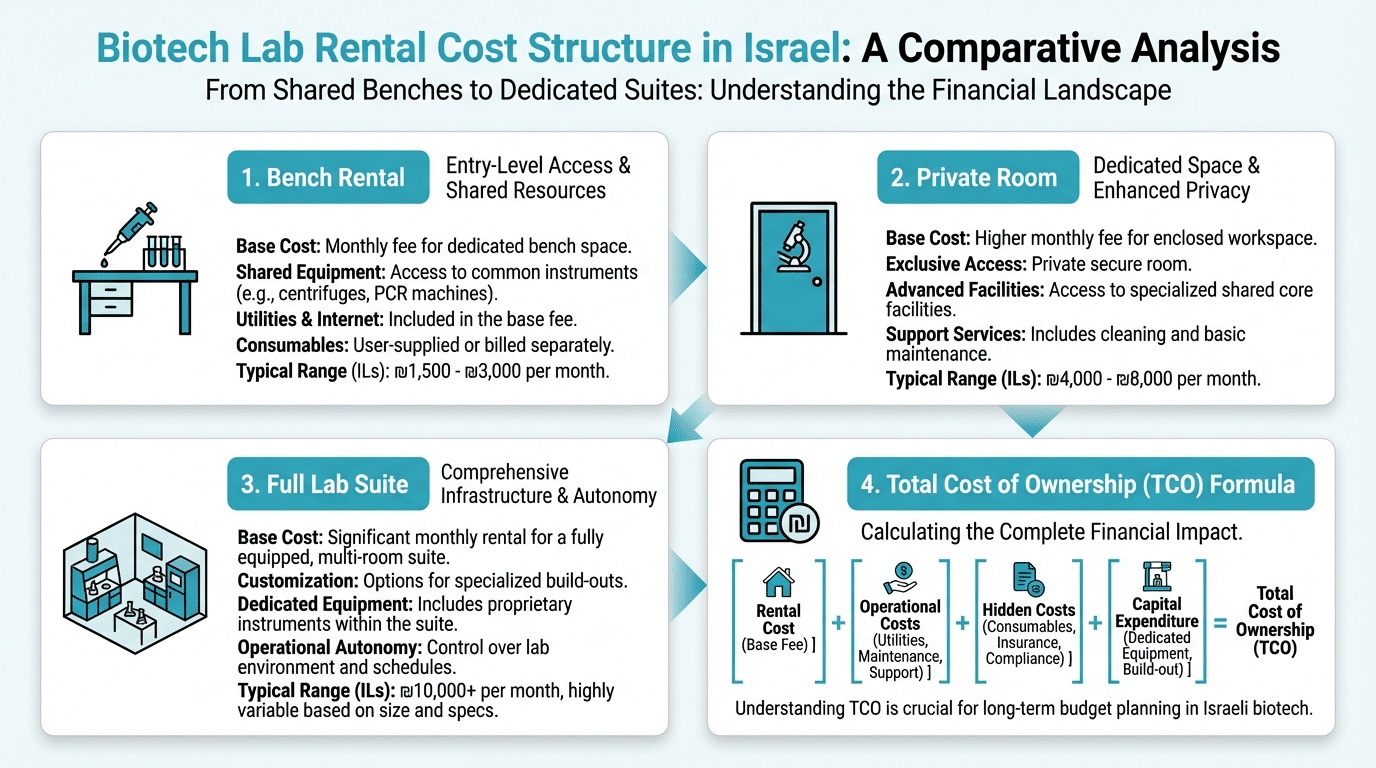
Pricing for biotech lab space for rent in Israel varies widely based on what you are renting. A single bench in a shared lab is the most affordable entry point. A private room within a managed facility costs more but offers dedicated space. A full lab suite — essentially your own wing — carries the highest price but the most control. In all cases, the headline rental fee is only part of the story.
Included services directly affect the final monthly number. A seemingly cheap bench that excludes waste management, gas supply, and equipment access can end up costing more than a higher-priced all-inclusive option. Shared resources (centrifuges, autoclaves, cold rooms) reduce the need for individual purchases, but confirm whether access is scheduled or first-come-first-served — and whether peak hours create bottlenecks.
Building Your Budget: The Total Cost of Ownership (TCO) Formula
📊 TCO Calculation Formula
TCO = Rental Fee + EHS/Waste Services + Utilities (gases, water, electricity) + Equipment Maintenance Share + Equipment Access Fees + Insurance
Account for unforeseen costs by adding a 10–15% buffer. Ask the facility manager for an itemized cost estimate based on your specific protocols. A transparent provider will offer this without hesitation. If they cannot, treat it as a warning sign.
What Is Bench Rental and Who Is It For?
Bench rental is a model where a company leases one or more workstations inside a shared laboratory. The renter gains access to common infrastructure — biosafety cabinets, incubators, centrifuges, cold storage — without purchasing or maintaining any of it. Lab bench rental in Israel has gained traction as the biotech ecosystem grows, particularly among teams of one to six researchers running proof-of-concept experiments or early feasibility studies.
The scalability advantage is significant. Start with a single bench, add a second when you hire, and transition to a private room when your IP-sensitive work demands it — all within the same facility, without relocating. At Da-Ta Biotech, this kind of operational flexibility is built into the model. Researchers can focus on their science while the facility handles maintenance, calibration, and compliance paperwork.
Signs This Is the Right Model for You (and Not an Independent Lab)
✓ Bench Rental Fits If:
- Team is small (1–6 people)
- Capital is limited
- Need to start experiments within weeks
- Benefit from collaborative environment
→ Independent Lab Makes Sense If:
- Require dedicated specialized equipment
- Handle sensitive IP needing isolation
- Have committed long-term funding
- Need 24/7 exclusive access
A Biotech Incubator vs. a Research Lab for Rent — Which One Fits Your Strategy?
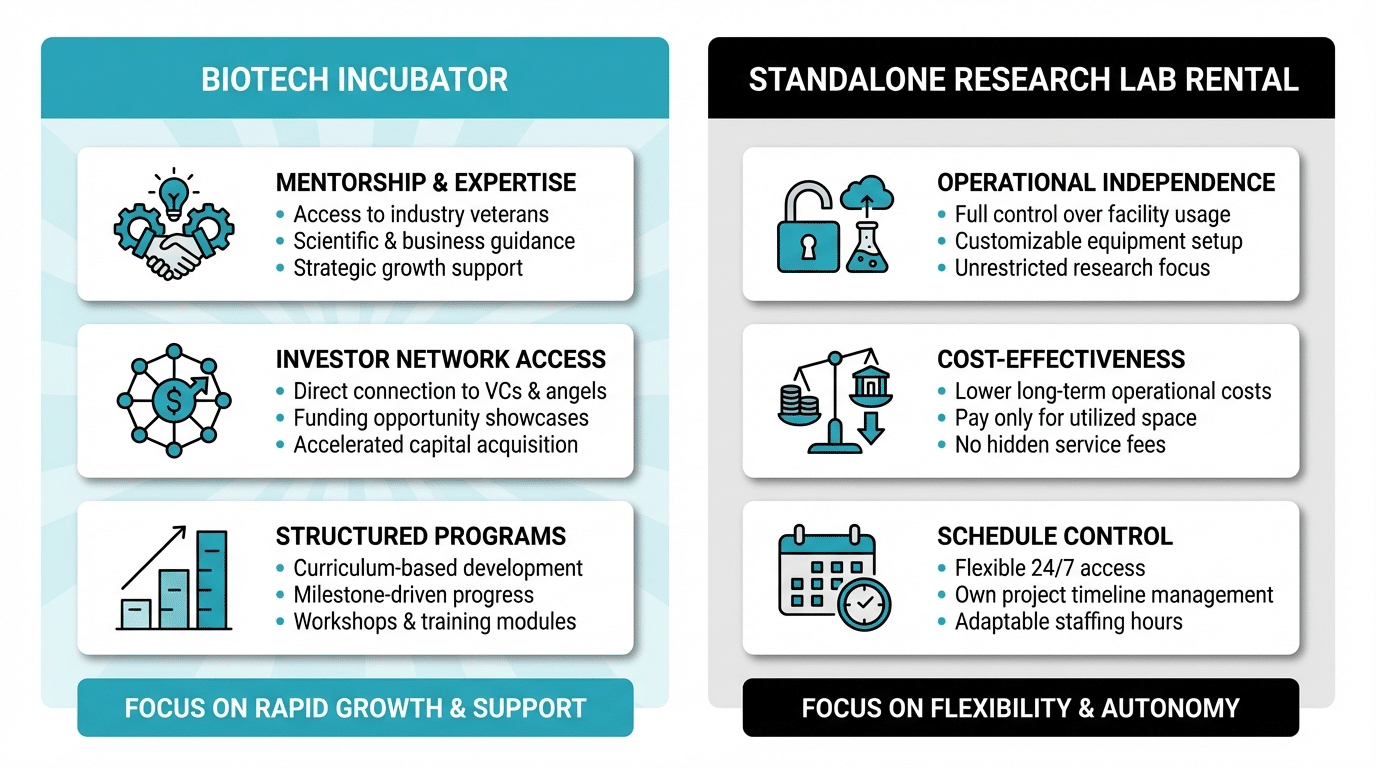
A biotech incubator offers more than lab space. It provides an ecosystem: mentorship, investor introductions, business development support, peer networking, and sometimes direct funding. However, incubators typically involve application processes, equity stakes or milestone requirements, and structured programs with defined timelines. They are ideal for very early-stage teams still validating their business model alongside the science.
A standalone research lab for rent gives you space and operational infrastructure without the ecosystem layer. You control your schedule, your collaborations, and your strategic direction. For teams with a clear R&D plan and existing funding, this model provides cost-effectiveness and freedom. There is no mentorship overhead if you do not need it — and no equity dilution.
When to Choose an Incubator Versus a Flexible Lab Space
Many companies begin in an incubator and then graduate to a dedicated lab space — planning for that transition upfront saves time later.
— Industry Best Practice
Which Standards, Safety, and Compliance Issues Must Be Checked Before Entering a Lab?
Compliance is not optional — it is the foundation of legal and safe operations. Before entering any biotech lab space for rent, verify that the facility maintains proper waste management protocols for both biological and chemical waste. In Israel, hazardous waste transfer requires formal documentation as outlined by the Ministry of Environmental Protection. Ask who holds the waste generator license and who bears liability.
Confirm that emergency procedures are documented and practiced, that safety training is provided to every new entrant, and that the facility has current business licensing per Ministry of Health requirements. ISO 9001:2015 certification, which Da-Ta Biotech maintains, signals a systematic approach to quality management that extends to safety and operational processes.
Quick EHS Checklist for Your First Lab Tour
🔍 During Your Walkthrough, Verify:
- ✓Functioning ventilation and HVAC systems
- ✓Accessible emergency showers and eyewash stations
- ✓Clearly marked fire suppression equipment
- ✓Designated waste disposal areas with proper labeling
- ✓Visible safety signage in Hebrew and English
- ✓Readily available Safety Data Sheets (SDS)
If any of these are missing or poorly maintained, reconsider.
Common Mistakes That Increase Relocation Costs or Cause Delays
⚠️ Expensive Errors to Avoid
- Underestimating waste disposal costs — leads to budget overruns within months
- Skipping safety training — results in regulatory citations and shutdowns
- Failing to secure permits — delays work by weeks for radioactive or select agents
- Overlooking facility restrictions — forces costly mid-project changes
Ask detailed questions upfront; surprises in a lab are for the science, not the operations.
What Essential Shared Equipment Should Be in a Biotech Lab Facility?
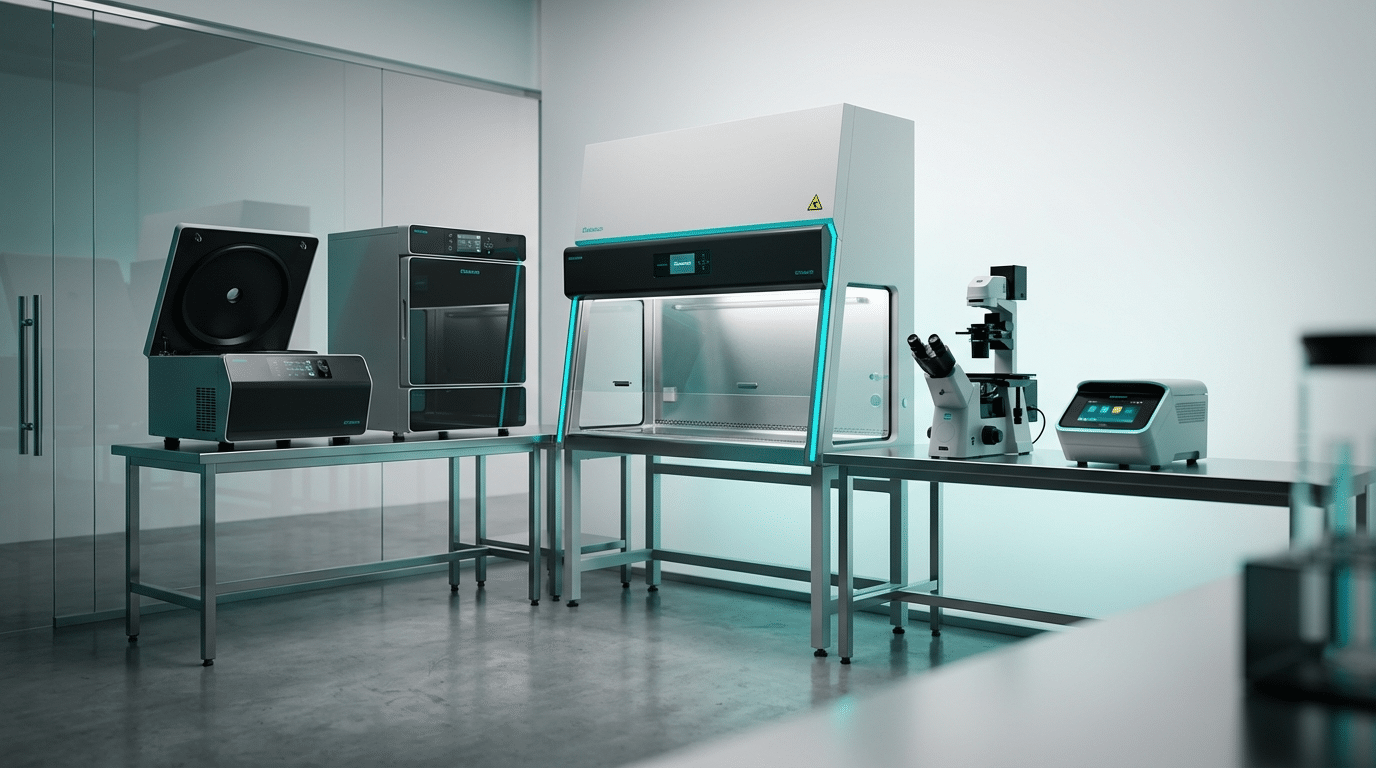
The equipment list depends entirely on your protocols, but certain instruments are considered baseline for any biotech research lab. Expect to find: fume hoods and biosafety cabinets, autoclaves for sterilization, refrigerated and high-speed centrifuges, cold storage at multiple temperatures, CO₂ incubators for cell culture, inverted and fluorescent microscopes, and basic molecular biology tools (PCR thermocyclers, gel electrophoresis systems, spectrophotometers).
High-quality shared equipment eliminates the need for six-figure capital purchases and shortens your experimental timelines. At Da-Ta Biotech, shared resources are maintained under validated protocols and calibration schedules — ensuring that the data you generate is reproducible and audit-ready, whether for internal milestones or regulatory submissions.
How to Ensure Equipment Availability (Not Just “Exists on Paper”)
❓ Questions That Separate Professional Facilities from Shared Rooms
- Is there a scheduling or booking system?
- How often is each instrument calibrated, and who performs it?
- Are maintenance logs available for review?
- Is training provided for complex equipment, and is there a charge?
- What happens when a critical instrument breaks down — backup or SLA for repair?
What to Ask Before Signing a Lab Rental Agreement?
A laboratory space for rent agreement is not a standard office lease. It contains clauses that can significantly impact your operations and finances. Focus on: minimum commitment period (6 months? 12?), options for early exit or expansion, liability for equipment damage or facility failures, insurance requirements (yours and theirs), 24/7 access hours or restricted schedules, and a detailed itemization of what is included in the monthly price.
Watch for surprising clauses: restrictions on the types of materials you can bring in, policies on storing proprietary samples, limitations on visitor or collaborator access, and hidden costs for waste disposal that scale with volume. A written inclusions appendix is essential — do not rely on verbal agreements made during a tour.
15-Point Contract Questions Checklist
What Does the Onboarding Process for a Lab Look Like?
In a ready-to-use facility, the onboarding process from contract signature to first experiment can take as little as one to two weeks. The sequence typically includes: an initial risk assessment of your planned activities, mandatory safety training covering facility-specific protocols, space allocation and storage assignment, definition of standard operating procedures (SOPs) for shared resources, and setup of access credentials and emergency contacts.
A well-managed facility drives this process proactively. At Da-Ta Biotech, onboarding is structured around the client’s actual research plan — ensuring that the space configuration, equipment reservations, and safety clearances align with your protocols before you arrive at the bench. This approach eliminates the weeks of back-and-forth that less organized facilities require.
Recommended Timeline: 1–2 Weeks to Operational
📅 Week 1
- Site visit and final walkthrough
- Contract finalization
- Safety briefing and orientation
- Access card and IT setup
- Storage allocation
🚀 Week 2
- Equipment installation (if bringing own)
- Bench and space configuration
- Consumables ordering and delivery
- First experiments begin!
✓ Pro Tip
This timeline assumes the facility is genuinely ready-to-use. Ask for references from current tenants to verify. A facility that hesitates to provide references may have operational issues they’re not disclosing.
Can We Bring Our Own Equipment to a Rented Lab?
In most cases, yes — but with conditions. Bringing personal equipment into a biotech lab space for rent typically requires prior written approval from the facility manager. The approval process involves compatibility checks: does your instrument’s electrical load match available circuits? Does it require dedicated ventilation or plumbing? Are there vibration or noise concerns that could affect neighboring researchers?
Some equipment — particularly items that generate heat, use compressed gases, or require chemical exhaust — may need dedicated hookups that incur additional costs. Clarify the installation and removal policies in your contract, including who pays for modifications and what happens to infrastructure changes when you leave. Facilities like Da-Ta Biotech, with experienced R&D operations teams, can often assess compatibility quickly and provide practical solutions for integration.
Why Choose Da-Ta Biotech for Your Biotech Lab Space in Israel?
Da-Ta Biotech operates as more than a space provider. Located in the Science Park in Rehovot, the facility functions as a β-site for R&D — a partner that supports biotech companies from proof-of-concept through demonstration of efficacy. The lab is equipped for cell-based assays, molecular biology, biochemistry, and a wide range of in vitro testing, all under ISO 9001:2015 certification.
What sets this model apart is the combination of operational readiness and scientific depth. Researchers gain access to validated protocols, maintained equipment, and experienced staff who understand the practical challenges of early-stage R&D. Whether you need flexible lab bench rental in Israel, wet lab space for rent, or a full lab suite, Da-Ta Biotech provides tailored biological laboratory solutions designed to accelerate your research while keeping compliance and quality management handled.
Frequently Asked Questions
What Is Your Next Step Toward Launching R&D in Israel?
Whether you are a startup searching for your first bench or an established team ready to scale into a dedicated lab, the right facility partner can shave months off your timeline and keep your budget focused on science — not infrastructure. Da-Ta Biotech provides the operational readiness, scientific expertise, and compliance framework that biotech companies need to move from concept to results.
Ready to Accelerate Your Research?
Come to us with your scientific challenge — contact Da-Ta Biotech to discuss available lab space options and find the configuration that fits your research.