Pharmaceutical Development Services
From the desk of Dr. Rinat Borenshtain-Koreh, PhD, DVM — With over 25 years directing biotech R&D programs from concept through FDA submission support, I’ve seen how the right CRO partnership can compress timelines by months and transform promising molecules into clinic-ready candidates. Israel’s pharmaceutical development ecosystem offers something unique: world-class scientific talent operating under rigorous regulatory frameworks, ready to execute your next critical experiment.
🔬 Exclusive Insight: The companies that accelerate fastest through preclinical development share one common trait — they treat their CRO as a scientific partner, not a vendor. This guide reveals the strategic framework for selecting, engaging, and extracting maximum value from pharmaceutical development services in Israel.
What Exactly Does a Pharmaceutical CRO Do?
A Contract Research Organization (CRO) provides outsourced research and development services to the pharmaceutical, biotechnology, and medical device industries. Rather than building internal capabilities from scratch — purchasing equipment, hiring specialized scientists, writing SOPs — companies engage a CRO to execute specific tasks in drug discovery, preclinical development, or clinical-stage support.
The CRO model is especially valuable when a company needs access to well-established cell-based assays, biochemistry platforms, or molecular biology techniques without the overhead of maintaining a full laboratory. A CRO takes on the experimental work, generates data, and provides actionable reports that inform your development decisions. Think of it as extending your R&D team with experienced specialists who are ready to execute from day one.
Why Israel for Pharma R&D Outsourcing?
Israel has earned its reputation as a hub for biotech innovation. The country’s scientific ecosystem — anchored by world-class universities, government-backed research institutes, and a dense network of startup companies — provides outsourcing partners with access to advanced laboratory capabilities and highly trained scientists.
Beyond talent, there is a practical advantage: speed. Outsourcing to an Israeli CRO allows companies to accelerate experiments, minimize setup costs, and shorten the “time to decision” for go/no-go judgments. This is particularly beneficial for startups operating under tight funding timelines, academic groups preparing grant milestones, and established companies with internal lab overloads.
✓ Strategic Advantage: Israeli CROs operate in a timezone that bridges US and European business hours, enabling real-time collaboration with global teams while maintaining rapid experimental turnaround.
Israel’s Regulatory Framework Supports Reliable Research
Israel maintains a well-established regulatory framework for clinical and preclinical research. The Ministry of Health oversees clinical trials through Helsinki Committees, ensuring that research on human subjects meets strict ethical and scientific standards. This framework, documented in the Supreme Helsinki Committee guidelines, extends to the import of investigational products, quality assessment of pharmaceutical compounds, and oversight of biological materials.
For companies shipping samples or reagents into Israel for testing, defined regulatory pathways exist for importing materials designated for clinical trials and drug production. These established processes reduce uncertainty and help project managers plan realistic timelines.
How Do You Select the Right Pharmaceutical Development Service Provider?
Choosing a CRO is not simply a procurement exercise. It is a scientific decision that directly affects the quality and relevance of your data. Here are the critical factors to evaluate:
Scientific Alignment and Quality Documentation
Match the CRO’s expertise with your specific scientific models, assay types, and project needs. Can they validate or adapt your in-house SOPs? Do they maintain robust positive and negative controls? Prioritize providers with clear quality documentation, statistical analysis capabilities, and a demonstrated commitment to reproducibility.
Published research, such as the validation study of static Franz diffusion cell systems, illustrates how protocol validation and operator training directly reduce variability — a standard you should expect from any partner.
💡 Expert Tip: Before signing any agreement, ask these three questions:
- What controls are run in each experiment?
- How are deviations handled and communicated?
- What raw data accompanies the final report?
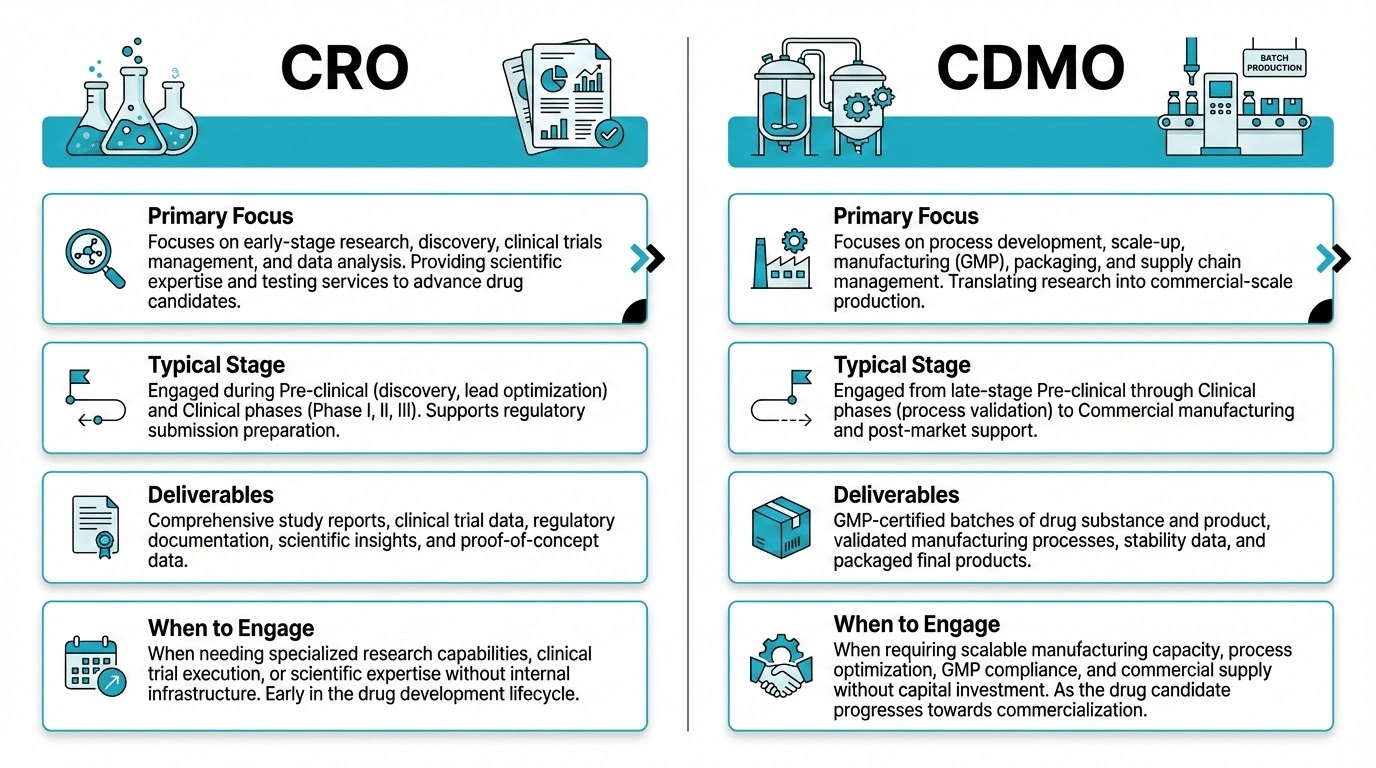
CRO vs. CDMO — A Common Source of Confusion
The distinction determines responsibility. If your goal is to prove a mechanism of action (MOA), evaluate cellular efficacy, or screen formulations for cytotoxicity, a laboratory CRO is the right fit. If you need GMP-compliant batch production, that is a CDMO domain. Many companies engage both sequentially, which requires careful planning for the handoff between discovery-phase data and manufacturing-phase requirements.
What Deliverables Should You Expect from Drug Development Research?
Every outsourced project should produce clear, decision-enabling data. Typical deliverables from a well-run CRO engagement include:
- Detailed experimental protocols with methodology documentation
- Quantitative results including EC50/IC50 values
- Graphical representations of dose-response curves
- Statistical analysis with interpretation and confidence intervals
- Conclusions with recommendations for next experiments
- Complete raw data for independent verification
“We may prove your hypothesis right or wrong — either way, there will be an answer supported by transparent data. Deliverables should not be limited to a polished summary.”
— Da-Ta Biotech Scientific Philosophy
📋 Real-World Scenario: When Outsourcing Makes the Most Sense
Consider a biotech startup with a novel peptide candidate. Internal resources consist of two scientists, a basic tissue culture hood, and limited analytical equipment. The company needs a proof-of-concept (PoC) study comparing three formulations across multiple cell lines, with dose-response curves and statistical analysis — all within three months to meet an investor milestone.
Building this capability internally would require purchasing equipment, qualifying cell lines, developing SOPs, and hiring additional staff. The timeline would stretch to six months or more. By engaging a CRO with established infrastructure, the company executes on schedule and allocates resources where they matter most.
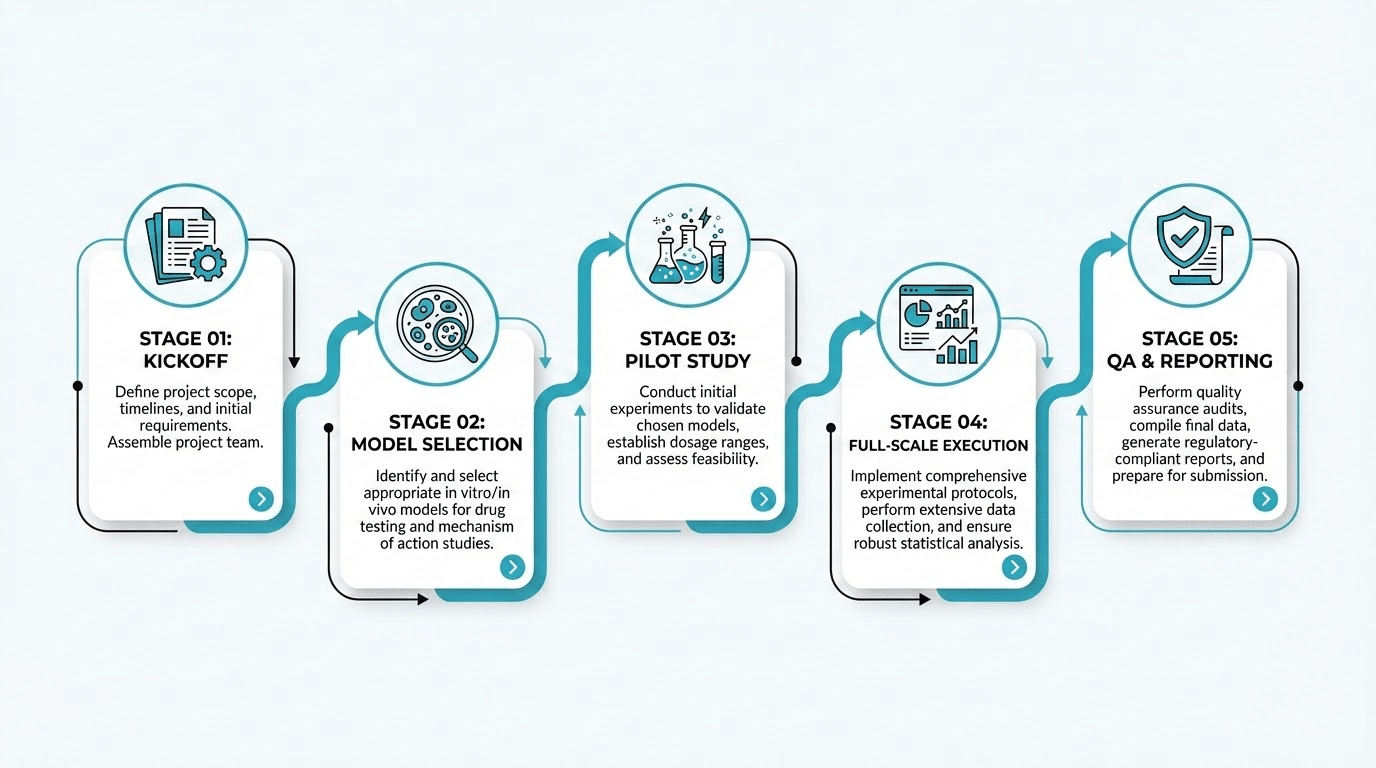
What Does the Typical Workflow Look Like?
Defining success criteria upfront is essential. Establish clear benchmarks — activity thresholds, safety windows, reproducibility targets, maximum coefficient of variation (CV), and the number of replicates — before any experiment begins. International guidelines such as ICH Q8/Q9/Q10 provide a framework for quality-by-design principles.
How Long Does a Pharmaceutical Development Project Take?
Most in vitro projects range from a few weeks to several months. A straightforward cytotoxicity screen on an established cell line with a single compound and standard protocol might be completed in two to four weeks. A multi-arm study requiring assay development, optimization, and multiple cell models could extend to three or four months.
⚠️ Timeline Factors to Consider:
- Availability of specific cell lines or reagents
- Number of conditions and dosages being tested
- Sample shipment and import approval requirements
- Whether new protocol development is needed
Five Common Mistakes When Outsourcing Pharma R&D
1. Undefined success criteria. Without clear, quantitative benchmarks before the first experiment, you risk generating data that cannot support a go/no-go decision.
2. Choosing on price alone. A lower quote that omits controls, statistical analysis, or detailed reporting creates hidden costs — repeat experiments and delayed timelines.
3. Ignoring communication structure. A CRO without a defined SLA for updates leaves you blind during execution. Establish the communication cadence before work begins.
4. Skipping the pilot. Moving directly to full-scale runs without optimization increases the probability of failed experiments and wasted resources.
5. Unclear IP and data ownership. Ensure your agreement specifies who owns raw data, protocols, and any novel assay methods developed during the project.
Cell-Based Assay Development: The Engine of Early-Stage R&D
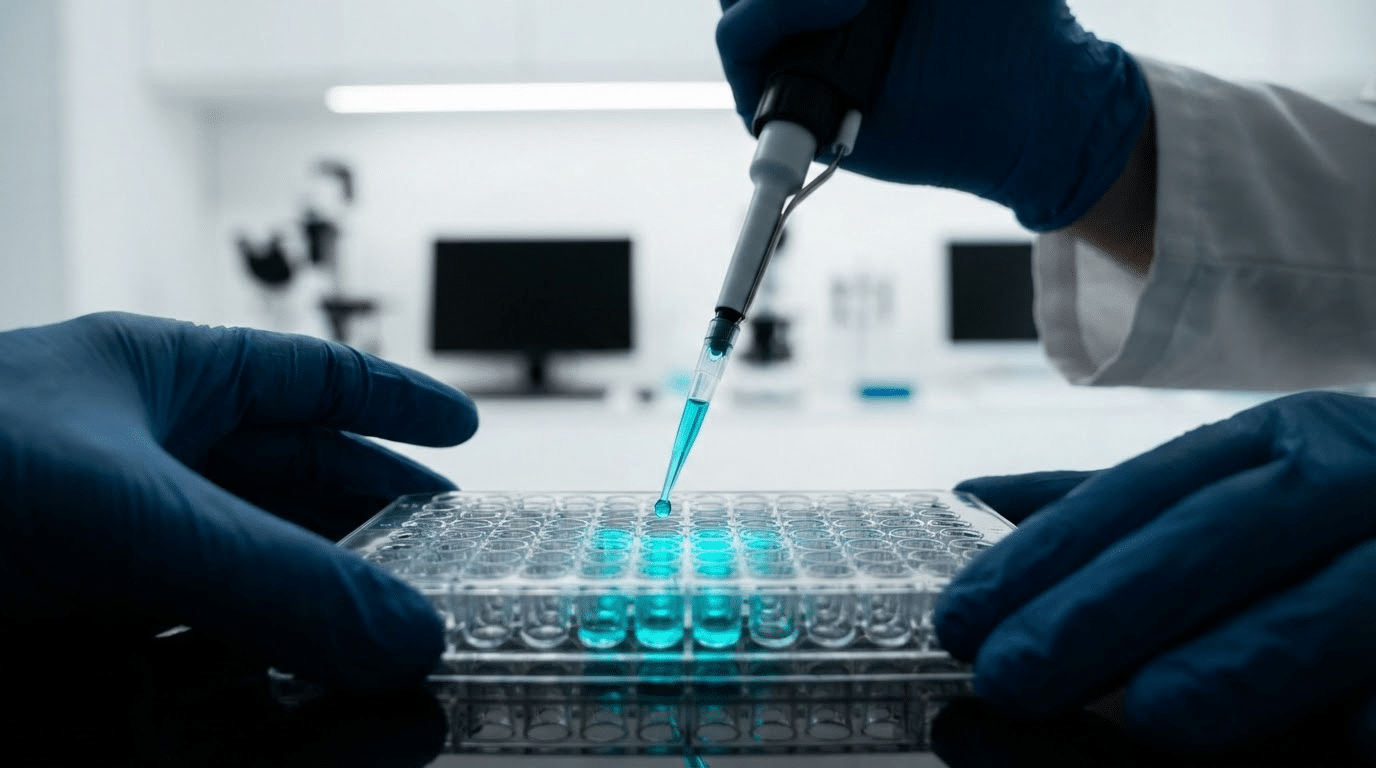
Cell-based assay development involves creating or adapting in vitro cellular experiments to measure a specific biological effect relevant to a drug candidate. Common measured parameters include:
- Cell viability and cytotoxicity
- Apoptosis induction and proliferation rates
- Cytokine secretion profiles
- Cell migration and adhesion behavior
The strategic importance is straightforward: biologically relevant data generated early in the pipeline enables quicker identification of promising candidates and elimination of weak ones. Assay optimization — selecting appropriate cell lines, establishing growth conditions, determining exposure times, defining dose ranges — is where scientific expertise directly translates into program efficiency.
You can explore our advanced biological analysis capabilities or review how our molecular biology services support assay development from gene introduction through functional readouts.
Biocompatibility Screening and Cytotoxicity Testing Under ISO 10993-5
Biocompatibility screening is a set of early tests that evaluate biological responses to materials or products. It is particularly crucial for combination products, medical devices, and innovative formulations where material-body interaction is a regulatory requirement.
The ISO 10993-5 standard specifically describes in vitro test methods for assessing cytotoxicity of medical devices and materials. Early cytotoxicity testing helps filter out problematic materials before advancing to more expensive development stages.
✓ Who Benefits Most: Companies developing biomaterials, drug-eluting devices, or novel delivery systems gain critical risk reduction data and regulatory-ready documentation that agencies expect in submissions.
Franz Cell Permeation Testing: Who Needs It and Why?
Franz cell permeation testing — also known as in vitro permeation test (IVPT) — evaluates how topical formulations penetrate through a membrane or skin model. It is used to compare formulations, select the most effective topical delivery system, and assess bioequivalence for generic topical products.
The FDA’s IVPT guidance outlines expectations for these studies when submitted in support of abbreviated new drug applications (ANDAs).
Who Benefits from IVPT Testing?
- Transdermal patch developers
- Topical cream, gel, and ointment formulators
- Dermatological and cosmetic product companies
- Generic manufacturers seeking bioequivalence data
Mapping Your Needs to Laboratory Capabilities
How is Data Quality and Reproducibility Ensured?
Reproducibility is the foundation of useful preclinical data. At Da-Ta Biotech, stringent quality control measures are embedded into every project:
- Well-defined SOPs with robust internal controls
- Comprehensive documentation of methods and results
- Planned replicates for statistical validity
- Quality control of cell lines (authenticity testing, mycoplasma screening)
- Consistent reagent batch tracking
How Much Do CRO Services Cost?
Pricing for pharmaceutical development services is driven by the scope of experiments, assay complexity, number of replicates, and the scientist and equipment time required. There is no universal price list — each project is scoped individually.
Common Pricing Models
- Per-study pricing: Fixed fee for a defined scope
- Per-assay pricing: Useful for repetitive screens
- Monthly retainers: For ongoing programs
- Milestone-based: Payment tied to deliverables (best for transparency)
Frequently Asked Questions
Ready to Move Your Program Forward?
What scientific challenge is holding your program back right now — is it a missing assay, a formulation comparison you cannot run internally, or a regulatory data gap that needs filling? Da-Ta Biotech partners with pharma and biotech teams to turn these challenges into clear, data-driven answers.
Come to us with your scientific question. We are here for you — ready to accelerate your next milestone with transparent, reproducible data.